
Musculoskeletal Injury Prevention in Healthcare: A 2026 Strategy for Australian Hospitals
- 1 day ago
- 12 min read
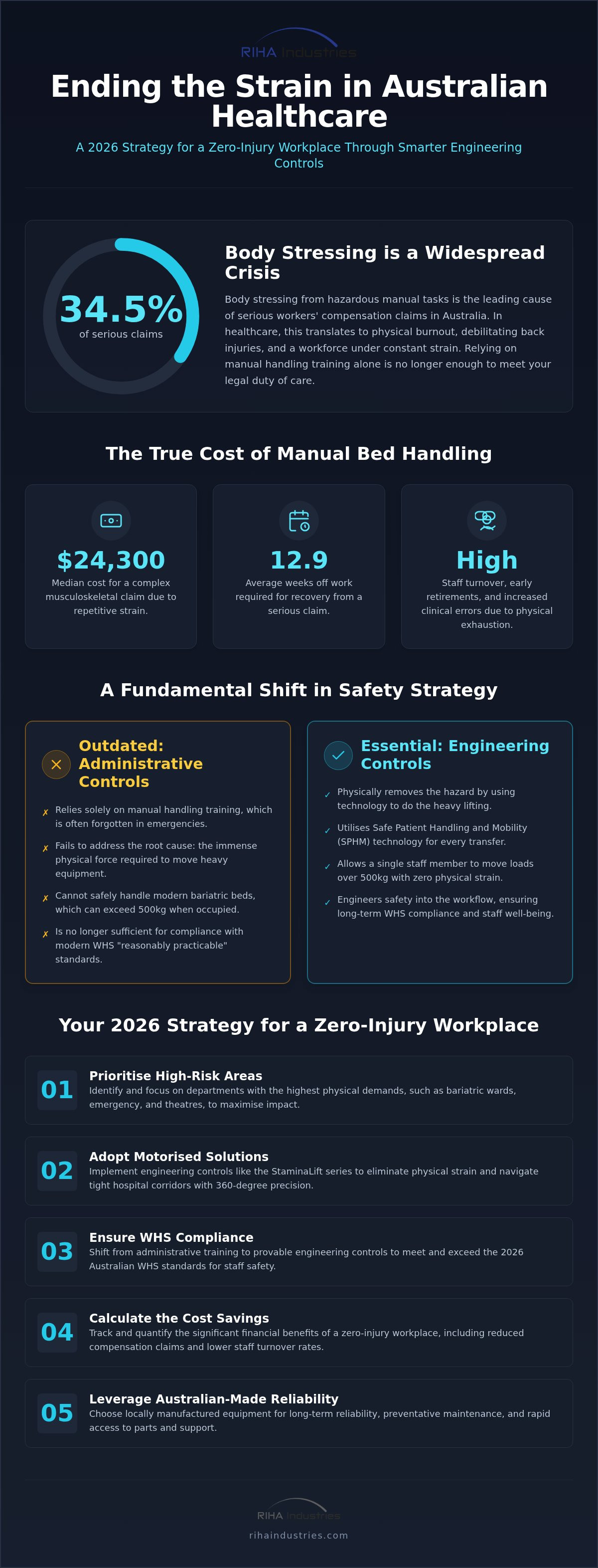
With body stressing accounting for 34.5% of all serious workers' compensation claims in Australia, it is time to admit that manual handling training alone cannot solve the crisis facing our wards. You likely see the impact every day in the form of physical burnout and the rising costs of back injury claims. Effective musculoskeletal injury prevention healthcare requires shifting the focus from how staff move to what they use to move. Relying on administrative controls is no longer a viable way to meet your legal duty of care under the WHS Act.
We understand that protecting your nursing staff is your highest priority, yet the pressure to maintain efficient patient flow often leads to compromises in safety. This guide outlines a 2026 strategy to eliminate these risks by adopting advanced motorised transfer technology. You will discover how evidence-based strategies and tools like the StaminaLift series can transform your facility into a zero-injury workplace. We will explore how to reduce the physical burden on nurses, ensure regulatory compliance, and improve staff retention through smarter engineering controls.
Table of Contents
Defining Musculoskeletal Injury Prevention in the Healthcare Sector
Musculoskeletal disorders (WMSDs) in the Australian healthcare sector aren't just occasional aches; they're debilitating conditions affecting the muscles, nerves, and tendons of our frontline workers. In the high-pressure environment of a modern hospital, these injuries are typically the result of repetitive, hazardous manual tasks. Effective musculoskeletal injury prevention healthcare focuses on identifying these high-risk activities before they lead to chronic disability or costly workers' compensation claims. It's a mission-driven approach that prioritises the long-term well-being of those who care for others.
By 2026, the regulatory landscape has shifted significantly. Safe Work Australia's guidelines now place a heavier burden on hospitals to demonstrate they've managed risks so far as is "reasonably practicable." This standard means that simply providing a training poster on how to lift is no longer sufficient for compliance. Regulators now expect hospitals to "engineer out" the hazard. This strategy involves physically removing the risk through technology rather than relying on staff to remember complex lifting techniques during a clinical emergency. It's about creating a stable environment where safety is built into the workflow.
Common WMSD Risk Factors in Wards and Theatres
The physical demands on Australian nurses and porters have intensified as patient acuity and equipment weights increase. Modern hospital beds, especially bariatric models, can exceed 500kg when occupied. Pushing these loads manually through carpeted corridors or around tight corners creates immense strain on the lower back and shoulders. Beyond the sheer weight, sustained awkward postures during patient repositioning in theatre spaces contribute to cumulative trauma. When you consider that a nurse walks an average of 15km during a single shift, this physical exhaustion makes them even more susceptible to acute injury during a heavy transfer.
The Shift from Manual Handling to Motorised Assistance
Decades of "safe lifting" workshops haven't moved the needle on injury rates because they don't address the underlying physical forces at play. You can't train a human body to safely push half a tonne. This realisation has led to the widespread adoption of Safe Patient Handling and Mobility (SPHM) technology in 2026. SPHM is a multi-modal approach combining policy, ergonomics, and technology to ensure every move is a safe one. By integrating motorised movers from the StaminaLift or Easi series, hospitals can finally bridge the gap between mechanical capability and human safety. These engineering controls allow a single staff member to move heavy beds with zero physical strain, effectively eliminating the primary cause of musculoskeletal trauma.
The True Cost of Manual Bed Handling in Australian Hospitals
The financial burden of musculoskeletal injuries in Australian hospitals is staggering. In the 2023-24 period, the median compensation for a serious claim was $16,300, but this figure doesn't tell the whole story. For complex musculoskeletal diseases caused by repetitive strain, the median cost jumps to $24,300 with an average of 12.9 weeks off work. These hazardous manual tasks drain hospital budgets and cripple operational capacity. When nursing staff are sidelined by back injuries, the reliance on expensive agency nurses increases, further inflating the high cost of manual bed handling within modern facility management.
Beyond the balance sheet, the human cost is equally severe. Tired, physically exhausted staff are significantly more prone to clinical errors, directly impacting patient safety. Effective musculoskeletal injury prevention healthcare is therefore not just a safety initiative; it's a fundamental component of quality patient care. Reducing the physical load on clinicians allows them to focus their energy on patient outcomes rather than their own physical survival through a shift.
Staff Retention and the Caregiver Crisis
Nursing is a physically demanding vocation, but it shouldn't be a career-ending one. Physical strain is a primary driver for early retirement among veteran nurses and porters. By providing "protective ally" technology like the StaminaLift series, hospitals offer more than just a tool; they offer a career lifeline. We've seen cases where veteran employees, on the verge of resigning due to chronic back pain, were able to continue their careers for years thanks to motorised assistance. This sense of empowerment improves morale and preserves the invaluable experience of senior staff who might otherwise be lost to the industry.
Operational Efficiency vs. Physical Burden
Manual handling doesn't just hurt people; it slows down the entire facility. Many wards enforce a "two-person rule" for moving heavy beds, which effectively doubles the labour cost of every patient transfer. This requirement frequently causes bottlenecks in Emergency Departments and Theatre suites as staff wait for a second person to become available. With the rise in bariatric patient numbers, where loads can reach up to 900kg, manual pushing becomes physically impossible for even the strongest teams. Implementing motorised solutions allows a single porter to manage these transfers safely and swiftly. You can evaluate how motorised movers streamline your ward logistics to reclaim lost productivity and protect your team.
Evaluating Motorised Solutions for Musculoskeletal Injury Prevention
Musculoskeletal injury prevention healthcare requires moving beyond generic assistive devices toward specialised engineering that addresses the unique physics of hospital logistics. While manual bed pushing relies on raw human strength to overcome inertia, the StaminaLift TS5000 uses calibrated motorised power to do the heavy lifting. This shift is vital because the force required to start a 500kg bed moving often exceeds safe limits for the human spine. By replacing muscle with machinery, hospitals can ensure that no staff member is ever required to perform a task that risks a career-ending injury.
Effective solutions must thrive in the high-pressure, confined environments of Australian wards. True 360-degree manoeuvrability allows a single operator to turn a heavy bed within its own length, a feat that's physically impossible with manual handling. This precision is essential for navigating tight corridors and busy lifts without risking collisions or requiring extra porters. Additionally, for any motorised system to be viable, it must offer universal compatibility. The StaminaLift series is designed to work with 95% of global hospital beds, ensuring that your investment protects staff regardless of the bed brand currently in use.
Safety is built into the core of these systems through intelligent engineering. Automatic braking ensures the load remains secure the moment the controls are released, while emergency bypass mechanisms allow for immediate manual takeover if required. These features provide staff with the confidence that they are in total control of the equipment at all times, reducing the psychological stress often associated with moving heavy loads in clinical settings.
Key Features of Effective Bed Movers
The most advanced movers prioritises ergonomics at every touchpoint. Hands-free 'connect and lock' jaw mechanisms are a critical feature of the StaminaLift series, allowing operators to secure a bed without bending or reaching. This specific design choice targets the awkward postures that often lead to acute back strain. Intuitive joystick controls provide granular precision, making it easy to guide equipment through crowded areas with minimal effort. To ensure long-term reliability, integrated Bluetooth diagnostics allow facility managers to monitor battery health and usage patterns, guaranteeing the equipment is always ready for a shift.
Addressing Non-Patient Loads: Tugs and Tows
Musculoskeletal risks aren't limited to patient transfers; the daily movement of linen, meals, and medical equipment also takes a heavy toll. The Easi Rider and Easi Mover are specifically engineered to handle these non-patient loads, from heavy meal trolleys to industrial wheelie bins. Given that nurses and porters often walk up to 15km during a single shift, ride-on platforms like those found on the Easi Rider are essential for reducing overall physical fatigue. By automating these repetitive, long-distance tasks, hospitals can significantly lower the cumulative physical burden on their workforce and improve overall morale.
5 Steps to Implementing a Zero-Injury Prevention Programme
Transitioning from physical labour to engineered assistance requires a methodical approach. A robust musculoskeletal injury prevention healthcare programme begins with a granular risk audit of every transfer path in your facility. You must look beyond the standard ward environment and examine the full journey, from the ambulance bay to the operating theatre and diagnostic imaging suites. By identifying where staff are forced to push, pull, or pivot heavy loads, you can pinpoint the exact locations where motorised intervention will have the most significant impact on staff longevity.
A successful implementation typically follows five defined stages:
Risk Audit: Mapping every hazardous manual task across the facility.
Prioritisation: Targeting ED, Theatre suites, and Bariatric wards first.
Selection: Choosing equipment with universal compatibility and 360-degree manoeuvrability.
Training: Empowering staff through formal certification and 'super-user' advocacy.
Monitoring: Using Bluetooth diagnostics to refine usage patterns and battery management.
Prioritising high-risk zones ensures that the most dangerous tasks are addressed immediately. Emergency Departments and Bariatric wards represent the highest danger areas due to unpredictable patient movements and extreme equipment weights. Once these zones are identified, selecting equipment based on universal compatibility ensures the programme is scalable. For instance, the StaminaLift series integrates with 95% of bed types, preventing the common mistake of purchasing technology that only works with a fraction of your existing fleet.
Calculating the ROI of Motorised Equipment
Justifying the transition to motorised equipment often requires a clear financial case. Using a Return on Investment calculator allows facility managers to factor in the volume of daily bed moves against current staff hourly rates. When you account for the elimination of workers' compensation payouts and the cost of agency cover, the data shows that reducing manual handling injuries to zero typically pays for the equipment within 24 months. This rapid amortisation makes motorised movers a fiscally responsible choice for modern hospital management.
Overcoming Staff Resistance to New Technology
Introducing new technology can sometimes be met with hesitation from staff accustomed to traditional methods. Overcoming this resistance is best achieved by involving 'super-users' in the early trial phases to act as internal advocates. When nurses experience the immediate physical relief of a 'hands-free' connection, the learning curve disappears. Seeing a colleague move a 900kg bariatric bed with a single finger via a joystick is the most persuasive argument for change. You can request a site assessment to let your team experience this empowerment firsthand.
Why RIHA Industries is the Global Leader in Healthcare Mobility
RIHA Industries has spent decades perfecting the intersection of mechanical precision and clinical safety. As a South Australian success story, we've grown into a global authority by focusing on tangible, proven results for frontline staff. Our commitment to musculoskeletal injury prevention healthcare is best evidenced by our impact on the ground; in one major hospital, the introduction of our motorised movers reduced staff injury rates from 20% to zero within twenty-four months. This level of reliability has made the StaminaLift and Easi series the standard for facilities that prioritise a zero-injury culture.
Choosing an Australian-made solution provides significant operational advantages. We maintain total control over our manufacturing processes, allowing us to offer 24-hour shipping on critical parts. Our philosophy of "Engineering Sustainability" means we manufacture our own custom components rather than relying on generic third-party supplies. This dedication ensures that your fleet remains a long-term asset, supported by a partner that understands the high-stakes nature of the healthcare environment. We don't just sell equipment; we provide a stable, long-term partnership dedicated to the well-being of your workforce.
The StaminaLift and Easi Series Advantage
Our equipment range is designed to solve specific physical challenges across the entire hospital campus. The StaminaLift Transfer System 5000 remains our flagship solution, engineered for universal compatibility with 95% of modern hospital beds. For more extreme requirements, the StaminaLift Transfer System 6000 is the industry's only mover capable of transporting a 900kg load up a 7-degree incline safely. While these systems handle patient transfers, the Easi Rider provides ultimate comfort for porters who must cover long distances, effectively reducing the fatigue associated with the long shifts common in large metropolitan centres.
Ongoing Support and Preventative Maintenance
Reliability in a clinical setting is non-negotiable. To ensure your fleet is always ready for duty, we provide comprehensive hospital equipment preventative maintenance across our national service network. Our support includes 3D online maintenance tools that allow your facility's technicians to identify parts and troubleshoot issues with absolute precision. This proactive approach to servicing extends the lifecycle of your equipment and guarantees that your staff always have the protection they deserve. Contact RIHA Industries for a hands-on demonstration in your facility to see how we can transform your workplace safety.
Securing the Future of the Australian Healthcare Workforce
The path to a zero-injury workplace is no longer a matter of better lifting techniques; it's a matter of superior engineering. By 2026, the transition to motorised mobility has become the benchmark for hospitals that value their staff as much as their patients. You've seen how integrating engineering controls can reduce the physical burden on nurses while simultaneously cutting the immense costs associated with workers' compensation and staff turnover. These solutions don't just move beds; they protect careers.
Prioritising musculoskeletal injury prevention healthcare through advanced technology ensures your facility meets its legal duty of care while fostering a culture of empowerment. With equipment that's compatible with 95% of global hospital beds and proven to reduce injuries from 20% to zero in documented cases, the shift to automation is both a clinical and fiscal necessity. We invite you to request a hands-on demonstration of StaminaLift in your hospital today to experience the difference that Australian-made, FDA-approved quality makes. Let's work together to protect the caregivers who protect us all.
Frequently Asked Questions
What is the most common cause of musculoskeletal injuries in healthcare?
The primary cause of workplace injuries in Australian hospitals is hazardous manual handling, specifically the repetitive pushing and pulling of heavy patient beds and trolleys. These tasks often require forces that exceed safe physiological limits for the human spine. Implementing a strategy for musculoskeletal injury prevention healthcare focuses on replacing this manual effort with mechanical assistance. By removing the need for raw physical strength, facilities can eliminate the cumulative strain that leads to chronic back and shoulder conditions.
How much weight can a StaminaLift bed mover actually push?
StaminaLift movers are engineered to handle the heaviest loads found in modern clinical settings. The StaminaLift Transfer System 5000 comfortably manages loads up to 600kg, while the advanced StaminaLift Transfer System 6000 is rated for weights up to 900kg. This capacity ensures that even the most complex bariatric beds and specialised imaging equipment can be moved safely by a single operator. This mechanical advantage provides significant relief to staff who'd otherwise face extreme physical risk.
Do motorised bed movers work on hospital ramps and inclines?
Yes, our motorised movers are specifically designed to navigate the architectural challenges of Australian hospitals, including ramps and inclines. The StaminaLift Transfer System 6000 is particularly robust, capable of transporting a 900kg load up a 7-degree incline with complete control. The integrated automatic braking systems ensure that the bed remains secure on the slope if the operator stops. This capability allows for seamless patient transfers between different building levels without requiring additional manual assistance.
Is it difficult to train staff to use motorised patient transfer systems?
Training staff is a straightforward process because the equipment is designed with intuitive, user-friendly controls. Most operators become proficient with the joystick steering and hands-free 'connect and lock' mechanisms within a single shift. We provide comprehensive on-site training and certification to ensure long-term adoption and safety. Because the technology provides immediate physical relief, staff typically embrace the system quickly as it makes their daily tasks significantly easier and much less physically demanding.
Can motorised movers be used for bariatric patient transport?
Motorised movers are the safest and most efficient solution for bariatric patient transport. The StaminaLift Transfer System 6000 is the industry's only mover capable of managing the extreme weights associated with bariatric care, supporting up to 900kg. Using motorised assistance removes the need for the "four-person push" often required for heavy transfers. This approach not only protects the nursing staff from acute injury but also provides a more dignified and smoother experience for the patient.
What is the expected ROI for a hospital bed mover in a large facility?
Large facilities typically see a full return on investment within 24 months of implementing a motorised transfer programme. This ROI is achieved by eliminating costly workers' compensation claims and reducing the need for expensive agency staff to cover injured employees. Additionally, the improved operational efficiency allows a single porter to complete transfers that previously required two or more people. Investing in musculoskeletal injury prevention healthcare provides a clear financial benefit while simultaneously improving staff retention and morale.
Does RIHA Industries provide maintenance for older hospital equipment?
We offer comprehensive preventative maintenance and repairs for our entire range, including older StaminaLift and Easi series models. Our national service network across Australia ensures that your equipment remains in peak condition, regardless of its age. We also provide 3D online maintenance tools to assist your facility's technicians with part identification and troubleshooting. Regular servicing is essential for maintaining the safety and reliability of your fleet, ensuring that staff protection is never compromised by mechanical downtime.
Are StaminaLift products compatible with all hospital bed brands?
StaminaLift products are engineered for universal compatibility, working seamlessly with 95% of global hospital bed brands. Our 'connect and lock' jaw mechanism is designed to adjust to various bed frames and caster configurations without requiring expensive modifications to your existing fleet. This high level of compatibility makes it simple to integrate motorised movers into any facility, even those with a diverse range of bed types. It ensures that your safety strategy is consistent across every ward and department.


