
Patient Transport Equipment for Aged Care: The 2026 Safety and Efficiency Guide
Updated: Jul 8
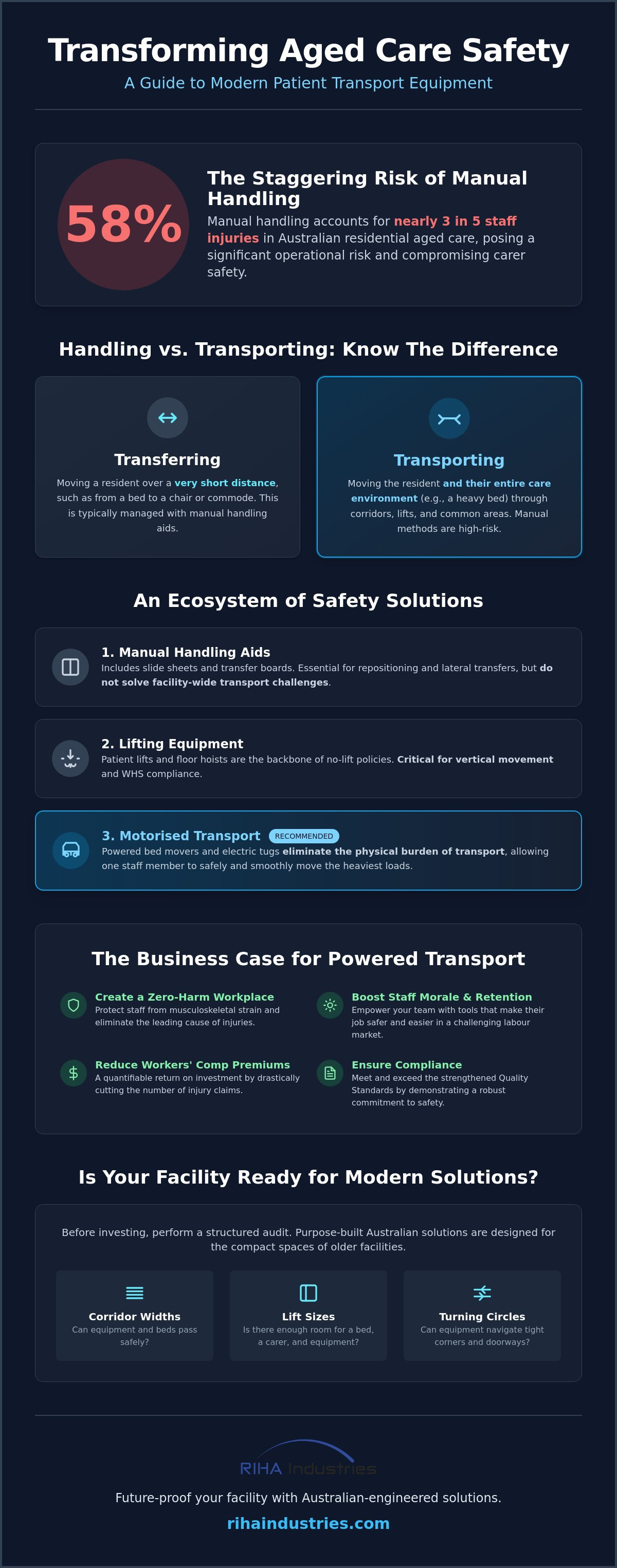
Did you know that manual handling accounts for a staggering 58% of all staff injuries in Australian residential aged care? In a sector already facing stricter care minute accountability and the rigorous requirements of the new Aged Care Act, the physical toll on your workforce represents a significant operational risk. You likely recognise that keeping your team safe while navigating narrow corridors and ageing infrastructure is a constant, exhausting challenge. It’s difficult to provide dignified care when the physical act of moving heavy beds or equipment feels like a battle against physics.
This 2026 guide reveals how the right patient transport equipment aged care facilities invest in can transform these high-risk tasks into seamless, one-person operations. By integrating advanced powered technology, you can protect your staff from musculoskeletal strain and create a truly zero-harm workplace. We will examine the latest safety standards and the specific engineering solutions, such as the StaminaLift and Easi series, that help streamline your facility while reducing workers’ compensation premiums and ensuring compliance with the strengthened Quality Standards.
Table of Contents
What is Patient Transport Equipment in an Aged Care Context?
In the context of Australian residential care, the patient transport equipment aged care facilities rely on has evolved from simple mobility aids into a sophisticated ecosystem of engineering solutions. It’s no longer just about moving a person; it’s about moving an entire care environment safely and efficiently. While many people use the terms "handling" and "transport" interchangeably, the distinction is vital for operational safety. Modern equipment doesn't just assist with the task; it completely redefines the physical relationship between the carer, the resident, and the facility infrastructure.
A critical distinction must be made between "transferring" and "transporting." Transferring involves moving a resident over a very short distance, such as from a bed to a chair or a commode. Transporting, however, involves the movement of the resident along with their entire care environment, often a heavy hospital bed, through the facility's corridors, lifts, and common areas. By 2026, the physical demand of manual pushing has become unsustainable. With the strengthened Quality Standards that commenced in late 2025, providers are under increased pressure to demonstrate a commitment to safety and dignity. Manual pushing risks staff injury and subjects residents to jerky, uncomfortable movements that can compromise their sense of security. High-quality patient transport equipment aged care teams use ensures that every journey through the facility is smooth, stable, and dignified.
The Evolution of Aged Care Handling
The industry has moved decisively away from the dangerous "two-person lifts" of the past toward strict no-lift policies. This shift was accelerated by the increasing weight of modern bariatric beds, which can exceed several hundred kilograms when occupied. Patient transport equipment is a system designed to neutralise the weight of both the resident and their furniture. As beds have become more complex and heavier to accommodate clinical needs, the mechanical assistance required to move them has had to keep pace to prevent catastrophic musculoskeletal injuries among nursing staff.
Key Categories of Equipment
Understanding the different categories of equipment helps facility managers identify where their safety gaps exist. Most facilities utilise a mix of three primary categories:
Manual handling aids: These include slide sheets and transfer boards, primarily used for repositioning or short-distance lateral transfers. While essential for daily care, they don't solve the problem of moving heavy furniture.
Lifting equipment: A patient lift or floor hoist is essential for vertical movement, ensuring residents are moved safely without manual lifting. These tools are the backbone of daily care routines and are primary requirements for WHS compliance.
Motorised transport: This category includes powered bed movers and electric tugs. These systems take the physical burden off the staff entirely during facility-wide transit, allowing a single staff member to move a fully occupied bed with minimal effort.
By categorising equipment this way, facilities can better assess if they're merely "lifting" when they should be "transporting." Moving a resident from the bedroom to the dining hall or a treatment room shouldn't be a high-risk event for the staff involved.
Essential Patient Handling and Transport Gear for Modern Facilities
A WHS-compliant facility in 2026 prioritises equipment that removes the physical burden from the operator entirely. When selecting patient transport equipment aged care managers must evaluate tools based on their ease of use for a diverse workforce. Your team likely includes staff of varying ages and physical strengths; therefore, the equipment must be intuitive and require minimal exertion. Universal compatibility is another non-negotiable factor. Investing in systems that work seamlessly across different bed brands ensures that your capital investment remains flexible as your facility upgrades its furniture over time.
Reliable safety protocols often align with OSHA safe patient handling guidelines, which emphasise that manual lifting and pushing should be the absolute last resort. By implementing motorised solutions, you create a protective barrier between your staff and the cumulative strain of daily portering tasks. This proactive approach doesn't just prevent acute injuries; it preserves the long-term health of your most valuable asset: your care team.
Motorised Bed Movers: The OHS Game Changer
The most dangerous moment in bed transport is the initial "break-out" force required to get a heavy, stationary bed moving. This sudden exertion is a primary cause of shoulder and lower back strain. The StaminaLift series eliminates this risk by using a powered drive system to initiate movement and manage the momentum during cornering. For facilities with ageing infrastructure, the StaminaLift 2100 Bed Mover provides a compact choice, allowing staff to navigate tight corners and small lifts without physical strain. This technology ensures that the weight of a bariatric bed is managed by the machine, not the nurse’s spine.
Electric Tugs for Support Services
Operational efficiency extends beyond resident rooms. Meal and laundry trolleys are often a hidden source of staff injury because they are moved dozens of times a day across long distances. Using the Easi Rider for portering supplies or the Easi Mover for heavy trolleys transforms these arduous tasks into simple, motorised workflows. This shift improves the overall flow of the residential centre and allows staff to focus on care rather than logistics. If you are looking to optimise your facility's safety profile, considering these support service tugs is a logical next step in your WHS strategy.
The Business Case: ROI of Investing in Powered Transport
Investing in high-quality patient transport equipment aged care facilities can rely on is a strategic financial decision, not merely a compliance checkbox. While the initial capital expenditure for powered systems is higher than manual alternatives, the return on investment (ROI) is realised through the drastic reduction of workplace injuries. In Australia, the healthcare and social assistance sector accounted for 19.9% of all serious workers' compensation claims in 2024. When you consider that manual handling is responsible for 58% of all injuries in aged care, the business case for removing the physical load becomes undeniable. A single serious back injury doesn't just result in a claim; it triggers a cascade of costs including agency staff premiums, recruitment fees, and the loss of institutional knowledge.
Reducing WorkCover and Insurance Premiums
There is a direct correlation between the implementation of motorised patient transport equipment aged care providers use and a measurable decrease in premium-driving incidents. By meeting the strengthened Aged Care Quality Standards that came into effect on 1 November 2025, providers demonstrate a proactive commitment to a "zero-harm" environment. Scheduling regular preventative maintenance and repairs ensures that high-torque drive systems remain reliable, preventing the costly operational downtime associated with equipment failure. This systematic approach to safety helps lower insurance risk profiles and protects the facility from the litigation risks associated with staff and resident handling accidents.
Operational Efficiency Gains
With the 2026 requirement for facilities to provide 200 minutes of care per resident per day, every minute saved on logistics is a minute returned to clinical care. Powered bed movers like the StaminaLift series create a "Portering Advantage" by allowing a single staff member to move heavy bariatric beds that previously required multiple people. This reallocation of labour is crucial in an environment where registered nurses are now required on-site 24/7. Instead of acting as manual labour, your skilled nursing team can focus on resident outcomes, improving both facility performance and staff morale. Efficiency isn't just about speed; it's about making the most of your existing workforce without compromising safety.
How to Audit Your Facility for New Transport Solutions
Auditing your facility for new patient transport equipment aged care staff can use effectively requires more than just a measuring tape. It involves a holistic assessment of the daily "care journeys" that occur within your walls. Start by mapping out the most frequent routes, such as the path from high-dependency wards to diagnostic suites or common dining areas. Identify the high-risk zones where manual pushing is currently most prevalent. By documenting these movements, you can pinpoint exactly where mechanical assistance will provide the most significant relief for your team.
Physical bottlenecks are often the biggest hurdle in older Australian facilities. You must measure corridor widths, lift dimensions, and the turning circles available in resident rooms. While a standard bed might fit through a doorway, a bed being moved with a manual team often requires extra clearance that isn't always available. Floor surfaces also play a critical role; the force required to move a bariatric bed on deep-pile carpet is significantly higher than on medical-grade vinyl. Don't forget to evaluate outdoor paths or ramps that connect different wings of the facility, as these gradients can turn a routine move into a major safety hazard.
Staff consultation is the final, vital step of your audit. Your frontline carers know exactly which beds are "sticky" and which corners cause the most frustration. By identifying these pain points, you ensure that the equipment you select solves real-world problems rather than just theoretical ones. To begin your facility assessment, you can book a professional site audit to identify the best-fit solutions for your unique layout.
Technical Specifications to Consider
When reviewing equipment, pay close attention to weight capacity and battery logistics. For facilities caring for bariatric residents, the StaminaLift Transfer System 6000 offers the necessary power to manage extreme loads safely. Consider where charging stations will be placed to ensure equipment is always ready for use. Long-term reliability is also essential, so ensure your plan includes Preventative Maintenance and Repairs to avoid unexpected downtime and keep your safety standards high.
Trial and Training Protocols
On-site trials are essential for building staff buy-in and proving the equipment's value in your specific environment. Once you've selected a system, organise a comprehensive training schedule that covers all shifts, including night staff who often work with fewer colleagues available for "two-person" moves. The goal is to create a culture of "Equipment First," where staff instinctively reach for a powered mover for every heavy transit task. This shift in mindset, supported by easy-to-use technology, is what ultimately delivers a zero-harm workplace.
Future-Proofing with RIHA Industries: StaminaLift and Easi Series
The StaminaLift 2100 Bed Mover is a specialised solution specifically engineered for compact aged care environments. It allows a single operator to navigate the tightest corridors and lifts with precision, effectively future-proofing facilities with ageing infrastructure. Beyond resident movement, the Easi series addresses total facility logistics. Whether it's moving heavy laundry cages or meal trolleys, these powered tugs ensure that every physical task is performed without the risk of musculoskeletal strain. This holistic approach to logistics transforms the way your facility operates, turning high-risk manual labour into a streamlined, motorised workflow that protects your workforce for the long haul.
The StaminaLift Advantage
The core of our technology is the commitment to zero-effort movement. By neutralising the weight of the load, the StaminaLift series protects the user from the cumulative strain that leads to chronic injury and long-term WorkCover claims. For high-use facilities that require constant bed movement across multiple wings, the StaminaLift Transfer System 5000 provides a robust, reliable workhorse that maintains its performance under heavy demand. This system is designed to connect to virtually any hospital or aged care bed, providing a versatile tool that adapts to your current equipment inventory without requiring expensive modifications or furniture replacements.
Reliability Through Service
Choosing the right equipment is only the first step toward a safer facility; maintaining that equipment is what ensures long-term OHS compliance. Regular preventative maintenance and repairs are essential to keep your fleet in peak condition and prevent the downtime that can compromise facility safety. RIHA Industries remains committed to global healthcare standards, providing ongoing support and comprehensive staff training to ensure your team remains confident in using these life-changing tools. Our partnership approach ensures that your investment continues to deliver value years after the initial installation. To ensure your facility meets the highest safety benchmarks and protects your team from harm, you should contact RIHA Industries for a facility safety audit to identify the most effective path forward for your team and residents.
Securing the Future of Your Care Facility
The transition toward a safer, more efficient workplace begins with a commitment to removing physical risk from your staff's daily routine. By implementing the right patient transport equipment aged care providers can transform high-risk manual handling into a controlled, motorised process that preserves both staff health and resident dignity. We have seen how auditing your facility's unique layout and choosing equipment with universal compatibility ensures that your investment remains effective as care requirements evolve. Protecting your team from cumulative strain isn't just a regulatory necessity; it's a fundamental step in building a sustainable and supportive care environment.
As a global leader in healthcare ergonomics, RIHA Industries provides Australian-designed and engineered tools that are used by leading facilities around the world. Our commitment extends beyond the initial purchase through comprehensive preventative maintenance programmes that ensure your equipment remains a reliable partner in safety. You can explore RIHA Industries’ full range of specialised transport solutions to find the ideal fit for your facility's specific needs. Empowering your team with the right tools creates a safer, more productive future for everyone in your care.
Frequently Asked Questions
What is the difference between a patient transfer and patient transport?
A patient transfer is a short-distance movement, such as shifting a resident from a bed to a chair, while patient transport involves moving the resident and their furniture across the facility. Transfers usually rely on lifting aids like hoists. In contrast, patient transport equipment aged care facilities use, such as motorised bed movers, is designed for long-distance transit through corridors and lifts, protecting staff from the sustained physical exertion of pushing heavy loads.
Does our aged care facility need a motorised bed mover if we have hoists?
Yes, because hoists and motorised bed movers solve two different physical challenges. Hoists manage the vertical lift required to move a resident into or out of a bed safely. Motorised movers, however, handle the horizontal force needed to propel that bed throughout the building. Without a mover, your staff still face significant musculoskeletal risks when pushing occupied beds, even if they used a hoist for the initial transfer.
Will the StaminaLift 2100 fit through standard Australian aged care doorways?
The StaminaLift 2100 Bed Mover is specifically engineered for the compact dimensions of Australian facilities. It features a slim profile and a tight turning circle that allow it to navigate standard doorways and small passenger lifts with ease. This design ensures that even in older buildings with narrow corridors, your team can move beds without having to perform dangerous manual manoeuvres or wide turns that risk wall damage.
How much training is required for staff to operate a powered tug safely?
Operating a powered tug is intuitive and generally requires only a short orientation session to ensure competency. Most staff members become proficient with the controls within thirty minutes of hands-on practice. RIHA Industries provides structured training to ensure every shift is comfortable with the equipment's safety features. This rapid learning curve helps maintain high safety standards without requiring extensive time away from resident care duties.
Can powered bed movers work on carpeted floors in residential care?
High-torque drive systems allow powered bed movers to operate effectively on various surfaces, including medical-grade carpet and vinyl. Moving a heavy bed on carpet manually is one of the most physically demanding tasks a carer can perform due to the high rolling resistance. Motorised equipment neutralises this resistance entirely, providing a smooth and consistent movement regardless of the flooring material used in your facility's residential wings.
What are the WHS requirements for manual handling in aged care?
Australian WHS laws require employers to eliminate or minimise the risk of musculoskeletal injuries as much as reasonably practicable. This involves identifying manual handling hazards and implementing mechanical aids to replace high-risk physical tasks. Using patient transport equipment aged care professionals can operate without exertion is a primary method for meeting these legal obligations, especially as resident acuity and bed weights continue to increase across the sector.
How do we maintain OHS compliance with our transport equipment?
Maintaining compliance requires a combination of regular staff training and a consistent schedule for Preventative Maintenance and Repairs. Equipment that isn't regularly serviced can become harder to operate, which reintroduces the risk of manual strain. By keeping a detailed service log and ensuring all safety features are fully operational, you demonstrate a proactive commitment to a safe workplace and satisfy the rigorous auditing requirements of the Aged Care Quality Standards.
Are RIHA Industries products compatible with all hospital bed brands?
The StaminaLift series is designed with universal compatibility in mind, allowing it to connect to virtually any hospital or aged care bed. The adjustable jaw system accommodates various castor sizes and frame widths, ensuring that your facility doesn't need to purchase brand-specific movers. This flexibility allows you to standardise your transport protocols across the entire facility, regardless of the different bed models or brands you currently have in your inventory.


