
Powered Patient Handling Equipment: The 2026 Guide to Hospital Safety
Did you know that body stressing accounts for 34.5% of all serious workers' compensation claims in Australia? For nursing and portering staff, the daily reality of pushing heavy beds through narrow corridors isn't just exhausting; it's a significant health risk. You likely see the toll this takes on your team through rising injury rates and the struggle of manoeuvring ageing powered patient handling equipment that doesn't quite fit your facility's layout. We understand that your priority is providing world-class care without compromising the safety of the professionals delivering it.
In this 2026 guide, we'll show you how to achieve zero manual handling injuries by integrating modern, Australian-made motorised solutions into your workflow. We'll explore how innovations like the StaminaLift Transfer System 5000 and the versatile Jaw System 300 allow for single-person operation across almost any bed brand. By the end of this article, you'll have a clear roadmap to modernise your facility, reduce the physical burden on your workforce, and ensure your equipment seamlessly fits into even the tightest ward spaces and lifts.
Table of Contents
The State of Manual Handling in Australian Healthcare
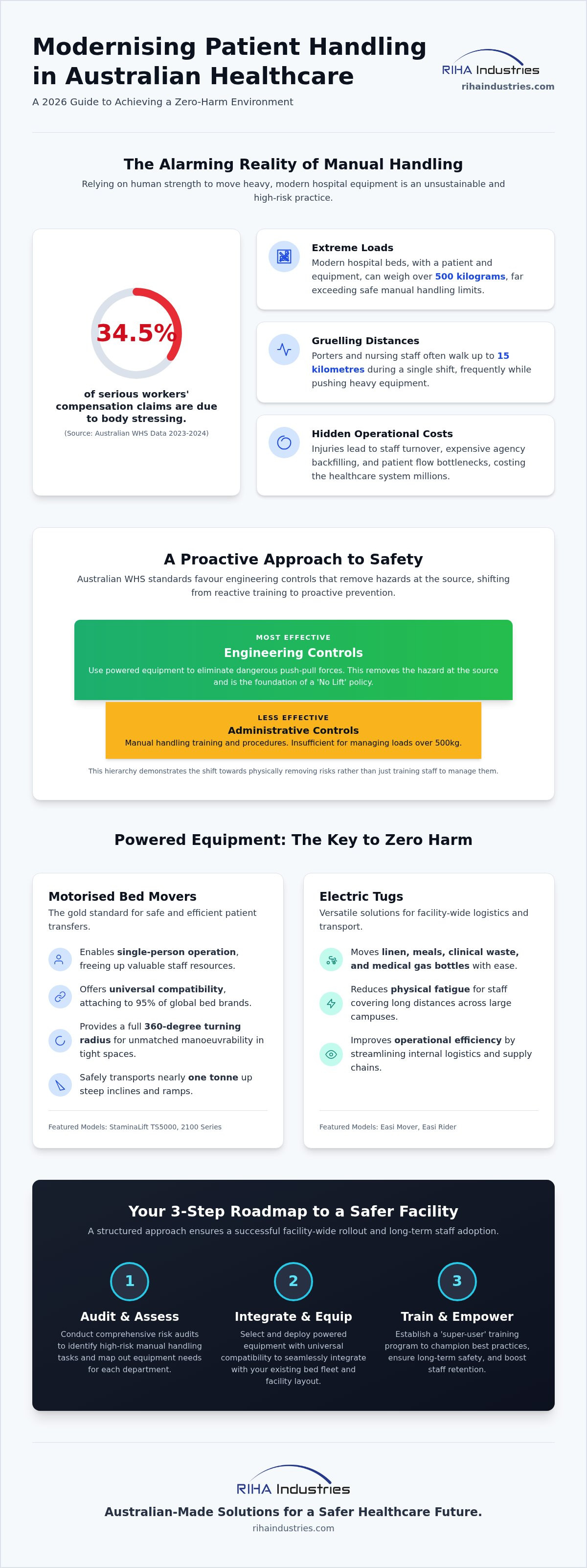
The daily physical demand placed on Australian healthcare workers has reached a critical threshold. Porters and nursing staff frequently walk up to 15 kilometres during a single shift, often while pushing equipment that exceeds safe manual limits. Modern hospital beds, when occupied by patients and equipped with necessary clinical attachments, can weigh well over 500 kilograms. Relying on human strength to move these loads is no longer a viable strategy for maintaining Occupational safety and health within a busy ward environment.
Musculoskeletal injuries, particularly chronic back strain, remain the primary WHS concern across the sector. Data from the 2023-2024 period shows that body stressing accounted for 34.5% of all serious workers' compensation claims in Australia. These aren't just statistics; they represent experienced staff members sidelined by preventable injuries. When a nurse or porter is injured, the hospital faces an immediate economic impact through increased insurance premiums, the high cost of agency backfilling, and a permanent loss of institutional knowledge.
WHS Compliance and the Hierarchy of Controls
Effective risk management requires a shift in how facilities approach safety. While administrative controls like manual handling training were once the standard, they're often insufficient when dealing with half-tonne loads. Engineering controls, such as powered patient handling equipment, provide a superior solution by removing the hazard at the source. Australian WHS standards increasingly favour these motorised aids to support "No Lift" policies, ensuring that the physical exertion required to move a patient never exceeds the natural limits of the human body.
The Hidden Costs of Manual Patient Transfers
The financial burden of manual handling extends far beyond direct compensation claims. High staff turnover rates often stem from physical burnout, leading to expensive recruitment cycles. Inefficient manual transfers also create bottlenecks in patient flow. If a bed cannot be moved quickly because two or three staff members aren't available to push it, ward discharge times are delayed. By 2026, the cumulative burden of care in Australia is defined by a landscape where manual handling injuries cost the healthcare system millions in lost productivity and avoidable medical expenses. Investing in motorised assistance isn't just a safety choice; it's a vital operational strategy for any modern facility.
Types of Powered Patient Handling Equipment
Selecting the right tools for a facility involves more than just replacing manual trolleys with motorised versions. While manual equipment relies entirely on the physical strength of the operator, modern powered patient handling equipment is engineered to eliminate the dangerous push-pull forces that lead to chronic injury. Adopting these advanced systems aligns with global standards for Safe Patient Handling and Mobility, ensuring that staff can move heavy loads without exceeding their physiological limits. The choice between different types of equipment often depends on the specific logistical challenge, from navigating acute care wards to transporting goods across sprawling hospital campuses.
Motorised Bed Movers: The Gold Standard
The most critical moment during a patient transfer is the initial "break-away" force required to get a heavy bed moving. Motorised bed movers, such as the StaminaLift TS5000 or the compact 2100 model, use advanced drive systems to handle this inertia, allowing a single operator to start and stop the bed with minimal effort. These machines are designed for universal compatibility, featuring patented hitching systems that connect to 95% of global bed brands. In the high-pressure environment of a theatre or emergency department, a 360-degree turning radius is essential. This level of precision allows porters to manoeuvre around clinical obstacles and through narrow doorways that would be impossible to navigate with traditional manual handling techniques.
Electric Tugs for Facility Logistics
Hospital safety isn't limited to patient beds; it also involves the constant movement of linen, meals, and medical gas bottles. Electric tugs like the Easi Mover provide a versatile solution for these facility-wide tasks, using specialised attachments to secure various trolley types. For staff who need to cover long distances across large hospitals, ride-on options like the Easi Rider reduce physical fatigue and improve operational efficiency. These tugs are compact enough to fit inside standard elevators and powerful enough to maintain controlled movement over ramps and inclines, ensuring that heavy logistical loads don't become a source of workplace strain.
Safety remains the cornerstone of these designs. High-quality equipment must include automatic braking systems that engage as soon as the controls are released, preventing runaway accidents on slopes. Emergency release mechanisms are equally vital, allowing staff to quickly disconnect the mover if manual control is required during a power failure. If you're looking to enhance the safety profile of your ward, you can explore the full range of Australian-made solutions designed specifically for the rigours of the modern healthcare environment.
Key Selection Criteria for Powered Equipment
Procuring the right powered patient handling equipment requires a nuanced understanding of both mechanical capability and the daily clinical workflow. While weight capacity is a fundamental metric, it's rarely the only factor that determines whether a device will be successfully adopted by frontline staff. Modern healthcare facilities must consider how equipment integrates with existing infrastructure, from the variety of bed frames in use to the specific cleaning protocols required for infection control. Adhering to guidelines such as OSHA Safe Patient Handling standards helps ensure that your selection prioritises the long-term well-being of both the caregiver and the patient.
Manoeuvrability is paramount in acute care and theatre environments where every centimetre counts. Equipment must be compact enough to park in designated bays without obstructing egress paths, yet powerful enough to handle heavy bariatric loads. Battery technology also plays a significant role in 24/7 operations. While conventional lead-acid batteries are common, lithium-ion alternatives offer faster charging cycles and longer lifespans, ensuring the movers are ready when a rapid transfer is required. Additionally, look for materials and finishes that can withstand rigorous hospital-grade disinfectants without corroding or degrading over time.
The Importance of Patented Hitch Systems
The connection point between the mover and the bed is where many generic systems fail. Busy hospital staff don't have the time for complex, tool-heavy coupling procedures. A patented, tool-free hitch system is essential for universal compatibility, allowing a single machine to connect to 95% of global bed brands. High-quality hitches should be adjustable to accommodate both round and square tube frames ranging from 20mm to 40mm. Electric adjustable hitches take this a step further by eliminating the need for the operator to bend or kneel during the connection process, further reducing the risk of musculoskeletal strain.
Performance on Ramps and Gradients
A mover that performs well on a flat corridor may struggle or become dangerous when encountering a slope. It's vital to evaluate equipment based on its performance on at least a 7-degree incline under a full load. For instance, the StaminaLift TS6000 is engineered to move nearly one tonne up such gradients with total control. Automatic braking systems are a non-negotiable safety feature; they must engage instantly on a slope to prevent any unintended movement. Gradient ratings are frequently the most overlooked specification in hospital equipment procurement, yet they determine whether a device remains functional or becomes a liability when navigating the architectural realities of ramps and fire-rated doors.
Implementing a Safer Handling Strategy
Successful implementation begins with a comprehensive facility-wide manual handling audit. This process identifies specific risk zones, such as steep ramps or high-traffic corridors, where manual effort is most likely to cause strain. Integrating powered patient handling equipment into daily portering schedules ensures these tools are available exactly when they're needed. We've found that hands-on demonstrations are far more effective than classroom sessions alone. By establishing a 'super-user' program, you create internal experts who can support their peers and ensure the equipment is utilised correctly in real-world clinical scenarios. Measuring success involves more than just looking at claim numbers; it's about capturing qualitative feedback from staff who no longer end their shifts in physical pain.
Maintenance and Long-Term Reliability
Maintaining a fleet of motorised movers requires a proactive approach to ensure 24/7 availability. Following a hospital equipment preventative maintenance schedule prevents unexpected downtime and extends the service life of your investment. Modern systems, like the 2026 StaminaLift 2100, now feature integrated Bluetooth diagnostics to assist internal engineering teams with rapid troubleshooting. Because RIHA Industries manufactures in South Australia, hospitals benefit from a local supply chain that can provide essential parts and support within 24 hours. This reliability is vital for maintaining the continuity of care in high-pressure environments where equipment failure isn't an option.
Calculating the Return on Investment (ROI)
The financial justification for upgrading your fleet is often found in immediate labour efficiencies. A single porter can safely manage a bariatric transfer that previously required two or three staff members, freeing up clinical resources for direct patient care. Beyond labour, facilities can see a reduction in WorkCover premiums by demonstrating a verified commitment to injury prevention. This strategy is also a powerful tool for reducing nurse back injuries and improving overall staff retention, especially among an ageing workforce. When staff feel protected by their employer, morale improves and the costs associated with recruitment and injury-related absenteeism drop significantly.
Ready to transform your facility's safety culture? You can contact our specialist team today to arrange a site audit and see our Australian-made transfer solutions in action.
The RIHA Solution: StaminaLift and Easi Series
Beyond patient transfers, the Easi series addresses the often-overlooked logistical burdens of healthcare facilities. The Easi Mover and Easi Rider are specifically engineered to streamline the movement of heavy linen, food, and waste trolleys. These tools transform high-strain tasks into controlled, motorised processes that protect staff from cumulative fatigue. For facilities with non-standard requirements, we offer extensive customisation options, including tailored hitches for specialised theatre tables and unique imaging equipment. To ensure your diagnostic displays are just as mobile as your patient beds, visit Dextro Imaging Solutions for high-performance portable imaging setups. This flexibility ensures that no mobility gap is left unaddressed within your facility.
As a South Australian manufacturer, RIHA Industries maintains a unique position as a global leader in safety engineering. We are the manufacturer of the only FDA-registered bed mover in the United States, reflecting a commitment to international quality standards that few can match. Our engineering team works directly with Australian hospitals to solve unique mobility gaps, often creating bespoke hitches for specialised clinical equipment. We also prioritise sustainability through modern manufacturing techniques. By utilising 3D printing for ABS-carbon fibre components, we can maintain legacy equipment and ensure your investment remains operational for the long term.
Staff Well-being and Retention
The most significant benefit of our technology is the protection it offers to the people who provide care. Empowering an ageing healthcare workforce to continue in physically demanding roles is essential for staff retention in a competitive market. The evidence of this impact is clear. In one major South Australian hospital, the introduction of our transfer solutions reduced bed-moving injuries from 20% to zero within a two-year period. This outcome transforms the workplace from a high-risk environment into a centre of excellence for safety and professional well-being. For a deeper technical analysis of our flagship model, you can read our StaminaLift Transfer System 5000 guide.
Securing the Future of Hospital Safety
Transitioning to a modern safety culture requires more than just updated training; it demands the implementation of reliable engineering solutions that eliminate the physical burden on your staff. By adopting high-performance powered patient handling equipment, your facility can move beyond reactive injury management and toward a standard of zero manual handling harm. We've seen the impact of this shift firsthand, including a major South Australian hospital that successfully reduced bed-moving injuries to zero through the strategic use of our transfer systems.
As the manufacturer of the only FDA-registered bed movers in the US, RIHA Industries provides world-class technology backed by comprehensive national service coverage across Australia. Whether you're managing bariatric transfers or complex ward logistics, our Australian-made solutions ensure your team remains protected and productive. It's time to empower your workforce with the tools they need to provide exceptional care without compromising their own well-being. We invite you to book a hands-on demonstration for your facility today and experience the difference that thoughtful engineering can make. Together, we can create a safer, more resilient healthcare environment for everyone.
Frequently Asked Questions
What is the best powered patient handling equipment for moving bariatric patients?
The StaminaLift TS6000 is the premier choice for bariatric patient transport due to its high-capacity engineering. It's specifically designed to manage nearly one tonne of weight, providing 450kg of lift and 900kg of push or pull force. This ensures that even the heaviest acute care beds can be moved safely by a single operator, significantly reducing the physical burden on staff in high-pressure environments.
How do motorised bed movers improve hospital portering efficiency?
Motorised movers transform hospital logistics by enabling single-person operation for tasks that traditionally required two or more staff members. Since porters often walk up to 15km per shift, these tools reduce physical fatigue and the risk of cumulative strain injuries. The 360-degree turning radius allows for effortless navigation through tight corners and narrow corridors, ensuring that patient flow remains efficient without compromising the safety of the workforce.
Are StaminaLift bed movers compatible with all hospital bed brands?
StaminaLift systems are designed for universal compatibility, currently integrating with 95% of hospital bed brands globally. This is achieved through patented attachment mechanisms, such as the Jaw System 300, which accommodates wheelbases ranging from 100mm to 300mm. Whether your facility uses standard stretchers or unique bariatric frames, the tool-free coupling system ensures a secure connection without the need for manual bending or complex strapping.
What safety features should I look for in a powered hospital tug?
When selecting a powered hospital tug, prioritise features that offer total control and fail-safe protection. Essential mechanisms include automatic braking that engages the moment the joystick is released and an emergency stop button. For walk-behind units like the Easi Mover, a "Back Off Button" is critical; it immediately stops the unit and drives it away from the operator for 1.5 seconds if activated, preventing potential pinning accidents in confined spaces.
How much training is required for staff to operate a bed mover safely?
While our powered patient handling equipment features intuitive joystick controls, formal training ensures optimal safety and efficiency. RIHA Industries provides comprehensive staff training and certification programmes tailored to your facility's specific needs. Most operators become proficient within a single session, as the equipment offers three customisable drive programmes to suit different experience levels. This structured approach helps maintain high safety standards and ensures long-term equipment reliability.
Can motorised handling equipment be used on hospital ramps and inclines?
Yes, high-quality motorised equipment is specifically rated for use on hospital ramps and fire-rated door gradients. The StaminaLift TS6000, for example, can safely transport nearly one tonne up a 7-degree incline under full load. It's essential that any equipment used on slopes includes automatic braking systems to prevent unintended rolling, ensuring both the patient and the operator remain secure during vertical transitions throughout the facility.
How does hospital equipment maintenance impact WHS compliance?
Regular preventative maintenance is a cornerstone of WHS compliance, as it ensures safety features like automatic brakes and emergency releases remain fully functional. Using powered patient handling equipment that includes Bluetooth diagnostics allows engineering teams to monitor battery health and usage history proactively. This data-driven approach simplifies servicing and helps identify when additional staff training may be required, ultimately maintaining the zero-injury environment achieved through motorised assistance.
What are the benefits of Australian-made manual handling solutions?
Sourcing Australian-made solutions provides significant logistical advantages, including 24-hour shipping for replacement parts and direct access to local engineering support. RIHA Industries manufactures in South Australia, allowing us to use CAD technology and 3D printing to create parts for legacy equipment, extending its operational life. This local presence ensures that your facility isn't left waiting for international shipments, maintaining the continuity of your patient handling strategy.


