
StaminaLift 2100 Bed Mover: The Definitive Guide for Australian Healthcare Facilities
- Jul 7
- 12 min read
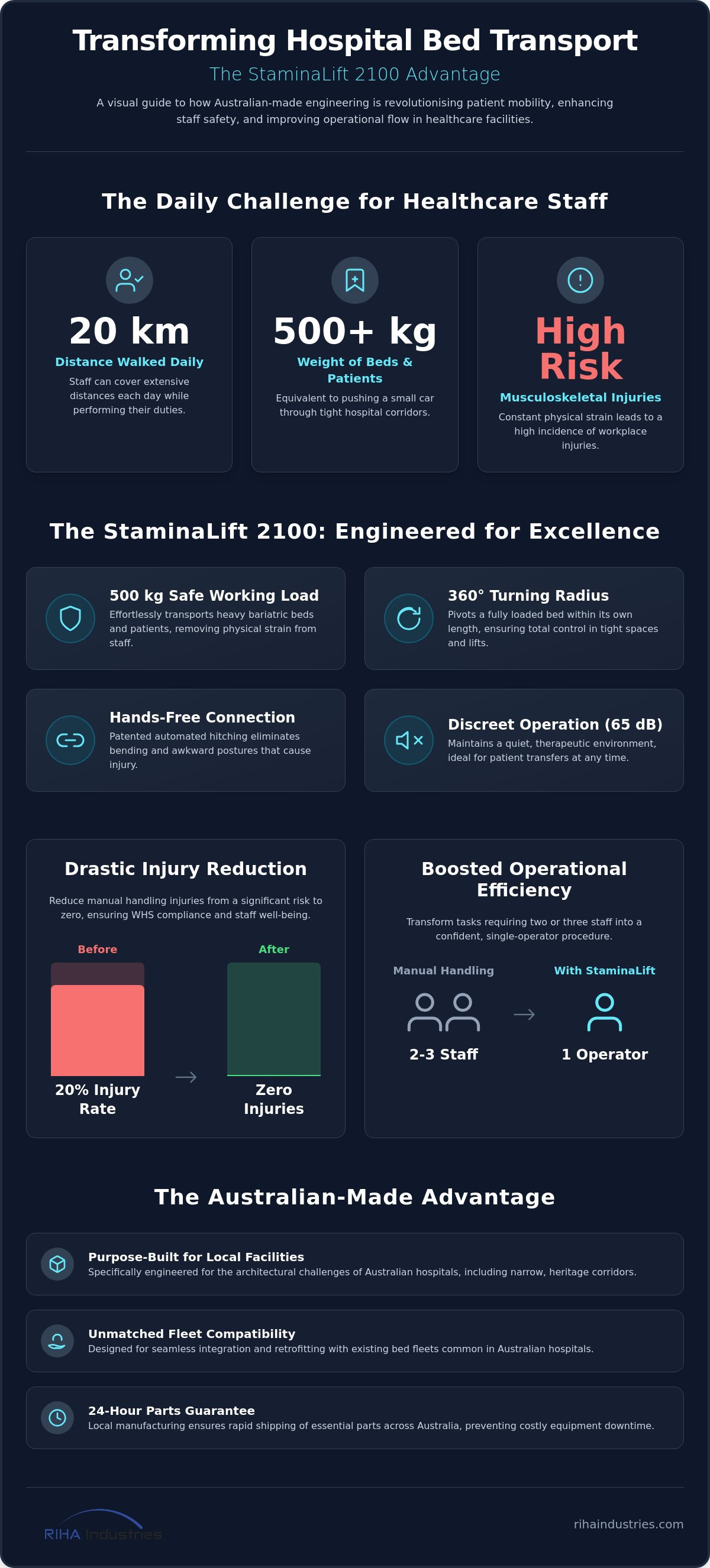
How many kilometres do your nursing and portering staff walk every day while pushing the weight of a small car? Research indicates that healthcare workers can cover up to 20 km daily, often while navigating heavy beds through the tight, challenging corridors of older facilities. It's a demanding reality that places an immense physical burden on your team. As one of the pre-eminent patient transfer system manufacturers Australia trusts, we recognise that reducing musculoskeletal injuries isn't just about compliance; it's about protecting the well-being of those who provide care.
You likely agree that the ideal workplace is one where manual handling injuries are a thing of the past and a single operator can move any patient with total confidence. This guide promises to show you how the StaminaLift 2100 transformed hospital bed transport by turning heavy manual fleets into safe, streamlined systems. We will preview the technical specifications that make this Australian-made mover a benchmark for reliability, from its 500 kg safe working load to its incredible 360 degree turning radius, ensuring your facility remains efficient and your staff stay safe.
Table of Contents
Why Patient Transfer System Manufacturers in Australia Prioritise the StaminaLift 2100
Technical Excellence: The Engineering Behind the StaminaLift 2100’s Manoeuvrability
Compatibility and Retrofitting: Why the 2100 is the Choice for Australian Bed Fleets
Maximising Workplace Safety: WHS Compliance and Injury Prevention
Investing in RIHA Industries: Australian-Made Reliability and Support
Why Patient Transfer System Manufacturers in Australia Prioritise the StaminaLift 2100
The StaminaLift 2100 stands as the foundational powered bed mover within the Australian clinical landscape. While some technologies focus primarily on home or disability care, RIHA Industries has dedicated its engineering to the high-volume, heavy-duty requirements of acute hospital wards. This specific focus is why patient transfer system manufacturers Australia wide look to the 2100 as the gold standard for safety and efficiency. As hospitals evaluate their options, they find that very few patient transfer system manufacturers Australia based can match the 2100's proven track record. RIHA Industries leads the market by focusing exclusively on bed and trolley mobility, ensuring that every engineering decision prioritises the ergonomic needs of the operator.
The transition from manual pushing to motorised assistance is no longer a luxury; it's a non-negotiable safety standard. It's designed to protect staff from the lifelong consequences of failing to use safe manual handling techniques. By removing the physical strain of the initial push and the ongoing momentum required to move a 500 kg load, the 2100 empowers porters and nurses to focus on patient care rather than physical exertion. This shift represents a commitment to workplace safety that modern healthcare facilities can't afford to ignore.
The Evolution of Powered Patient Transfers
Tracing its origins back to South Australia, the StaminaLift 2100 was born from a direct need to solve a specific problem. It addressed the physical toll of moving heavy beds through narrow, historical hospital corridors where space is at a premium. Even as global healthcare demands increase, this original design remains remarkably relevant for modern clinical environments. It enables a single operator to perform tasks that once required two or three staff members. This capability is vital as patient volumes continue to rise across the country. The 2100 isn't just a piece of equipment; it represents a shift in how hospitals value their workforce's long-term health.
The Role of Local Manufacturing in 2026
In 2026, the value of Australian-made certification is a critical factor for local healthcare procurement. Sourcing from Australian-owned manufacturers like RIHA Industries ensures that facility managers aren't just buying a product, but a long-term partnership. RIHA meets global FDA standards while maintaining a local footprint that global competitors often struggle to match. This proximity allows for a 24-hour shipping guarantee for essential parts across Australia. It prevents the long, costly downtimes often associated with imported equipment. Supporting local manufacturing also strengthens the domestic economy, ensuring that the expertise required to service these machines stays right here in Australia.
Technical Excellence: The Engineering Behind the StaminaLift 2100’s Manoeuvrability
Precision engineering serves a dual purpose: it ensures operational efficiency while actively preventing musculoskeletal disorders among frontline staff. While many patient transfer system manufacturers Australia hosts focus on simple motorised assistance, the StaminaLift 2100 is engineered for the specific architectural challenges of local facilities. Its hallmark 360-degree turning radius allows a single operator to pivot a fully loaded bed within its own length. This level of control is essential for navigating the heritage corridors and compact lifts common in many older Australian hospitals, where every centimetre counts.
Connecting the mover is equally effortless. The patented "hands-free" connection mechanism eliminates the need for staff to bend, reach, or manually strap the device to the bed frame. By automating the hitching process, the 2100 removes the awkward postures that often lead to workplace injuries. The unit operates at a discreet 65 dB, ensuring that therapeutic environments remain undisturbed. This allows for quiet patient transfers even during late-night shift changes without waking nearby patients. For managers looking to modernise their approach, exploring the full range of StaminaLift solutions provides a clear path toward a safer clinical environment.
Mastering Confined Spaces
Standard hospital lifts in Australia often present a significant bottleneck for bed transport. The 2100 addresses this by maintaining an incredibly compact footprint, adding only 180mm to 200mm to the total length of the bed. This allows the entire assembly to fit into lifts where bulkier movers would fail. Stability is maintained through a specialised four-wheel system that provides constant traction. This engineering choice is particularly beneficial when traversing 7-degree ramps or uneven floor joins, ensuring the patient remains level and the operator remains in total control at all times.
Smart Controls and Customisation
Accessibility is at the heart of the 2100’s control system. The intuitive joystick interface allows staff members of all heights and strengths to operate the mover with minimal training. To account for the diverse flooring found in modern wards, the drive settings are fully programmable. The mover can be calibrated for high-traction surfaces or smooth, polished tiles depending on the facility's needs. To ensure safety in public thoroughfares, a security lockout feature prevents unauthorised operation, keeping the equipment secure when not in use. New Bluetooth diagnostic updates for 2026 now allow maintenance teams to monitor fleet health and battery cycles remotely, ensuring maximum uptime for every unit.
Compatibility and Retrofitting: Why the 2100 is the Choice for Australian Bed Fleets
Healthcare facility managers often face a difficult choice when their bed fleets age: undergo a massive capital expenditure to replace manual beds or continue risking staff safety. The StaminaLift 2100 provides a sustainable middle ground by allowing facilities to retrofit existing fleets with powered mobility. Unlike many solutions offered by patient transfer system manufacturers Australia wide, the 2100 is specifically designed for the unique frame dimensions of Australian-manufactured beds. This compatibility ensures that older, mechanically sound beds don't need to be decommissioned prematurely, saving significant budget while meeting modern safety requirements.
Adopting this technology is a proactive step toward aligning with the Hazardous Manual Tasks Code of Practice. It addresses the core risks associated with pushing and pulling heavy loads without requiring a total fleet overhaul. By choosing a mover that integrates with both round and square tube frames ranging from 20mm to 40mm, hospitals can maintain a diverse inventory of beds while standardising their transport protocols. This universal approach is what distinguishes the most reliable patient transfer system manufacturers Australia has to offer, as it prioritises practical utility over proprietary restrictions.
The Universal Attachment Advantage
The 2100 utilises a patented jaw mechanism that secures the bed frame at the press of a button. This system is remarkably adaptable, adjusting automatically to different wheelbases and castor sizes without the need for manual tools. It's a "one-size-fits-most" solution that works as effectively on older palliative care models as it does on modern acute care beds. In one instance, a facility managed to extend the operational life of a 500-bed fleet by several years simply by introducing powered movers, effectively turning a manual handling liability into a streamlined, single-operator system.
Comparing the 2100 and the TS5000
Choosing the right equipment depends heavily on your facility's architecture and existing bed brands. While the 2100 is the compact, high-manoeuvrability alternative for older wards with narrow doorways, some environments may require the broader compatibility of the StaminaLift Transfer System 5000. The TS5000 is often preferred for facilities with a mix of international bed brands, whereas the 2100 remains the benchmark for those using predominantly Australian-made frames. Matching the mover to your specific floor layout and bed types ensures that your staff have the most efficient tool for their unique workplace challenges.
Maximising Workplace Safety: WHS Compliance and Injury Prevention
The daily physical demand placed on healthcare staff is often underestimated. Between patient care and logistics, porters and nurses can walk up to 20 kilometres in a single shift, much of that time spent pushing heavy equipment. This constant exertion leads to a high rate of musculoskeletal disorders, which is a primary concern for patient transfer system manufacturers Australia wide. By implementing the StaminaLift 2100, facilities have seen evidence-based results where bed-moving injuries dropped from 20% to zero. This isn't just about efficiency; it's about meeting the stringent Australian WHS standards for manual handling and protecting the people who keep our hospitals running.
Reducing workers' compensation claims is a significant financial benefit, but the impact on staff retention is even more profound. When staff feel physically safe, they're more likely to remain in their roles, preserving years of clinical expertise within the ward. Investing in powered mobility demonstrates a commitment to employee well-being that pays dividends in morale and operational stability. To see how these systems can be integrated into your facility, you can enquire about a site assessment today. As leading patient transfer system manufacturers Australia relies on, we ensure every unit is built to withstand the rigours of the modern ward while prioritising the health of the operator.
Reducing the Musculoskeletal Burden
The most dangerous moment of any patient transfer is the "initial push". This requires a sudden burst of force to overcome the inertia of a stationary bed, which is a leading cause of lower back and shoulder injuries. The StaminaLift 2100 eliminates this risk entirely by providing the necessary torque through its motorised drive. This support is especially critical for an aging workforce, allowing experienced nurses to continue their bedside work without the fear of a career-ending injury. For more on this topic, explore our guide on musculoskeletal injury prevention healthcare to understand the broader impact on aged care and acute wards.
Safety Features for High-Traffic Wards
Operating in a busy hospital requires equipment that can react instantly to a changing environment. The 2100 features an automatic braking system that engages the moment the operator releases the joystick, preventing any unintended movement in public corridors. In the rare event of a power loss, emergency release mechanisms allow for the manual disengagement of the jaws and brakes, ensuring the bed is never trapped. Hygiene is also prioritised through the use of non-marking wheels. These wheels prevent the scuffing and debris buildup that can compromise hospital floor hygiene, ensuring the mover is as clean as it is capable.
Investing in RIHA Industries: Australian-Made Reliability and Support
RIHA Industries operates with a mission-driven strategy that prioritises direct engagement with facility managers. This approach ensures that the equipment isn't just delivered; it's integrated into the hospital's unique workflow. As one of the few patient transfer system manufacturers Australia hosts that manages the entire lifecycle of the product, we provide a level of stability that imported brands often lack. Our national service coverage ensures that technical support is always within reach. We also provide a specialised 3D-viewer tool. This allows in-house engineers to identify components and perform basic maintenance with total precision, reducing the need for external call-outs and ensuring your fleet stays operational.
Sustainability is a core pillar of our engineering philosophy. We recognise that budget constraints are a constant challenge, which is why we use 3D printing technology to manufacture parts for discontinued machinery. This extends the life of your equipment well beyond the typical replacement cycle. When calculating the return on investment, the StaminaLift 2100 often pays for itself rapidly. The combination of reduced labour requirements and the elimination of injury-related costs creates a compelling financial case. A single manual handling injury can cost a facility tens of thousands of dollars in workers' compensation and temporary staffing. By preventing these incidents, the 2100 protects both your people and your bottom line.
Comprehensive Support and Maintenance
A well-maintained fleet is a reliable fleet. Our preventative maintenance programmes are designed to prevent downtime before it occurs, protecting your capital investment for the long term. With the 2026 Bluetooth diagnostic updates, on-site engineers can now simplify the troubleshooting process by accessing real-time data from the mover's internal systems. We also provide comprehensive training and certification for all staff. This ensures that every operator feels empowered to use the equipment safely and effectively, further reducing the risk of accidental damage or improper handling during high-pressure shifts.
The Future of Healthcare Mobility
As we look toward the 2026 landscape, RIHA’s commitment to engineering sustainability remains stronger than ever. We are currently rolling out lithium battery upgrades across our range, which will significantly enhance shift performance and reduce charging intervals. These advancements ensure that the StaminaLift 2100 remains the benchmark for patient transfer system manufacturers Australia wide. It represents a long-term solution for facilities that value durability and local expertise. If you are ready to see the difference that Australian-made engineering can make in your ward, we invite you to enquire about a hands-on demonstration for your facility.
Empowering Your Facility with Proven Australian Engineering
Protecting your workforce while maintaining operational efficiency requires more than just equipment; it requires a partnership with a manufacturer that understands the unique pressures of the Australian healthcare sector. We've explored how the StaminaLift 2100 provides a foundation for safety through its 360-degree manoeuvrability and seamless retrofitting for existing bed fleets. As one of the most reliable patient transfer system manufacturers Australia relies on, RIHA Industries remains dedicated to delivering solutions that are both FDA-registered and TGA-compliant.
The evidence is clear: by removing the musculoskeletal burden of manual bed transport, facilities have seen proven injury reductions from 20% to zero. This certified Australian-made technology is backed by 24-hour parts shipping and a commitment to long-term engineering sustainability that keeps your facility moving. You can take the first step toward a safer, more efficient ward by choosing to Book a Hands-On Demonstration of the StaminaLift 2100. Let's work together to ensure your staff can focus on what they do best: providing world-class care to their patients.
Frequently Asked Questions
Is the StaminaLift 2100 compatible with all hospital beds in Australia?
Yes, it's highly compatible with the vast majority of hospital beds manufactured in Australia. The universal hitch system connects securely to both round and square tube frames ranging from 20mm to 40mm in diameter. This flexibility allows facilities to organise their transport protocols across different wards without replacing manual fleets. It's this focus on local compatibility that distinguishes the top patient transfer system manufacturers Australia hosts.
Can one person operate the StaminaLift 2100 safely on a ramp?
A single operator can safely navigate hospital ramps with a full load using the StaminaLift 2100. The device is engineered to handle inclines of up to 7 degrees while maintaining total control of the bed. Its motorised drive system provides the necessary torque to overcome gravity, ensuring the staff member doesn't experience physical strain. This capability is essential for older facilities where ramps are common between different ward sections.
What is the maximum weight capacity of the StaminaLift 2100?
The StaminaLift 2100 features a robust safe working load of 500 kg. This high capacity ensures that the mover can handle standard hospital beds, specialised bariatric equipment, and the weight of the patient with ease. By providing this level of power, the unit eliminates the need for multiple staff members to assist with a single transfer. It remains a reliable choice for high-volume clinical environments across the country.
How does the StaminaLift 2100 compare to the TS5000 model?
The 2100 model is specifically optimised for Australian-made beds and older, tighter ward environments. In contrast, the StaminaLift Transfer System 5000 offers broader compatibility with a wider range of international bed brands and stretchers. While the 2100 is prized for its compact footprint and 360-degree turning radius in narrow corridors, the TS5000 is often the preferred choice for modern facilities with highly diverse equipment fleets.
Does RIHA Industries provide on-site training for hospital staff?
RIHA Industries provides comprehensive on-site training and certification for all healthcare staff. We believe that proper education is just as important as the equipment itself to ensure maximum safety and efficiency. Our team works directly with your porters and nurses to demonstrate correct operation, hitching techniques, and safety protocols. This hands-on approach ensures that your facility gets the most value out of its investment from day one.
What is the expected battery life of a 2100 bed mover during a standard shift?
The battery is designed to last through a full clinical shift under normal operating conditions. With a standard charging cycle, the 2100 provides consistent power for multiple transfers throughout the day. New Bluetooth diagnostic updates also allow maintenance teams to monitor battery health and charge cycles remotely. This ensures that the equipment is always ready when needed, preventing delays in patient transport during peak periods.
Are spare parts for the StaminaLift 2100 readily available in regional Australia?
Spare parts are readily available with a 24-hour shipping guarantee across the country. As one of the dedicated patient transfer system manufacturers Australia relies on, we maintain a comprehensive local inventory to prevent equipment downtime. Our commitment to supporting regional facilities means even remote hospitals can access components quickly. We also utilise 3D printing for specific parts to ensure long-term sustainability for every unit.
How much does the StaminaLift 2100 reduce the risk of staff back injuries?
Implementing the StaminaLift 2100 has been shown to reduce hospital bed-moving injuries, specifically back injuries, from 20% to zero in documented clinical settings. By automating the initial push and maintaining momentum, the mover removes the primary cause of musculoskeletal disorders. This protection is vital for staff well-being and significantly reduces the costs associated with workers' compensation claims. It allows your team to work with confidence, knowing their physical health is prioritised.


