
The StaminaLift Transfer System 5000: A Comprehensive Guide to Safer Patient Handling in 2026
- Jul 30
- 11 min read
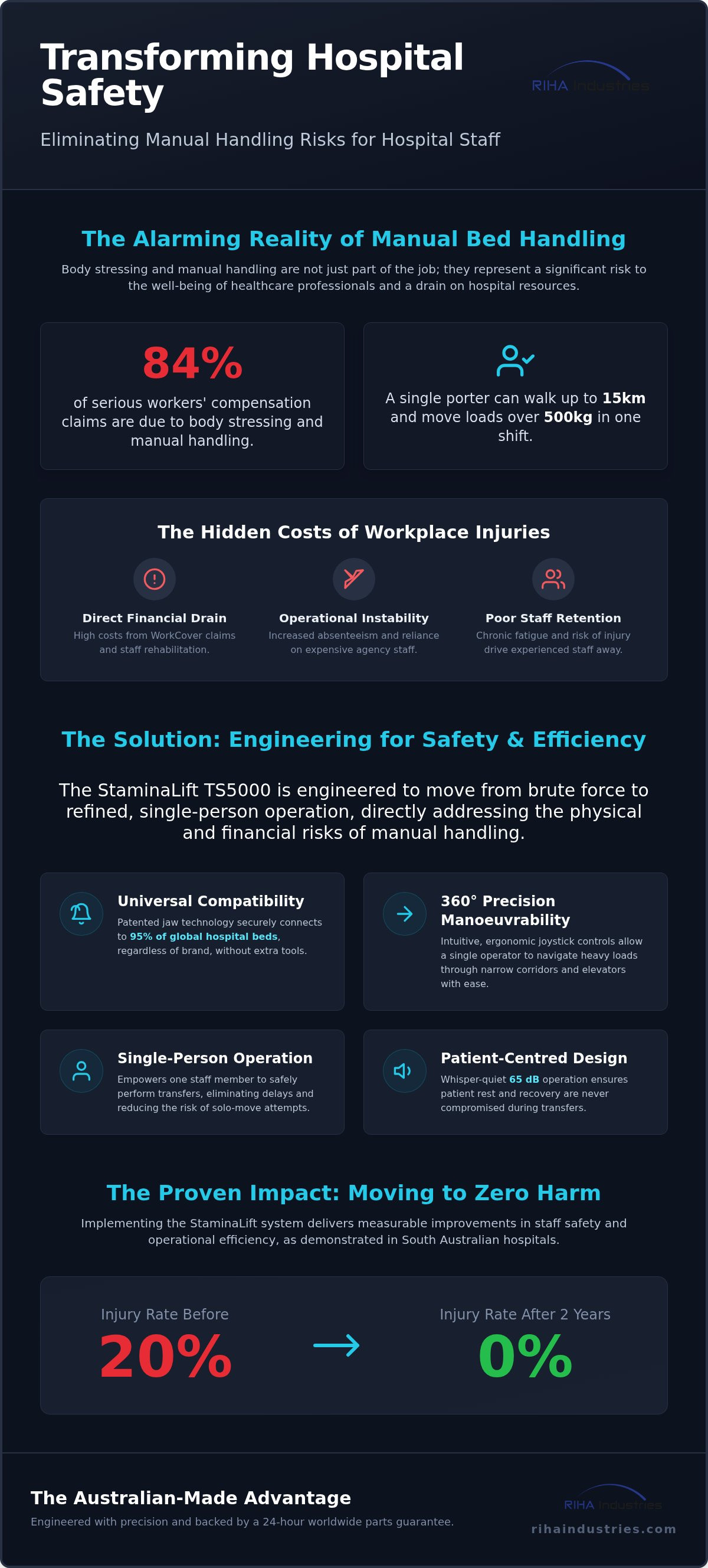
Did you know that body stressing and manual handling account for 84% of serious workers' compensation claims across Australian workplaces? For hospital porters and nursing staff, the daily reality of navigating a 500kg bariatric bed through a narrow corridor isn't just a logistical puzzle; it's a significant physical risk that often leads to debilitating musculoskeletal injuries. When evaluating different patient transfer system manufacturers, the primary challenge usually lies in finding a powered solution that's truly compatible with a diverse, multi-brand bed fleet. We understand that protecting your team's well-being is just as critical as the patient care they provide.
This guide demonstrates how the StaminaLift TS5000 eliminates manual handling risks and transforms hospital portering efficiency with Australian-made precision. We'll explore how its patented jaw technology and 360-degree manoeuvrability allow a single operator to move 95% of global hospital beds safely, regardless of the brand. You'll discover how implementing this single-person operation system can help your facility move toward zero manual handling injuries, mirroring results seen in South Australian hospitals where injuries dropped from 20% to zero within two years. By the end, you'll see how to achieve seamless compatibility across your entire facility infrastructure.
Table of Contents
The Physical Strain of Hospital Portering: Why Manual Bed Handling is a Risk
Engineering for Safety: Inside the StaminaLift Transfer System 5000
Compatibility and Versatility: What Sets Top Patient Transfer System Manufacturers Apart
Implementing Powered Bed Movers: Training, Safety, and Operational ROI
Why Choose an Australian-Made Original? The RIHA Industries Advantage as a Manufacturer
The Physical Strain of Hospital Portering: Why Manual Bed Handling is a Risk
Hospital porters and nursing staff serve as the vital engine of clinical flow, yet they're frequently pushed to their physical breaking points. On a typical shift, a porter might walk up to 15km while navigating heavy beds and stretchers that often exceed 500kg. This isn't just a matter of fitness; it's a hazardous manual task that places immense pressure on the spine and joints. While many patient transfer system manufacturers focus purely on the mechanical specifications of their machines, we recognise that the true challenge is the cumulative strain on the human body over a 12-hour shift.
By 2026, Australian Work Health and Safety (WHS) guidelines have evolved to mandate motorised assistance for these high-mass transfers, acknowledging that human strength has its limits. Relying on manual effort creates a significant operational bottleneck. Wards often face delays as they wait for multiple staff members to become available for a single bed move. This delay compromises patient throughput and often leads to staff attempting a risky "solo" move to save time, which significantly increases the chance of a career-ending injury.
The Hidden Costs of Workplace Injuries
The financial impact of manual handling reaches far beyond the immediate medical bill. Direct costs from WorkCover claims and rehabilitation for injured staff can drain hospital budgets rapidly. However, the indirect costs are often more damaging to the facility's health. High rates of absenteeism and the constant need for expensive agency staff to fill gaps create a cycle of instability and stress for the remaining team. Choosing the right patient handling equipment selection criteria is essential for facilities looking to mitigate these financial risks and ensure long-term operational sustainability.
Staff Retention and Caregiver Well-being
Retaining experienced staff is a major priority for healthcare providers facing global workforce shortages. When a facility invests in a high-quality assistive device, they're investing in the longevity of their most valuable asset. Leading patient transfer system manufacturers understand that safety technology isn't just a luxury; it's a strategic retention tool. Reducing physical fatigue allows nurses and porters to dedicate their energy to clinical care rather than exhausting logistics.
We've seen this impact firsthand; in one instance, the introduction of motorised movers allowed a veteran employee to continue their career well past retirement age, as the physical barrier of bed moving was removed. This creates a positive psychological shift, as staff feel empowered by a workplace that prioritises their safety through modern technology. A hospital that values its staff's physical well-being naturally fosters a culture of excellence and reliability.
Engineering for Safety: Inside the StaminaLift Transfer System 5000
The StaminaLift Transfer System 5000 represents a significant leap from brute force to refined engineering. While many patient transfer system manufacturers focus on basic motorisation, the TS5000 is built specifically for the spatial constraints and high-stakes environment of a modern Australian hospital. By automating the heavy lifting, it directly addresses the risk of overexertion related to repeated manual patient handling that frequently sidelines nursing and portering teams. The system operates at a whisper-quiet 65 dB, ensuring that patient recovery and rest are never compromised, even during late-night transfers through high-dependency units or quiet zones.
Precise movement is achieved through intuitive, ergonomic joystick controls that require minimal muscle activation. This design choice is critical for preventing the small, repetitive strain injuries that often accumulate when operators use less sophisticated equipment. The system includes three programmable drive settings, which allow facility managers to tailor the speed and responsiveness to suit different operator experience levels or the specific requirements of different wards.
Advanced Manoeuvrability in Confined Spaces
Navigating a standard hospital lift with a bariatric bed is often a centimetre-perfect operation that requires multiple staff members. The TS5000 features a true 360-degree turning radius, allowing a single operator to pivot the entire bed and mover assembly on a dime. This level of precision is made possible by a compact design that adds a mere 180mm to 200mm to the total bed length during transport. Its sleek profile allows the unit to tuck partially underneath the bed frame, which effectively reduces tripping hazards and ensures the system fits into tight spaces where larger, bulkier tugs would simply fail. Whether you're navigating 7-degree ramps or cluttered corridors, the system maintains total control under a full 600kg push/pull load, providing the operator with absolute confidence in every movement.
Smart Technology and Customisation
Safety is reinforced through an automatic braking system and an emergency jaw release mechanism, ensuring the operator always has a failsafe. Integrated Bluetooth connectivity provides real-time battery monitoring and diagnostic feedback, meaning preventative maintenance can be managed proactively rather than reactively. This connectivity allows engineering teams to identify potential issues before they lead to equipment downtime, keeping the fleet operational when it's needed most. For those looking to modernise their bed fleet and reduce physical burden on staff, exploring the full range of StaminaLift solutions provides a clear path toward a safer and more efficient clinical environment.
Compatibility and Versatility: What Sets Top Patient Transfer System Manufacturers Apart
One of the most persistent frustrations for facility managers is the lack of standardisation across their equipment fleets. While some patient transfer system manufacturers design products that only work with their own specific brand of beds, we believe true operational efficiency requires a more universal approach. The StaminaLift TS5000 solves this through its patented jaw mechanism, which effortlessly accommodates wheel widths ranging from 550mm to 890mm. This versatility ensures that a single investment can service almost any bed in a facility, regardless of the original manufacturer.
To eliminate the physical burden on staff, the system features a hands-free connect and lock mechanism. This design removes the need for porters to bend down, manually attach straps, or use specialised tools to secure a load. It provides a universal connection to wheel diameters from 125mm to 200mm, allowing for a secure grip on everything from standard acute care beds to heavy-duty bariatric frames. For highly specialised environments, custom clamp options are also available to safely transport theatre tables and other unique medical equipment.
Solving the Multi-Brand Fleet Headache
Most Australian hospitals manage a diverse mix of equipment, often combining newer plastic-shrouded beds with older acute care stretchers. Navigating this complexity is a primary focus of our 2026 hospital bed mover procurement guide, which helps facilities identify equipment that bridges these compatibility gaps. The TS5000 is engineered to handle these variations with ease, and for exceptionally wide equipment, the Jaw System 300 upgrade extends compatibility to 300mm. This adaptability ensures that your team isn't left searching for a specific mover for a specific bed, which directly reduces delays in patient transport.
Beyond Beds: Moving Trolleys and Tugs
The utility of a high-quality transfer system should extend beyond the ward. The TS5000 integrates seamlessly with the wider RIHA range, including the Easi Rider, creating a unified solution for facility logistics. By utilising a universal hitch system, porters can quickly adapt the mover to transport linen, meal, and medical equipment trolleys. The integration of such versatile equipment is a cornerstone of modern Safe Patient Handling and Mobility (SPHM) programs, which aim to standardise safety protocols and reduce the physical strain of moving any heavy load within the hospital environment. This holistic approach to mobility ensures that every department, from catering to clinical care, benefits from reduced manual handling risks.
Implementing Powered Bed Movers: Training, Safety, and Operational ROI
Integrating the StaminaLift TS5000 into a busy facility involves more than just unboxing equipment. It requires a methodical implementation plan that ensures every staff member feels confident and every bed move is optimised. Unlike some patient transfer system manufacturers that provide the hardware without a roadmap, we advocate for a four-step integration process. First, conduct a facility-wide audit of bed types and high-traffic transfer routes to identify where the physical burden is highest. Second, use the RIHA ROI calculator to demonstrate how labour savings and injury reduction justify the investment. Third, roll out comprehensive staff training and certification programmes. Finally, establish a preventative maintenance programme to ensure your fleet remains available 24/7.
Calculating the Return on Investment
The financial justification for powered assistance is clear when you factor in the transition from two-person to single-person bed transfers. Freeing up a second staff member for clinical duties immediately improves ward efficiency and reduces the need for agency staff. The most significant saving, however, comes from preventing musculoskeletal injuries. Data from South Australian hospitals shows that injuries can drop from 20% to zero within two years of implementing the TS5000. To protect this investment, a bed mover service contract ensures long-term fleet longevity and predictable operational costs, safeguarding your budget against unexpected repairs.
Safety Protocols and Compliance
Adhering to the 2026 Australian WHS standards for manual handling is a non-negotiable requirement for modern healthcare providers. The TS5000 supports these standards through built-in safety features like key-only operation and safety lockouts, which prevent unauthorised or untrained use. In the event of a power loss or clinical emergency, the system includes a manual brake bypass and emergency jaw release, allowing the bed to be moved manually without delay. This level of safety engineering gives facility managers peace of mind that their staff are protected by the highest industry standards. To see how these safety features can be tailored to your specific ward layout, contact our technical team for a facility audit.
Why Choose an Australian-Made Original? The RIHA Industries Advantage as a Manufacturer
Selecting a partner for hospital mobility equipment involves more than comparing technical data sheets. While many patient transfer system manufacturers rely on offshore assembly to reduce overheads, RIHA Industries maintains its proprietary manufacturing centre in Edinburgh North, South Australia. This commitment to Australian-made quality ensures every StaminaLift TS5000 meets the rigorous standards required by our local healthcare environment. Choosing a local manufacturer means you have direct access to the engineers who designed the system, allowing for custom modifications that imported alternatives simply can't offer.
Operational downtime is a significant risk when relying on imported hardware. If a critical component fails on a generic mover, waiting weeks for international shipping can paralyse a busy ward's logistics. We eliminate this bottleneck with a 24-hour worldwide parts guarantee. Because we control the entire production cycle, we keep every component in stock and ready for immediate dispatch. This reliability is why the StaminaLift brand has achieved global recognition; it remains the only bed mover in the world to be FDA-registered in the United States, a testament to its safety and precision.
Local Support for Australian Facilities
Our national service network provides comprehensive coverage across Australia, ensuring that rural and remote health hubs receive the same level of technical support as metropolitan hospitals. To empower your facility's internal engineering team, we provide online 3D viewer tools that simplify part identification and basic servicing. We also utilise advanced CAD technology and 3D printing to support older equipment fleets. This approach allows us to manufacture replacement parts for legacy systems that other manufacturers might have long since abandoned, protecting your long-term capital investment and reducing waste.
A Legacy of Innovation
Since the first StaminaLift was introduced in 2003, we've dedicated over 20 years to continuous refinement and sustainable engineering. We don't believe in planned obsolescence. Instead, we focus on extending the life of your hospital assets through durable construction and backwards-compatible upgrades. This mission-driven approach has transformed RIHA Industries from a local innovator into a global authority in patient handling. We're committed to being a stable, long-term partner for your facility's safety journey. Ready to transform your facility? Contact RIHA Industries for a TS5000 demonstration today.
Future-Proofing Your Facility with Clinical Precision
Transitioning to a safer hospital environment requires a shift from manual effort to intelligent automation. We've explored how the StaminaLift TS5000 solves the multi-brand fleet headache through its patented jaw technology and 360-degree manoeuvrability. By choosing a solution that's compatible with 95% of global hospital beds, you aren't just buying a machine; you're implementing a safety system that protects your most valuable clinical assets. It's about ensuring your staff return home healthy after every shift.
While many patient transfer system manufacturers focus on basic tugging, our commitment to being an FDA-registered manufacturer and Certified Australian Made ensures your facility meets the highest global standards. Clinical case studies have proven that this technology can reduce manual handling injury rates to zero, providing immediate relief for nursing and portering teams. Take the first step toward a safer, more efficient ward by choosing a partner that values precision and staff well-being. Request a TS5000 Demo for Your Hospital today and experience the difference that Australian engineering makes. We're here to help you create a workplace where safety is never compromised.
Frequently Asked Questions
How much weight can the StaminaLift Transfer System 5000 move safely?
The StaminaLift TS5000 safely manages a 600kg push and pull load, alongside a 300kg lift capacity. This robust engineering ensures that staff can move heavy bariatric beds and specialised clinical equipment without the risk of spinal strain or overexertion. By automating the most physically demanding aspects of portering, the system allows a single operator to manage loads that would otherwise require multiple staff members.
Is the StaminaLift TS5000 compatible with bariatric hospital beds?
Yes, the TS5000 is fully compatible with bariatric hospital beds and is engineered to handle their significant mass. Its patented jaw technology adjusts to accommodate wide wheelbases, ensuring a secure grip on heavy-duty frames. This compatibility allows your facility to maintain a high standard of care for bariatric patients without compromising the physical safety of the nursing or portering staff responsible for their transport.
Do I need a special licence or certification to operate a powered bed mover?
You don't need a formal government licence to operate a powered bed mover, but we highly recommend facility-specific competency training. We provide structured training modules that cover everything from basic manoeuvring to emergency procedures. This ensures that every operator feels empowered and confident, reducing the likelihood of workplace accidents and ensuring the equipment is used according to the manufacturer's safety guidelines.
How long does the battery last on a single charge during a standard shift?
The dual 12V batteries are designed to support a full 12-hour shift under typical hospital operating conditions. To ensure the system is always ready for high-volume periods, it features an integrated charging system that works with any standard power outlet. We suggest plugging the unit in during quiet periods or at the end of a shift to maintain optimal battery health and 24/7 availability.
Can the StaminaLift 5000 fit into a standard hospital lift while attached to a bed?
Yes, the TS5000 is designed to be exceptionally compact and adds only 180mm to 200mm to the total length of a bed. This sleek profile, combined with a true 360-degree turning radius, allows operators to navigate standard hospital lifts and tight corridors with total precision. It eliminates the logistical headache of trying to fit bulky transport equipment into confined clinical spaces.
What is the difference between the TS5000 and the StaminaLift 6000 model?
The TS5000 is our flagship universal mover designed to connect with 95% of global hospital beds, while the StaminaLift Transfer System 6000 offers specialised hitching for unique fleet requirements. While both systems provide the same 600kg capacity, the 6000 model is often selected for facilities with non-standard equipment that requires a different attachment mechanism. Our team can help you determine which model best suits your specific equipment audit.
Does RIHA Industries provide on-site training for hospital portering teams?
Yes, RIHA Industries delivers comprehensive on-site training for portering teams to ensure maximum safety and operational efficiency. Unlike some other patient transfer system manufacturers, we provide hands-on certification to help your facility maintain compliance with Australian manual handling standards. This direct support helps to foster a culture of safety and ensures that your investment in modern technology yields the best possible results.
How often does the StaminaLift TS5000 require professional servicing?
We recommend professional servicing every six to twelve months to keep your fleet in peak operational condition. Regular preventative maintenance by our qualified technicians includes a thorough check of the automatic braking system, battery health, and the patented jaw mechanism. This proactive approach prevents unexpected equipment downtime and extends the overall life of your hospital assets, ensuring they're always ready for duty.


