
2026 Australian Aged Care Safe Patient Handling Guide
- 3 hours ago
- 12 min read
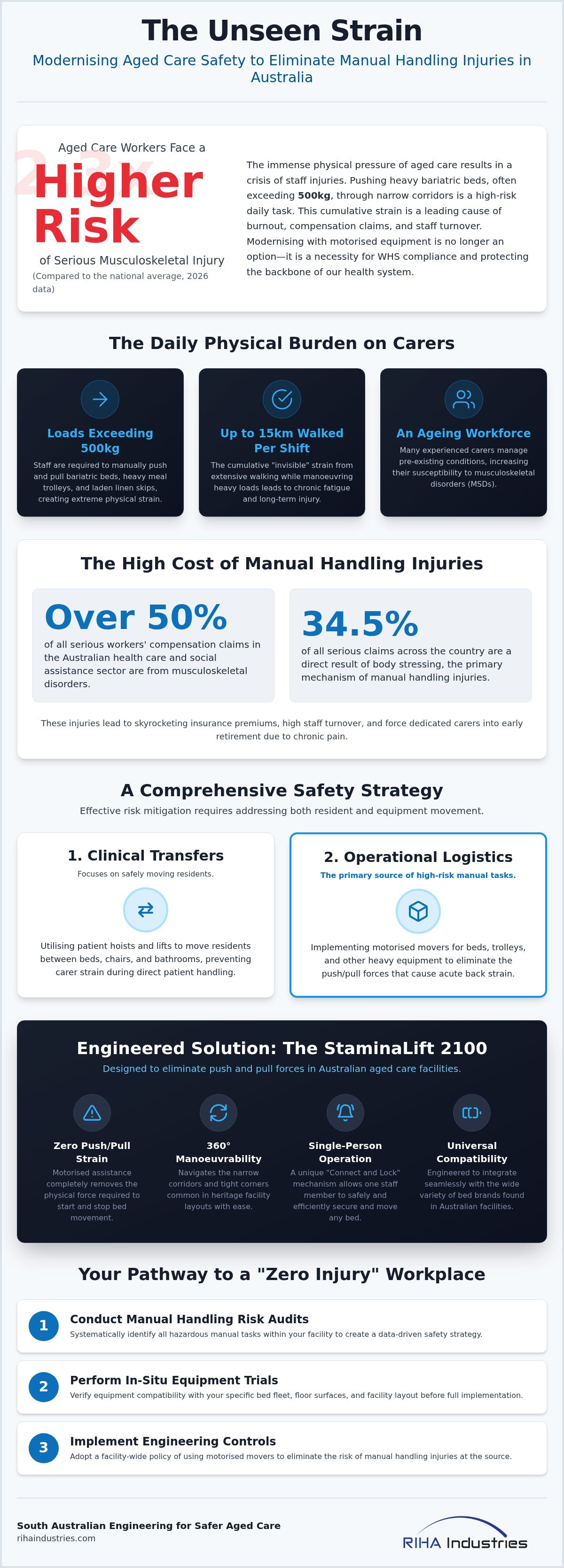
Did you know that in 2026, Australian aged care workers experience serious musculoskeletal injury claims at a rate 2.3 times the national average? It's a sobering statistic that reflects the immense physical pressure placed on those who provide essential care. Navigating heavy bariatric beds through narrow corridors isn't simply a clinical duty; it's a high-risk logistical challenge that often results in staff burnout and rising workers compensation costs. If you feel that protecting your team from back injuries is becoming an uphill battle, you aren't alone. Modernising your facility with advanced hospital patient transport equipment is the most effective way to bridge the gap between clinical excellence and staff safety.
We believe that every carer deserves to finish their shift without physical pain. This guide will show you how to eliminate manual handling injuries and achieve total compliance with Australian WHS standards by adopting motorised solutions like the StaminaLift 2100. We'll examine the latest 2026 safety regulations, the impact of lithium-powered technology on facility efficiency, and how the right tools can transform staff retention and morale across your organisation.
Table of Contents
The Physical Toll: Why Manual Handling in Aged Care is a Critical Risk
Safe Patient Handling (SPH) in 2026 has evolved into a fundamental pillar of Australian clinical governance. Within our current regulatory environment, SPH represents the systematic removal of manual lifting and pulling through advanced engineering controls. Aged care staff are the backbone of the health system, yet they're frequently expected to perform tasks that push the limits of human physiology. It's common for a carer to walk up to 15km per shift while manoeuvring loads that exceed 500kg. This isn't just about the occasional heavy lift; it's the cumulative, "invisible" strain of moving bariatric beds, heavy meal trolleys, and laden linen skips every single day.
The Australian healthcare sector faces a unique challenge with an ageing workforce. Many experienced carers manage pre-existing conditions, which increases their susceptibility to musculoskeletal disorders (MSDs). These disorders are responsible for over 50% of all serious workers' compensation claims in the Australian health care and social assistance sector. When a facility relies on manual effort rather than modern hospital patient transport equipment, these dedicated professionals are at a 2.3 times higher risk of serious injury compared to the national average. Motorised assistance is no longer a luxury. It's a necessary tool for ensuring the longevity and health of your team.
The High Cost of Caregiver Injuries in Australia
The financial burden of manual handling injuries is immense for residential aged care providers. Body stressing, the primary mechanism behind these injuries, accounts for 34.5% of all serious workers' compensation claims across the country. These claims lead to skyrocketing premiums and contribute to the high staff turnover rates currently plaguing the industry. Beyond the balance sheet, there's a profound emotional toll on staff nearing retirement who find themselves forced out of the profession by chronic back pain. We believe a "Zero Injury" goal is a realistic target when facilities prioritise engineering solutions over simple manual handling training. By integrating motorised movers, you create a workplace where safety is built into the equipment itself. For those looking for broader clinical support models, you can explore Home Care and Skilled Nursing Services to see how professional care is delivered in home-based settings.
WHS Compliance and the Duty of Care
Australian WHS legislation places a direct, non-delegable responsibility on employers to eliminate or minimise risks associated with hazardous manual tasks. Relying on "manual-only" policies is increasingly viewed as insufficient for meeting modern safety standards. Using a Patient lift or a motorised bed mover is often the only way to meet this duty of care when transporting residents or heavy equipment through a facility. True safety is achieved when an organisation defines SPH as a robust combination of policy, culture, and specific patient handling equipment selection criteria. This strategic approach ensures that the physical capacity of a carer never becomes the limiting factor in providing high-quality resident care.
Essential Categories of Hospital Patient Transport Equipment
Effective safety management requires a clear distinction between clinical transfers and operational logistics. While many facilities focus on hoists for resident movement, the primary risk often lies in the daily movement of heavy infrastructure. High-performance hospital patient transport equipment must address both areas to truly mitigate hazardous manual handling risks. By categorising equipment into resident-focused transfers and facility-wide logistics, providers can implement a comprehensive strategy that protects every member of the workforce. This dual focus ensures that no task, however routine, is left to manual effort alone.
Motorised Bed Movers: The StaminaLift Advantage
The physical force required to initiate the movement of a bariatric bed is a primary cause of acute back strain. We've designed the StaminaLift 2100 Bed Mover specifically to eliminate these initial push and pull forces. It's the compact, agile choice for Australian residential aged care, engineered to integrate seamlessly with the wide variety of bed brands found in local facilities. Its unique "Connect and Lock" mechanism allows a single staff member to secure a bed without bending or using complex straps. This technology shifts the workflow from a high-risk, two-person task to a safe, efficient single-person operation. Staff can navigate tight spaces with confidence, knowing the equipment is doing the heavy work.
Logistics Tugs for Heavy Facility Loads
Operational safety extends well beyond the bedside. Moving meal trolleys and linen skips involves repetitive strain that can lead to long-term musculoskeletal injury. The Easi Mover transforms these daily tasks by providing motorised assistance that handles the weight for the operator. It includes critical safety features like a "Back Off Button" and automatic braking systems to prevent accidents in busy corridors. For facilities with large campuses or long distances between service areas, the Easi Rider seated tug offers a comfortable, ergonomic solution. It allows staff to transport heavy loads across the facility without the physical fatigue associated with manual trolley pushing.
Ensuring your facility uses the right tools for both clinical and operational tasks is the first step toward a safer workplace. You can explore our full range of motorised solutions to find the best fit for your specific facility requirements and fleet compatibility.
Evaluating Manoeuvrability in Tight Aged Care Environments
Many facility managers believe their heritage buildings are simply too cramped for motorised hospital patient transport equipment. It's a common concern, but modern engineering has solved the spatial challenges of narrow halls and tight corners. Unlike traditional bulky aids, the StaminaLift series is designed with a 360-degree turning radius. This allows the operator to pivot a bed or trolley within its own length, which is vital for navigating the 90-degree turns found in older Australian facilities. By using non-marking drive wheels, the equipment ensures that facility floor surfaces remain pristine, even when transporting heavy bariatric loads. This combination of power and precision means you don't have to choose between staff safety and facility preservation.
Navigating Narrow Corridors and Standard Lifts
The StaminaLift 2100 excels in environments where every centimetre counts. It features a compact design that adds minimal length to the bed, making it possible to enter standard residential elevators without the need to remove headboards or footboards. Because the unit has a sleek profile that fits partially underneath the bed frame, it reduces the overall footprint and removes potential tripping hazards for residents. This ability to turn on its own axis means a single operator can move a bed through a crowded corridor with total confidence. You'll find that the equipment's agility allows for a seamless flow of movement, even during peak hours when hallways are busy with staff and visitors.
Precision Control with Intuitive Joysticks
Effectively managing work health and safety (WHS) risks requires equipment that staff feel comfortable and confident using. Programmable joystick controls allow for varying skill levels, ensuring smooth movement regardless of the operator's previous experience. Safety is further enhanced by automatic braking systems that prevent runaway loads on ramps or gradients; the machine stops instantly if the handle is released. Operation is also exceptionally quiet, running at just 65 dB. This is roughly the volume of a normal conversation, which helps maintain a peaceful atmosphere for residents while the team completes essential logistics. It's a thoughtful approach to engineering that respects the residential nature of the care environment.
Implementing a Successful SPHM Programme in Your Facility
Establishing a robust Safe Patient Handling and Mobility (SPHM) programme requires moving beyond simple policy and into practical, engineering-led application. It's about creating a sustainable ecosystem where staff safety is guaranteed by the tools they use every day. To transition your facility toward a zero-injury environment, we recommend following a structured five-step implementation process:
Step 1: Conduct a manual handling risk audit. Document every daily movement of beds, meal trolleys, and linen skips to identify high-risk "stress points" in your corridors.
Step 2: Trial equipment in-situ. It's vital to ensure your chosen hospital patient transport equipment is fully compatible with your existing bed fleet and can navigate your specific floor surfaces.
Step 3: Train and certify staff. Formal certification builds confidence and ensures that every operator understands how to use motorised assistance to its full potential.
Step 4: Establish a preventative maintenance schedule. Regular servicing ensures your equipment is always ready for use, preventing a return to manual handling due to unexpected downtime.
Step 5: Monitor injury data. Quantify your success by tracking the reduction in musculoskeletal injury claims and staff absenteeism following the rollout.
Staff Training and Cultural Adoption
Resistance to new technology is a common hurdle in residential care. You can overcome this by prioritising hands-on demonstrations that allow staff to feel the immediate relief of motorised movement. We've found that identifying "Super Users" within your nursing and portering teams is the most effective way to drive adoption. These internal champions provide peer-to-peer support and help integrate new workflows into daily routines. For more detailed strategies on fostering a safety-first culture, you can explore our guide on patient transport equipment aged care.
Maintenance and Long-Term Reliability
Uptime is critical in a high-stakes care environment. When equipment fails, staff often revert to risky manual pushing. This is why choosing Australian-made solutions with local service coverage is a strategic advantage. Our 2026 product range features integrated Bluetooth diagnostics, allowing for remote battery monitoring and simplified in-house servicing. Having access to 24-hour parts shipping across Australia ensures that your fleet remains operational year-round. You should also consider the long-term benefits of a professional hospital bed mover repair service to extend the life of your investment.
If you're ready to protect your workforce and reduce your compensation premiums, you can contact our expert team today to book a comprehensive on-site equipment trial.
Why RIHA Industries is the Benchmark for Australian Aged Care
RIHA Industries represents more than 20 years of Australian engineering excellence and innovation. As a South Australian manufacturer, we've dedicated decades to solving the specific logistical challenges found in our local healthcare environments. Our mission is grounded in the belief that smarter mobility can profoundly improve the daily lives of healthcare professionals. We don't just provide equipment; we offer a partnership focused on long-term safety and operational reliability. This commitment is best illustrated by our South Australian hospital case study, where the adoption of our motorised solutions reduced bed-moving injuries from 20% to zero within just two years. It's a result that proves the power of thoughtful, mission-driven engineering.
We also believe in "Engineering Sustainability," which means we continue to support and provide parts for discontinued equipment long after other manufacturers have moved on. This approach ensures that your investment in hospital patient transport equipment remains viable for the long term. By choosing a local partner, you gain access to a team that understands the high-stakes nature of aged care and is committed to keeping your facility running smoothly. Our focus remains on the human impact of our work, ensuring that every carer can perform their duties without the fear of career-ending injury.
The StaminaLift Range: Tailored for Every Ward
The StaminaLift range offers a specialised solution for every unique ward requirement. The StaminaLift Transfer System 5000 serves as our universal workhorse, while the StaminaLift Transfer System 6000 provides the extra power needed for bariatric care. For the tighter spaces typical of residential aged care, the StaminaLift 2100 Bed Mover offers the compact manoeuvrability required for narrow hallways. Each model features our patented attachment mechanisms, which are recognised for their ability to fit 95% of global bed brands. If you're ready to see how these systems perform in your specific environment, you can Book a hands-on demonstration at your facility to experience the difference firsthand.
Global Standards, Local Australian Support
RIHA Industries is proud to be the only FDA-registered bed mover manufacturer, a testament to our adherence to the highest global quality standards. While we operate on an international level, our support remains deeply local. We offer 24-hour parts shipping to ensure minimal downtime for both rural and metro facilities across Australia. This rapid response is vital for maintaining a safe workplace where staff never have to revert to manual handling due to equipment failure. Ultimately, our goal is to create a perfect synergy between caregiver well-being and resident security, providing the peace of mind that comes with world-class, Australian-made technology.
Securing a Sustainable Future for Your Care Team
The physical demands of the aged care sector don't have to result in staff burnout or chronic injury. By transitioning from manual effort to precise engineering controls, you can protect your team while meeting the rigorous 2026 Australian WHS standards. We've seen how integrating advanced hospital patient transport equipment like the StaminaLift 2100 can navigate the tightest corridors and eliminate the strain of pushing heavy bariatric loads. This shift doesn't just improve safety; it fosters a culture of care where staff feel valued and empowered.
As a Top 10 Mobility Aids Provider 2024, we're proud to be an Australian-made and owned innovator. Our solutions have already proven their value, such as in our South Australian hospital case study where bed-moving injuries were reduced to zero. You have the opportunity to transform your facility into a centre of excellence where both residents and carers thrive. We're dedicated to supporting your journey toward a safer, more efficient workplace.
Protect your staff and improve facility efficiency. Explore the StaminaLift range today.
Frequently Asked Questions
What is the most important equipment for safe patient handling in aged care?
The most vital tools for safe patient handling are motorised bed movers and logistics tugs that eliminate manual pushing. While hoists are essential for resident transfers, hospital patient transport equipment like the StaminaLift 2100 addresses the daily burden of moving infrastructure. These systems are designed to handle the 500kg load of a standard bed and patient, ensuring that staff never have to exceed their physical limits during routine facility movements.
How does motorised equipment reduce musculoskeletal injuries in nursing staff?
Motorised solutions reduce musculoskeletal injuries by absorbing the high-risk initial push and pull forces. Traditional manual handling often requires staff to strain their backs to overcome inertia, but the StaminaLift series handles this weight electronically. Statistics from a South Australian hospital confirm this impact, where injury rates dropped from 20% to zero within two years of implementation. By removing the need for bending and strapping, the equipment protects the long-term health of your workforce.
Can motorised bed movers fit into small aged care elevators?
Compact design is a hallmark of the StaminaLift 2100, making it ideal for the small elevators found in many Australian aged care facilities. The connection process adds only 180mm to 200mm to the total length of a standard hospital bed, ensuring it fits within standard lift dimensions. Combined with a 360-degree turning radius, this equipment allows a single operator to navigate tight corners and confined spaces that would be impossible to manage manually.
Is specialised training required for staff to operate StaminaLift equipment?
While the equipment is designed for intuitive use, RIHA Industries provides comprehensive staff training and certification to ensure maximum safety. Our motorised solutions feature programmable joystick controls and three distinct drive programs to suit different operator preferences. This training process builds confidence among your team, helping them master the 360-degree manoeuvrability and automatic braking systems. Proper certification ensures that your facility maintains the highest standards of operational safety and equipment longevity.
How do I ensure my facility complies with Australian WHS manual handling standards?
Compliance with Australian WHS standards involves identifying hazardous manual tasks and implementing the highest level of control possible. Rather than relying solely on training, you should prioritise engineering controls like motorised hospital patient transport equipment. Conducting a thorough risk audit of all bed and trolley movements is the first step. By providing tools that eliminate physical strain, you meet your duty of care and align with the Code of Practice for Hazardous Manual Tasks.
What is the weight capacity of a bariatric bed mover like the TS6000?
The StaminaLift TS6000 is our heavy-duty solution, featuring a 450kg lift capacity and a 900kg push or pull capacity. This enables a single staff member to transport nearly one ton of weight safely, even when navigating a seven-degree incline under full load. It's specifically engineered for bariatric and acute care environments where standard equipment may fall short. This power ensures that even the most challenging transfers are handled with precision and minimal physical effort.
Does RIHA Industries provide service and maintenance across Australia?
RIHA Industries provides full national service coverage across Australia, supported by 24-hour shipping for all replacement parts. We offer comprehensive preventative maintenance and repair services to ensure your fleet remains in peak condition. To assist with in-house servicing, our website features a 3D viewer and Bluetooth diagnostics for remote battery monitoring. This local support network minimises downtime and ensures that your facility always has access to the parts and expertise required for safe operation.
How do motorised tugs help with meal and linen delivery in aged care?
Motorised tugs like the Easi Mover and Easi Rider are designed to transport up to 1500kg of equipment, including heavy linen skips and meal trolleys. These tools eliminate the repetitive strain associated with pushing heavy loads over long distances or up ramps. Features like the "Back Off Button" and automatic braking provide an extra layer of safety in busy aged care corridors. By automating logistics, you allow your staff to focus their energy on direct resident care.


