
Aged Care Facility Patient Handling Policy: The 2026 Compliance Checklist
- Aug 2
- 12 min read
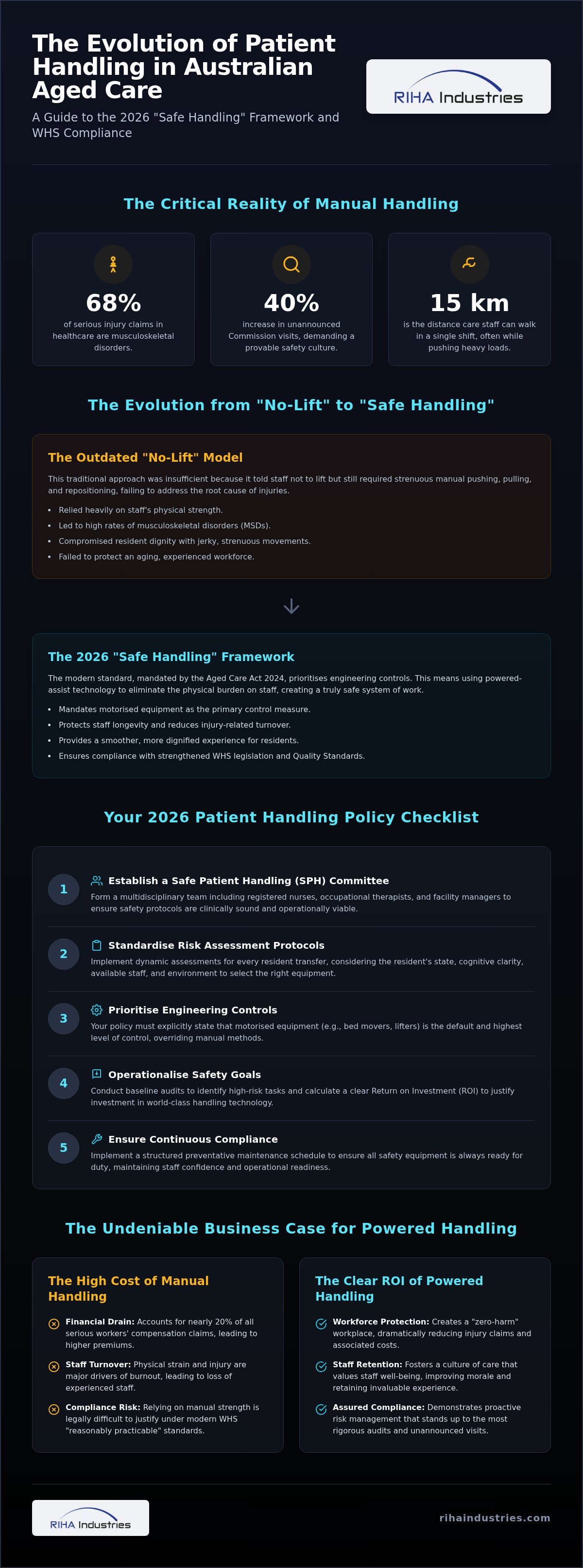
Did you know that musculoskeletal disorders account for 68% of serious injury claims in Australia's healthcare sector? This staggering figure highlights why a robust aged care facility patient handling policy is no longer just a regulatory box to tick; it's a vital shield for your workforce. With the 2026 regulatory landscape now in full effect, including a 40% increase in unannounced Commission visits, the pressure to maintain a zero-harm workplace has never been higher. Relying on outdated manual techniques doesn't just risk staff safety, it puts your entire facility's compliance status on the line.
We understand that managing an aging workforce while handling the complexities of bariatric transfers feels like a constant challenge. You want to foster a culture of care that prioritises both staff longevity and resident dignity. This article provides the master checklist you need to align with the newest Australian safety standards and the Aged Care Act 2024. We'll explore how transitioning to a powered-assist framework can reduce injury-related turnover and ensure your facility remains a leader in clinical excellence and workplace health.
Table of Contents
The Evolution of Patient Handling Policies in Australian Aged Care
A modern aged care facility patient handling policy is no longer a static document gathering dust on a shelf; it's a dynamic framework for risk mitigation. The Australian aged care landscape has shifted fundamentally from the traditional "No-Lift" era into a comprehensive "Safe Handling" model. This evolution recognises that simply telling staff not to lift is insufficient if they're still expected to push, pull, and manoeuvre heavy equipment manually. By 2026, the focus has expanded to include motorised assistance as a standard requirement, ensuring that staff longevity and resident dignity are protected simultaneously. This shift is largely driven by the New Aged Care Act 2024, which commenced in late 2025, and the strengthened Quality Standards that now demand a higher level of clinical care and workforce safety.
Why Manual Handling is No Longer the Standard
Healthcare professionals in residential care centres often walk up to 15 kilometres during a single shift, frequently while pushing heavy beds or equipment. When you add the increasing complexity of bariatric resident transfers to this physical load, manual handling becomes a recipe for disaster. The Manual handling of loads remains the leading cause of injury in the sector, as the physical strength required to move modern bariatric beds often exceeds safe human limits. Musculoskeletal Disorders (MSDs) in aged care nursing are the physical consequences of repetitive strain and overexertion during these transfers, affecting the muscles, joints, and spinal discs of the workforce.
Relying on manual force doesn't just risk injury; it compromises the quality of care. Residents feel every jerk and strain when a carer struggles to move a bed manually. By integrating motorised solutions, facilities provide a smoother, more dignified experience for the resident while ensuring the carer isn't pushed to their physical breaking point. This proactive approach to ergonomics is vital for retaining an aging nursing workforce that possesses invaluable experience but may have physical limitations.
WHS Legislation and Duty of Care in 2026
The Work Health and Safety (WHS) Act requires providers to manage risks to health and safety so far as is "reasonably practicable." In the 2026 regulatory environment, what's considered practicable has changed. With the availability of advanced motorised transfer systems, relying on manual strength is difficult to justify legally. This is particularly relevant as the healthcare and social assistance sector now accounts for nearly 20% of all serious workers' compensation claims in Australia. Safe Work Australia guidelines emphasise that engineering controls, such as motorised bed movers, provide a higher level of protection than relying on staff training or administrative policies alone.
Integrating these technologies into your aged care facility patient handling policy is essential for meeting the strengthened Aged Care Quality Standards. With the Aged Care Quality and Safety Commission increasing unannounced visits by 40% in 2026, facilities must demonstrate a living safety culture. This means showing that you've identified hazardous manual tasks and implemented the highest level of control possible. A policy that relies on motorised assistance proves a commitment to both staff well-being and legislative compliance, creating a zero-harm workplace that stands up to the most rigorous audits.
Essential Components of a 2026 Patient Handling Policy Checklist
To operationalise an aged care facility patient handling policy, you must move beyond high-level statements and implement concrete, measurable actions. A robust checklist ensures that every member of the team understands their role in maintaining a zero-harm environment. This starts with establishing a multidisciplinary Safe Patient Handling (SPH) committee. By including registered nurses, occupational therapists, and facility managers, you ensure that safety protocols are both clinically sound and operationally viable across all departments.
Standardising risk assessment protocols for every resident transfer is equally vital. Each interaction requires a dynamic assessment that accounts for the resident's current physical state, cognitive clarity, and the available staff. Your policy must mandate the use of motorised aids for loads exceeding specific weight thresholds. While traditional models focused primarily on lifting, 2026 standards recognise the extreme danger of horizontal pushing and pulling. Integrating patient handling equipment selection criteria into your procurement process ensures that any new equipment meets these rigorous safety requirements before it reaches the floor.
Finally, formalise incident reporting loops to ensure continuous improvement. By treating every "near miss" as a valuable data point, you can evolve your aged care facility patient handling policy to address emerging risks before they result in a lost-time injury. This proactive stance transforms compliance from a burden into a strategic advantage for staff retention.
Administrative and Engineering Controls
Administrative controls foster a culture of safety by ensuring leadership prioritises staff well-being through regular training and clear accountability. However, engineering controls offer the most reliable protection against injury. Motorised bed movers are significantly safer than manual tugging because they remove the high initial force required to start a bed moving. This mechanical advantage is the most effective way to protect a carer's spine during a shift. Facilities should also consider environmental design, such as doorway widths and floor surfaces, to ensure that motorised bed movers can be used seamlessly throughout the building without obstruction.
Resident Assessment and Handling Plans
Person-centred care requires individualised handling plans that account for mobility, cognition, and weight. These plans shouldn't be static; regular re-assessment is necessary as a resident’s condition changes or after a health event. Visual bedside cues are a practical way to communicate these requirements to staff instantly, preventing the risk of manual handling when mechanical aid is required. For facilities seeking to align with global best practices, the OSHA Safe Patient Handling Guidelines provide an excellent framework for establishing these assessment protocols within an Australian context.
Manual vs. Powered Handling: Evaluating Equipment for Policy Integration
A successful aged care facility patient handling policy depends entirely on the tools provided to frontline staff. While manual pushing might seem like a standard part of the care role, the physical toll on a nurse's body is immense. Motorised bed movers replace human force with mechanical precision, effectively eliminating the peak forces that cause long-term spinal damage. Transitioning from manual effort to powered assistance isn't just a safety upgrade; it's a strategic shift that protects your most valuable asset: your people. Citing Manual Handling in Aged Care research, we see that environmental interventions and the right equipment are the most effective ways to reduce injury rates in residential care settings.
The return on investment for motorised solutions becomes clear when you analyse staff allocation. Many manual transfers require two or more staff members to manage the weight and steering of a bed safely. By implementing a powered system, these tasks become single-operator duties. This efficiency allows care minutes to be redirected back to the residents, improving the overall quality of life within the facility. Crucially, choosing FDA-registered equipment provides a higher tier of safety assurance, ensuring that the devices used in your facility meet the world's most rigorous medical standards for reliability and performance.
The Limitations of Traditional Mechanical Aids
Traditional mechanical aids, such as passive hoists and manual trolleys, often fail to address the root cause of shoulder and back strain. While they assist with lifting, they still require significant manual force to manoeuvre across different floor types. The "friction factor" on carpeted corridors or uneven surfaces can make a manual trolley feel twice as heavy as it actually is. This physical burden often leads to equipment abandonment. If a device is difficult to use or requires too much effort to get moving, staff will naturally revert to manual methods to save time, which undermines your entire aged care facility patient handling policy.
Powered Solutions: The StaminaLift Advantage
The StaminaLift 2100 Bed Mover is specifically engineered to overcome the spatial challenges of Australian residential care centres. Its 360-degree manoeuvrability allows a single operator to turn a bed within its own length, making it ideal for tight corridors and small resident rooms. For facilities managing a wide variety of equipment, the StaminaLift Transfer System 5000 offers universal compatibility with 95% of global bed types. This versatility ensures that your safety policy is applied consistently across the entire facility, regardless of the bed brand.
When handling bariatric residents, the StaminaLift Transfer System 6000 provides the power needed to move loads up to 900kg, even on a 7-degree incline. This capability is vital for managing the physical limitations of an aging workforce. Additionally, the proprietary "Connect and Lock" technology eliminates the need for staff to bend or reach under beds to secure the mover. By removing these hazardous postures, you directly mitigate the risk of acute injury during the connection phase of a transfer.
Step-by-Step Guide to Implementing a New Handling Policy
Modernising your aged care facility patient handling policy requires a methodical approach that balances technical implementation with staff engagement. Success begins with a comprehensive baseline audit. You must document current injury rates, specifically looking for recurring musculoskeletal issues, and assess the age and condition of your existing equipment. This data provides the foundation for a clear ROI calculation that compares the investment in motorised technology against the significant costs of workers' compensation claims and staff turnover. When leadership sees that a single back injury can cost far more than a fleet of movers, securing a budget becomes a logical business decision rather than a clinical hurdle.
Execution should follow a phased rollout strategy. Rather than attempting a facility-wide change overnight, introduce motorised aids to high-risk areas first, such as bariatric units or wards with a high ratio of non-ambulatory residents. This allows you to refine your workflows and demonstrate immediate success. To ensure long-term adoption, provide competency-based training that leads to a 'super-user' certification for key staff members. These internal champions then provide ongoing peer support, ensuring that the policy remains active during every shift. Reviewing your policy efficacy through quarterly OHS data analysis ensures that your safety framework evolves alongside your resident profile.
Staff Training and Change Management
Introducing new technology can sometimes trigger 'tech-phobia' among an aging nursing workforce that is accustomed to traditional methods. Overcoming this resistance requires empathetic change management and hands-on demonstrations. The power of 'trying before buying' cannot be overstated; once a carer feels how easily a motorised mover navigates a heavy bed, the physical relief usually outweighs any initial hesitation. Advanced motorised systems now utilise Bluetooth diagnostics to provide valuable insights into equipment usage patterns, allowing managers to identify exactly where additional support or refresher training might be needed. This data-driven approach ensures that training is targeted and effective, rather than just a generic annual requirement.
Auditing and Compliance Monitoring
Consistency is the hallmark of a compliant facility. Regular inspections are necessary to maintain OHS compliance for hospital equipment and ensure that all motorised aids are functioning at peak performance. By using Bluetooth battery monitoring and integrated diagnostics, maintenance teams can predict training needs or equipment servicing before a failure occurs. This proactive monitoring keeps your aged care facility patient handling policy robust and defensible during unannounced Commission visits. Updating your protocols based on real-world staff feedback and incident trends ensures that your safety culture remains relevant and respected by the frontline team.
If you are ready to transition your facility to a safer, motorised framework, you can explore our range of Australian-made transfer solutions to find the right fit for your specific ward requirements.
Ensuring Long-Term Success: Maintenance and Policy Evolution
The endurance of any aged care facility patient handling policy relies on the consistent reliability of the technology that powers it. Even the most comprehensive safety framework will collapse if staff find that their motorised aids are frequently out of service or unreliable. When equipment fails, carers often feel forced to revert to manual handling to maintain their tight care schedules; this immediately reintroduces the risk of back injuries and musculoskeletal strain. By prioritising equipment uptime, you reinforce the safety culture established in your initial policy rollout and prove to your team that their well-being remains a top priority.
Future-proofing your facility also involves planning for technological evolution. This includes scheduling lithium battery upgrades to extend operational life and implementing software refinements that enhance diagnostic capabilities. At RIHA Industries, we position ourselves as a long-term partner in aged care safety rather than a simple equipment vendor. We understand that a policy is a living entity that requires ongoing support, world-class engineering, and a commitment to technical excellence to succeed over the coming decade.
Preventative Maintenance Programmes
Establishing a structured preventative maintenance schedule is an essential component of your handling policy budget. For Australian facilities, especially those in regional areas, the availability of 24-hour parts shipping is a critical safeguard against prolonged downtime. We provide 3D-viewer tools that empower in-house maintenance teams in rural centres to identify and resolve minor issues quickly. A formal service contract ensures that your motorised fleet remains in peak condition, preventing the hazardous "work-arounds" that occur when primary safety tools are unavailable.
Adapting to Future Healthcare Trends
As we look toward the late 2020s, your aged care facility patient handling policy must account for the continued rise in bariatric admissions. The physical demands of managing larger residents will only increase, making high-capacity movers indispensable for protecting an aging workforce. Integrating these handling policies with broader 'smart facility' initiatives, such as automated equipment tracking and digital health records, will further streamline operations. Ultimately, your safety policy is only as strong as the equipment that supports it. By investing in durable, Australian-made solutions and rigorous maintenance, you create a sustainable environment where staff thrive and residents receive the highest standard of dignified care.
Future-Proofing Your Facility Through Enhanced Safety Culture
Implementing a modernised aged care facility patient handling policy is the most effective way to safeguard your workforce and maintain compliance with the 2026 standards. By moving beyond manual effort and embracing motorised assistance, you eliminate the primary cause of musculoskeletal injuries while improving the resident experience. These engineering controls provide a defensible safety framework that stands up to the most rigorous Commission audits. It's a strategic investment in staff longevity that pays dividends in reduced turnover and enhanced clinical care.
We're dedicated to helping you achieve a zero-harm workplace through thoughtful engineering and long-term partnership. Our Australian-made, FDA-registered StaminaLift solutions are compatible with 95% of hospital beds and have been proven to reduce handling injuries to zero in hospital case studies. We invite you to request a hands-on demonstration of StaminaLift equipment for your facility to see how we can transform your daily operations. Building a safer environment for your team doesn't just protect their health; it empowers them to provide the exceptional, dignified care your residents deserve.
Frequently Asked Questions
What is a 'no-lift' policy in an aged care facility?
A 'no-lift' policy is a safety standard where staff are prohibited from manually lifting a resident's full body weight. Instead, specialised mechanical equipment must be used if a resident cannot support themselves. This approach is a core part of a modern aged care facility patient handling policy, shifting the physical burden from the carer to mechanical aids. It ensures that hazardous manual tasks are eliminated, protecting staff from acute injuries during daily care routines.
Are motorised bed movers mandatory under Australian WHS law?
Motorised bed movers aren't explicitly named in legislation, but Australian WHS law mandates that employers manage risks associated with hazardous manual tasks. Under the "reasonably practicable" clause, if an engineering control like a motorised mover is available and effective, it should be implemented to mitigate pushing and pulling risks. In the 2026 regulatory environment, relying on manual force for heavy bed transfers is increasingly difficult to justify during safety audits.
How do I calculate the ROI for patient handling equipment?
Calculating ROI involves comparing the initial equipment investment against the direct and indirect costs of manual handling injuries. You should factor in workers' compensation premiums, the high cost of recruiting replacement staff, and the efficiency gains of single-operator transfers. When one person can safely do the work of two using a motorised system, the saved care minutes can be redirected to resident support, providing a clear financial and operational benefit.
Can the StaminaLift 2100 fit in standard aged care lifts?
Yes, the StaminaLift 2100 is specifically engineered with a compact footprint to fit within standard aged care lifts and navigate narrow corridors. Its 360-degree manoeuvrability allows it to turn a bed within its own length, making it ideal for facilities with spatial constraints. This ensures that your aged care facility patient handling policy can be applied consistently across every floor of the building without equipment accessibility issues.
What training is required for staff to operate powered movers?
Staff require competency-based training that focuses on the safe operation of the specific device and understanding the connection mechanisms. This usually includes hands-on demonstrations and a practical assessment to ensure carers feel confident using the technology. Establishing a "super-user" programme is also recommended, where selected staff receive advanced certification to provide peer support and ensure safety protocols are followed across all shifts and departments.
How often should a patient handling policy be reviewed?
A patient handling policy should be reviewed at least annually or whenever there's a significant change in resident needs or safety regulations. The introduction of the New Aged Care Act and the 2026 quality standards makes a current review particularly urgent. Regular audits of incident reports and staff feedback also provide critical data that can trigger a policy update to address emerging workplace hazards or equipment gaps.
What are the most common injuries prevented by a safe handling policy?
The most common injuries prevented are musculoskeletal disorders (MSDs), particularly chronic lower back pain and shoulder strains caused by repetitive pushing and pulling. These injuries often result from the high initial force required to move a static hospital bed manually. By using motorised assistance, you eliminate these peak physical demands, significantly reducing the likelihood of long-term disability and the serious workers' compensation claims that often follow.
How does a handling policy affect resident dignity and comfort?
A robust handling policy improves resident dignity by ensuring transfers are smooth, controlled, and free from the physical jerking associated with manual effort. When a carer isn't struggling with the weight of a bed, they can focus more on the resident's comfort and emotional well-being. This creates a calmer environment where residents feel safe and respected, rather than feeling like a physical burden to the nursing team.


