
Beyond the Sticker Price: Calculating Hospital Bed Mover Total Cost of Ownership in 2026
Did you know that a single South Australian hospital successfully reduced bed-moving-related manual handling injuries from 20% to zero within just two years of upgrading their equipment? When you're assessing a bed mover total cost of ownership, the initial purchase price is often the least significant figure on your balance sheet. You're likely already feeling the strain of rising WorkCover premiums and the constant challenge of staff turnover in high-pressure wards. It's difficult to secure board approval for new technology when you're only looking at the upfront capital expense.
We understand that you need a robust, evidence-based case to justify long-term investments. This article will help you discover how to evaluate the true value of motorised bed movers by accounting for maintenance, injury prevention, and operational efficiency. We'll provide a clear framework for calculating TCO, including the "negative costs" saved by avoiding the $19,400 median cost of a serious body-stressing claim. You'll learn how to present a compelling ROI to your board that focuses on both financial stability and the safety of your most valuable asset: your people.
Table of Contents
What is Total Cost of Ownership (TCO) for Powered Bed Movers?
Direct Capital and Operational Expenditure: Batteries, Servicing, and Parts
The Hidden Financial Burden: Manual Handling Injuries and WorkCover Premiums
Operational ROI: Optimising Portering Labour and Ward Throughput
Engineering Sustainability: Why Australian-Made StaminaLift Systems Offer Superior Value
What is Total Cost of Ownership (TCO) for Powered Bed Movers?
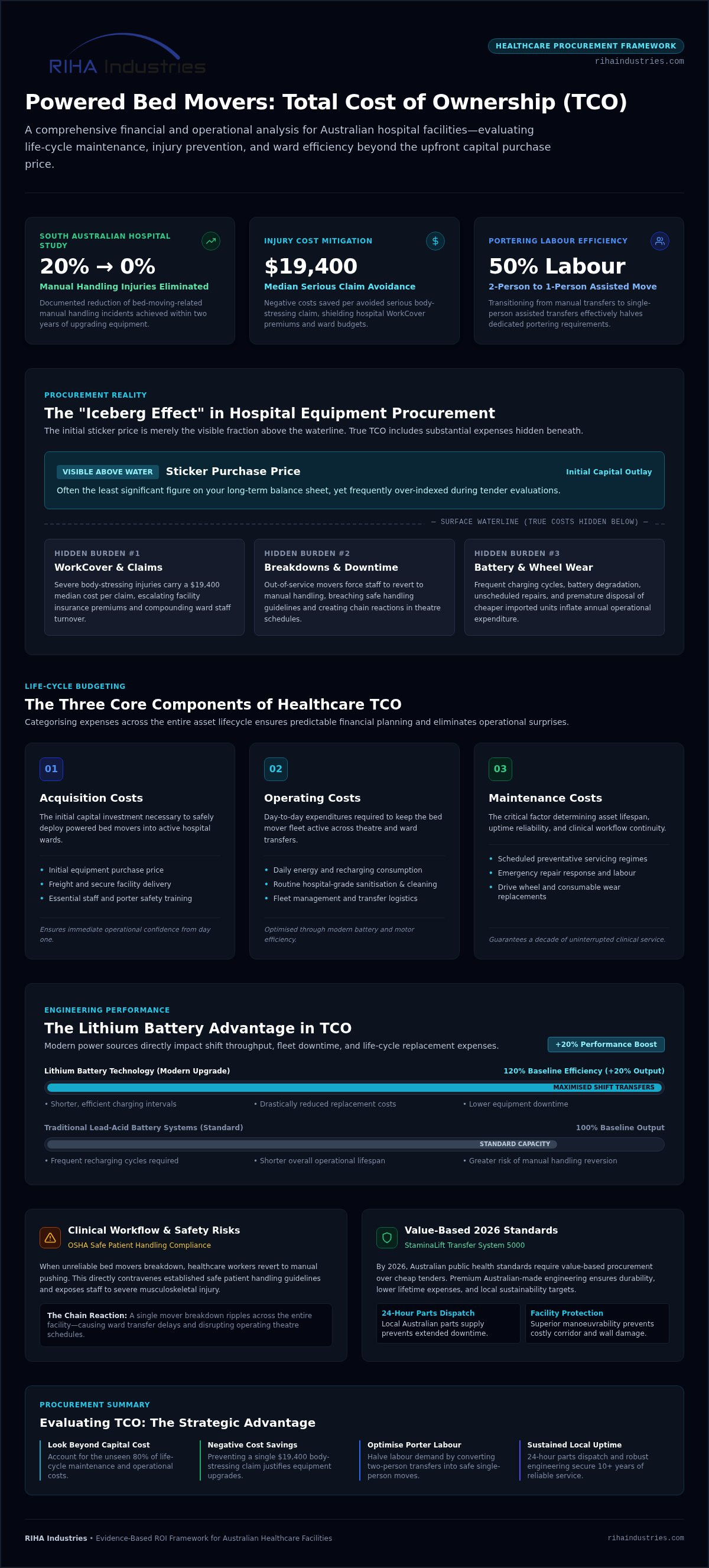
In the high-stakes environment of an Australian hospital, procurement isn't just about balancing the books; it's about protecting staff and ensuring seamless patient flow. While the upfront price of equipment often dominates the initial conversation, savvy facility managers look much deeper. The Total Cost of Ownership (TCO) is a comprehensive methodology that accounts for every dollar spent over the entire lifecycle of an asset. We often refer to this as the "Iceberg Effect" in hospital equipment procurement. The sticker price is merely the small portion visible above the water line. The true bed mover total cost of ownership includes the massive, unseen expenses lurking beneath, such as unscheduled maintenance, battery replacements, and the devastatingly high costs of workplace injuries. RIHA Industries has developed a dedicated ROI framework to help Australian facilities navigate these complexities, ensuring that every investment delivers measurable, long-term value rather than just a short-term budget fix.
The Core Components of Healthcare TCO
Effective budgeting requires breaking down expenses into three distinct categories to avoid nasty surprises later. First, acquisition costs cover the initial purchase, delivery, and the essential staff training required to ensure your team feels confident and safe from day one. Second, operating costs include energy consumption, regular cleaning, and daily fleet management. Finally, maintenance costs are the most critical factor for long-term reliability. This includes scheduled preventative servicing, emergency repairs, and the replacement of wear-and-tear parts like drive wheels. By analysing these factors together, you gain a transparent view of the equipment's impact on your annual operational budget, allowing for more predictable financial planning and fewer interruptions to clinical workflows.
Why 2026 Procurement Standards Demand TCO Analysis
By 2026, Australian public health standards have shifted decisively toward value-based procurement. It's no longer enough to choose the cheapest option on a tender; equipment must prove its worth through durability and clinical outcomes. Using a rigorous TCO model helps department heads justify the selection of premium systems like the StaminaLift Transfer System 5000. While these units represent a serious investment, they offer significantly lower lifetime expenses through superior engineering and local support. This approach also aligns with modern sustainability targets. Choosing high-quality, Australian-made machinery reduces the need for frequent replacements and avoids the waste associated with cheap imports that fail prematurely. Understanding your bed mover total cost of ownership ensures you aren't just buying a tool, but securing a decade of reliable, safe service for your facility.
Direct Capital and Operational Expenditure: Batteries, Servicing, and Parts
Managing the bed mover total cost of ownership requires a granular look at the components that keep your fleet moving. While a lower-priced unit might use traditional lead-acid batteries, the long-term financial impact of frequent charging cycles and shorter lifespans often outweighs the initial saving. Equipment downtime isn't just a logistical headache; it's a safety risk. When a mover is out of service, staff revert to manual handling, which directly contradicts OSHA safe patient handling guidelines and increases the likelihood of costly musculoskeletal injuries. A single breakdown can trigger a chain reaction of delays, impacting theatre schedules and ward transfers across the entire facility.
The Lithium Advantage in TCO
Choosing the right power source is a primary factor in reducing your bed mover total cost of ownership. Modern lithium battery upgrades provide a 20% performance boost, allowing porters to complete more transfers per shift with shorter, more efficient charging intervals. While lead-acid batteries typically require replacement every two years in a high-use hospital environment, high-quality lithium cells often last five years or more. This longevity reduces both the direct cost of new batteries and the labour hours spent on technical swaps. Additionally, integrated smart chargers with retractable cables help prevent "trip and break" incidents, protecting both the equipment and the staff from accidental damage during the charging process.
Maintenance and Global Support Logistics
A reactive approach to repairs is almost always more expensive than a structured preventative plan. Waiting weeks for an imported part to arrive can leave a critical asset idle, forcing your team to work harder and increasing the risk of injury. Because RIHA Industries manufactures equipment locally in Australia, we ensure 24-hour part shipping, which drastically reduces the "cost of waiting." Our in-house engineers also benefit from 3D-viewer tools that simplify basic servicing, keeping your fleet in peak condition without unnecessary complexity. Securing a formal hospital bed mover repair service contract ensures that minor wear doesn't escalate into a major mechanical failure. Prioritising optimised fleet management through regular check-ups is the most effective way to extend the lifespan of your investment and maintain a safe, efficient workplace for every porter and nurse.
The Hidden Financial Burden: Manual Handling Injuries and WorkCover Premiums
Every serious manual handling claim represents a failure in both safety and financial management. In Australia, the median direct compensation paid for a serious body-stressing claim is $19,400, involving an average of 9.2 weeks of lost productivity. When evaluating your bed mover total cost of ownership, these avoided expenses act as a "negative cost" that significantly improves your ROI. High injury rates don't just hurt people; they trigger experience-rated premium surcharges from WorkCover, locking your facility into higher insurance costs for years. Investing in preventative technology is often the most direct route to stabilising these volatile overheads.
Quantifying the Risk of Manual Handling
The physical reality for frontline staff is daunting. Porters often cover up to 75km every week, frequently pushing acute care beds that can weigh up to 500kg under full load. These tasks often fall outside the safety parameters defined in the Safe Work Australia Hazardous Manual Tasks Code of Practice. To manage these risks, hospitals are increasingly turning to specialised equipment like the StaminaLift Transfer System 6000. By providing 900kg of push/pull capacity, this system handles the most demanding bariatric transfers, removing the physical liability from the operator and ensuring compliance with national safety standards.
Staff Wellbeing and Long-Term Retention
Retaining experienced staff is far more cost-effective than constant recruitment cycles. Physical burnout often forces seasoned professionals into early retirement, leaving wards understaffed and reliant on expensive agency backfills. Providing motorised support changes this dynamic, allowing staff of all ages and physical builds to work without fear of chronic pain. The proof is in the results: a major South Australian hospital saw manual handling injuries plummet from 20% to zero in just two years after deploying StaminaLift technology. This total elimination of injury risk is the most powerful lever available to reduce your bed mover total cost of ownership while fostering a culture of safety and empowerment.
Operational ROI: Optimising Portering Labour and Ward Throughput
Operational efficiency is a cornerstone of a healthy bed mover total cost of ownership. In many facilities, the "Two-Person Rule" is a standard safety requirement for manual bed transfers to manage momentum and navigate tight corners. This requirement effectively doubles the labour cost for every patient move. By implementing motorised solutions, you enable a single porter to safely manage even the heaviest acute care beds. This transition halves the labour hours required for transport, allowing you to redirect skilled staff to higher-value clinical tasks or urgent theatre support. When you consider that the true employer cost for a porter in 2026 can exceed $46.00 per hour, the financial impact of this shift is immediate and substantial.
Labour Efficiency and Resource Allocation
Selecting the right hospital porter equipment is about more than just moving a bed; it's about optimising the entire facility workflow. Using an ROI calculator that factors in your daily transfer volume and staff hourly rates reveals significant hidden savings. For instance, the hands-free connection systems found on StaminaLift units save approximately 2 to 3 minutes per transfer. Over a busy shift, this time adds up. It reduces patient wait times and improves theatre-to-ward throughput. Faster transfers mean beds are cleared sooner, directly addressing the bottlenecks that often plague emergency departments and surgical suites.
Facility Maintenance and Spatial Efficiency
The cost of facility repair is a frequently overlooked component of the bed mover total cost of ownership. Manual handling often leads to scuffed walls, gouged plaster, and broken door frames as staff struggle to control heavy loads in narrow corridors. Equipment with a 360-degree turning radius prevents this damage by providing precise, controlled movement in confined spaces. Our compact designs also reduce tripping hazards and take up minimal floor space in busy ward alcoves. For facilities requiring long-distance porting across large campuses, the Easi Rider provides an ergonomic advantage that maintains speed without sacrificing safety. To see how these efficiencies can transform your facility, you can explore our range of motorised solutions today.
Engineering Sustainability: Why Australian-Made StaminaLift Systems Offer Superior Value
Choosing Australian-made equipment is a strategic decision that pays dividends long after the initial procurement phase. At RIHA Industries, our "Built to Last" philosophy prioritises heavy-gauge steel construction over the plastic-heavy components often found in imported units. This industrial-grade durability is essential for machinery that must navigate the high-traffic, 24/7 environment of a modern hospital. When you calculate the bed mover total cost of ownership, the longevity of the chassis and the drive system becomes a critical factor. A machine that remains in service for over a decade provides a far better return than a cheaper alternative that requires replacement every few years.
Direct engagement with a local manufacturer also eliminates the risks associated with global supply chain volatility. Because we manufacture the StaminaLift range in South Australia, we offer a level of technical support that distributors simply can't match. This includes being the only hospital bed mover brand to hold FDA registration, a rigorous standard that confirms our engineering meets the world's most demanding safety and quality requirements. Investing in such highly regulated equipment ensures your facility is protected by world-class standards, providing a stable, long-term foundation for your equipment strategy.
Extending Equipment Lifecycles
Sustainability in healthcare isn't just about reducing carbon; it's about reducing financial waste. We help facilities avoid the "decommissioning trap" by using CAD and industrial 3D printing to create replacement parts for older or even discontinued equipment. This approach allows in-house engineers to keep aging fleets operational rather than forcing a premature, capital-heavy replacement. Additionally, we can often modernise existing units with Bluetooth diagnostics and updated software, ensuring your older assets benefit from the latest operational efficiencies. This commitment to engineering sustainability significantly lowers the bed mover total cost of ownership by extending the useful life of every unit in your fleet.
The RIHA Industries Support Guarantee
Reliability is built on the strength of the support behind the machine. We provide a 24-hour response guarantee for all technical enquiries and maintain a national service network to ensure your equipment stays on the floor where it's needed most. This comprehensive coverage prevents the "cost of waiting" that often plagues imported brands. In summary, your patient handling equipment selection criteria must move beyond the sticker price to prioritise long-term value. By focusing on Australian-made quality and local repairability, you secure a safer, more efficient, and more sustainable future for your facility and your staff.
Securing the Future of Your Facility's Mobility Fleet
Shifting your focus from initial capital expenditure to a comprehensive bed mover total cost of ownership is the most effective way to protect your hospital's budget and its people. By accounting for the massive savings generated through halving labour requirements and eliminating manual handling injuries, you transform a simple equipment purchase into a strategic asset. Every avoided WorkCover claim and every minute saved during a patient transfer contributes to a more resilient healthcare system. It's about looking past the sticker price to see the decade of safety and efficiency that follows.
As an FDA-registered manufacturer, RIHA Industries provides the precision and reliability needed to reduce workplace injuries from 20% to zero, as proven in South Australian clinical settings. Our Australian-made systems are engineered for durability, ensuring your investment remains operational for years with 24-hour part support. Choosing high-quality engineering means you won't be trapped by the obsolescence or long wait times often associated with imported alternatives. We're dedicated to providing the tools that keep your porters and nurses safe every day.
Ready to see the data for yourself? Request a Hands-On Demonstration and TCO Analysis to discover how our motorised solutions can stabilise your overheads and empower your staff. We're here to help you build a safer, more efficient healthcare environment that's ready for the challenges of tomorrow.
Frequently Asked Questions
What is the typical lifespan of a StaminaLift bed mover?
A StaminaLift bed mover is engineered for a service life exceeding ten years in high-volume hospital environments. This durability is achieved through our "Built to Last" philosophy, using heavy-gauge steel rather than the plastic-heavy materials common in imported units. Maintaining your equipment through our preventative service contracts ensures the machine remains a reliable asset for a decade or more. This longevity is a primary driver in reducing your bed mover total cost of ownership over the asset's lifecycle.
How much can a hospital save on WorkCover premiums by using bed movers?
Implementing motorised movers can reduce manual handling injuries from 20% to zero, as documented in South Australian hospitals. By preventing even a single serious body-stressing claim, which has a median direct cost of $19,400, your facility avoids significant financial liabilities. These safety improvements directly influence your experience-rated WorkCover premiums, preventing the costly surcharges that follow high injury rates. Eliminating these hidden expenses is essential for stabilising your long-term operational budget and protecting your staff.
Is a Lithium battery upgrade worth the extra cost for TCO?
Upgrading to lithium batteries is a highly effective way to optimise your bed mover total cost of ownership. These batteries provide a 20% performance boost and have significantly shorter charging cycles compared to traditional lead-acid options. While the initial investment is higher, the five-year replacement frequency of lithium cells far outlasts the typical two-year cycle of lead-acid. This reduces both the direct cost of new batteries and the labour hours required for technical swaps and maintenance.
How do Australian-made bed movers compare to imported models in terms of long-term cost?
Australian-made bed movers offer superior long-term value because they eliminate the "cost of waiting" associated with imported models. RIHA Industries provides 24-hour shipping for replacement parts, ensuring your fleet stays operational rather than sitting idle for weeks. Imported units often face premature decommissioning when parts become unavailable or support networks fail. Engaging directly with a local manufacturer ensures you have a stable partner for repairs and modernisations, which lowers the lifetime cost of the equipment.
Can one person really move a bariatric bed safely with a motorised mover?
The StaminaLift TS6000 is specifically designed to allow one person to move bariatric beds weighing nearly one ton. This system can transport heavy loads up a seven-degree incline under full load, removing the physical burden from the porter. By transitioning from a "two-person rule" to single-person operation, you effectively halve the labour hours required for every bariatric transfer. This efficiency allows your team to manage rising patient volumes without increasing the risk of musculoskeletal injuries.
What maintenance is required to keep the total cost of ownership low?
Maintaining a low TCO requires a shift from reactive repairs to a structured preventative maintenance schedule. Regular checks of drive wheels, battery health, and connection mechanisms prevent minor wear from escalating into major mechanical failures. Utilising our Bluetooth diagnostic tools allows facility managers to monitor usage history and identify training needs before accidents occur. Consistent servicing through a dedicated contract ensures your equipment remains safe and efficient, extending the productive life of every unit in your fleet.
How does 3D printing help reduce the cost of maintaining older bed movers?
We utilise industrial 3D printers to manufacture high-precision parts for older or discontinued equipment, preventing the need for premature decommissioning. By using ABS-carbon fibre materials, we can recreate durable components that keep aging fleets in service. This "Engineering Sustainability" approach saves hospitals from the capital-heavy trap of replacing entire equipment sets when a single part fails. It's a cost-effective way to modernise your existing assets and reduce the environmental impact of equipment waste.
Does RIHA Industries provide an ROI calculator for procurement teams?
RIHA Industries provides a comprehensive ROI calculator designed to help procurement teams justify equipment upgrades to their boards. This tool factors in specific data points, such as the number of beds moved per day and your staff's hourly rates, to demonstrate clear labour savings. By quantifying the transition from two-person manual moves to single-person assisted transfers, the calculator provides the evidence needed for a compelling business case. It's an essential resource for facilities facing tight budget constraints.


