
Compact Bed Mover for Narrow Hallways: Navigating Tight Hospital Corridors Safely
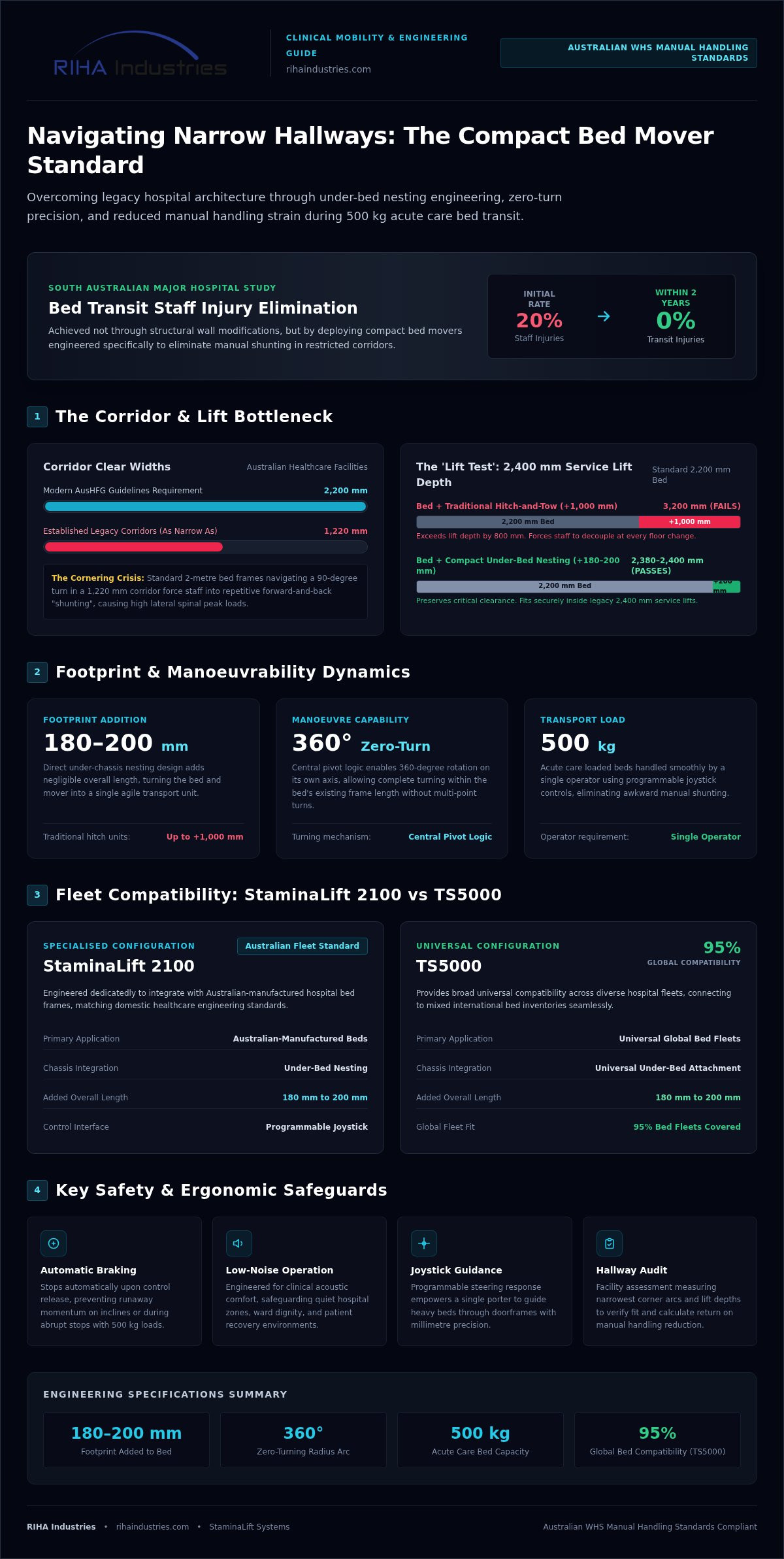
Did you know that at one major South Australian hospital, staff injuries related to bed transit dropped from 20 per cent to zero within just two years? This remarkable shift wasn't achieved by widening structural walls, but by introducing a compact bed mover for narrow hallways to handle the heavy lifting. You're likely all too familiar with the daily strain of 'shunting' 500 kg acute care beds through corridors that feel tighter by the day, often resulting in musculoskeletal injuries and scuffed doorframes. It's a high-stakes environment where every millimetre matters. Traditional equipment often fails to fit the reality of legacy healthcare architecture, leaving nursing staff to bear the physical burden alone.
We recognise that protecting your team while maintaining seamless patient flow is a complex challenge, and the right technology empowers your staff to focus on care rather than physical exertion. This guide will show you how to select and implement advanced transport systems that ensure your facility remains compliant with Australian WHS manual handling standards. We'll explore the engineering behind zero-turning radius technology and explain how under-bed nesting designs allow a single operator to navigate restrictive lifts and sharp intersections with total confidence and ease.
Table of Contents
The Spatial Challenge: Why Narrow Hallways Demand Specialist Equipment
Australian healthcare facilities often operate within a delicate balance between heritage architecture and the demands of modern clinical volumes. While newer wings might comply with the latest Australasian Health Facility Guidelines (AusHFG) requiring 2,200 mm clear widths, many established hospitals still navigate corridors as narrow as 1,220 mm. This spatial constraint creates a "Cornering Crisis" during patient transport. Standard hospital bed dimensions and maneuverability dictate that a 2-metre frame requires a significant arc to clear a 90-degree turn. Implementing a compact bed mover for narrow hallways is no longer a luxury; it's a necessity for operational safety in these restricted zones. When space is limited, porters are forced into awkward "shunting" manoeuvres, repeatedly nudging the bed forward and back to clear the corner. This isn't just inefficient; it's a primary cause of staff burnout and delayed emergency response times.
The Hidden Risks of Manual Handling in Tight Spaces
The physics of manual transport in restricted zones are unforgiving. When a porter attempts to "swing" a 500 kg loaded bed laterally to avoid a wall, they experience high peak spinal loads. Unlike a straight push, these lateral movements require twisting and sudden bursts of force to overcome inertia. Over time, this leads to the alarming rates of overexertion injuries seen across the industry. Beyond staff safety, manual errors frequently result in "wall-strikes." These collisions damage expensive facility infrastructure and disturb patient dignity during what is already a stressful time. Adhering to established patient handling equipment selection criteria is vital to move away from these high-risk manual methods.
When Standard Bed Movers Fail the 'Lift Test'
Many motorised tugs on the market fail to solve the spatial puzzle because they rely on "hitch-and-tow" designs. These units can add up to 1,000 mm to the total length of the transport train. In a legacy hospital where service lifts may only measure 2,400 mm in depth, a 2,200 mm bed coupled with a bulky mover simply won't fit. This forces staff to decouple the mover at every floor change, defeating the primary purpose of motorised assistance. A true compact bed mover for narrow hallways must utilise an under-bed nesting design. By connecting directly beneath the chassis, these systems add only 180 mm to 200 mm to the overall footprint. This compact standard ensures that the bed and mover function as a single, agile unit that fits into standard lifts and manoeuvres through the tightest architectural bottlenecks without compromise.
What Makes a Bed Mover Truly 'Compact'?
In the clinical environment, "compact" isn't merely a descriptor of size; it's a measure of operational efficiency. A true compact bed mover for narrow hallways is a motorised unit specifically engineered to augment a bed's mobility without compromising its original footprint. Traditional tugs often turn a standard bed into a cumbersome vehicle, but a compact solution integrates directly with the existing frame. This integration is vital for adhering to OSHA safe patient handling guidelines, as it reduces the high initial push and pull forces that lead to chronic back injuries. By prioritising a sleek, under-bed profile, these movers also eliminate tripping hazards for staff working in the crowded, high-pressure environment of a ward.
The 360-Degree Turning Radius Explained
Navigating a 90-degree intersection in a 1,200 mm corridor is impossible with a standard towing arc. Compact movers solve this through central pivot logic, allowing the entire unit to rotate on its own axis. This 360-degree manoeuvrability enables porters to guide heavy beds with millimetre-perfect precision, avoiding the need for dangerous three-point turns that block hallway traffic. Zero-turn capability is defined as the ability to rotate a bed entirely within its own length. Using programmable joystick controls, a single operator can glide through doorframes that would otherwise require multiple staff members to "shunt" and steer manually.
Minimal Added Length: The 200mm Benchmark
The most critical dimension for vertical transit is total length. Many legacy Australian hospital lifts are just deep enough to accommodate a modern acute care bed. If a motorised mover adds more than 200 mm to that length, the bed becomes "un-liftable" without decoupling the equipment. RIHA Industries addresses this through a patented jaw mechanism that secures the bed from underneath rather than from the front. This connection adds only 180 mm to 200 mm to the total footprint, ensuring the bed fits comfortably into standard lifts. This streamlined design also allows the mover to navigate around bedside medical equipment and oxygen cylinders without snagging. If you're looking to upgrade your facility's fleet, exploring specialised bed moving solutions can help you find the right fit for your specific architectural constraints.
Comparing RIHA’s Compact Solutions: StaminaLift 2100 vs TS5000
Selecting the right compact bed mover for narrow hallways depends on your facility's specific bed fleet and the architectural bottlenecks your team faces daily. Both the StaminaLift 2100 and the TS5000 are engineered to solve the "extra length" problem that often makes traditional tugs unusable in legacy buildings. By adhering to a strict connection footprint that adds only 180 mm to 200 mm to the total bed length, these systems ensure that your transport train remains agile and lift-compliant. This engineering focus aligns perfectly with the NIOSH safe patient handling and mobility framework, which advocates for mechanical aids that eliminate high-risk push and pull forces. By implementing these tools, hospitals can successfully move toward single-person operation, which is a vital strategy to reduce nurse back injuries and porter overexertion.
The StaminaLift 2100: Built for Australian Standards
The StaminaLift 2100 remains a favourite for metropolitan hospitals across Australia because it's specifically optimised for the geometry of Australian-manufactured beds. It's the ideal compact bed mover for narrow hallways when working with established ward layouts where every centimetre of clearance counts. The 2100 features a hands-free connection mechanism, recently updated with Bluetooth connectivity, allowing operators to secure the bed without manual strapping or awkward stooping. With its 360-degree turning radius, it can rotate a standard acute care bed within its own length, allowing for seamless navigation through 2,100 mm corridors without the risk of striking walls or doorframes.
The TS5000: Universal Compact Power
While the 2100 is tailored for local frames, the StaminaLift TS5000 provides universal compatibility for 95 per cent of global bed types. It's designed to accommodate modern acute care beds featuring complex moulded plastic bumpers, low-clearance bases, and integrated fifth-wheel steer assemblies. The "Connect and Lock" jaw system ensures that the TS5000 maintains a tight turning circle, regardless of the bed's specific chassis design. It offers a 300 kg lift capacity and can handle inclines of up to 7 degrees under full load, making it a powerhouse for facilities with multi-level transitions. For a deeper look at the technical specifications and compatibility options, you can consult the StaminaLift Transfer System 5000 buying guide.
Key Features for Navigating Restricted Healthcare Spaces
In the high-pressure environment of a narrow hospital corridor, precision and control are paramount. A premium compact bed mover for narrow hallways must include automatic braking systems that engage the moment the operator releases the joystick. This ensures that in a sudden hallway blockage, a 500 kg bed stops instantly, preventing collisions with staff or patients. These units operate at a discreet 65 dB, which is roughly the volume of a normal conversation. This low noise profile is essential in echoing, heritage corridors to maintain a calm atmosphere for resting patients and minimise clinical noise pollution. Additionally, programmable joystick controls allow facility managers to customise speed settings for specific high-traffic zones, while non-marking drive wheels protect hospital flooring from the scuffs and wear often caused by high-turnover manual steering and heavy weight distribution.
Safety Mechanisms for Tight Turns
When working in confined spaces, equipment must be as safe as it is agile. The Easi Mover includes a critical 'Back Off Button' safety feature, which automatically reverses the unit if it makes contact with the operator. This provides essential protection in dead-end hallways or tight service lifts where a porter could otherwise be pinned. For added security, key-only operation prevents unauthorised use in public-facing corridors, ensuring that only trained staff handle the motorised equipment. In the rare event of a power loss or system error, emergency jaw and brake releases allow staff to manually move the bed, ensuring patient transit is never compromised during a technical fault.
Visibility and Ergonomics
Operating a compact mover provides a clear, unobstructed line of sight, which is a significant advantage over manual pushing where the bed frame often blocks the porter's view. This visibility is crucial for avoiding collisions with pedestrians, visitors, or medical equipment in restricted spines. Beyond immediate safety, these systems address the immense physical burden placed on patient transport teams. Porters in large facilities often walk up to 15 km per day, totalling 75 km per week, which contributes significantly to fatigue and long-term musculoskeletal injury. To mitigate this, a ride-on platform accessory can be integrated, allowing staff to travel long distances through narrow corridors without the physical strain of constant walking.
If you're ready to improve your facility's safety standards and operational efficiency, discuss our range of specialised transport solutions with the RIHA Industries team today.
Implementing Compact Mobility: A Guide for Facility Managers
Successful integration of motorised equipment begins with a thorough "Hallway Audit". Before selecting a compact bed mover for narrow hallways, facility managers should map the tightest architectural bottlenecks, including legacy lift depths and the radius of 90-degree corridor intersections. This data-driven approach ensures that the chosen equipment doesn't just look compact on a spec sheet, but actually performs within your facility's specific constraints. Once the physical fit is confirmed, the focus shifts to staff training. Ensuring porters and nursing staff are certified in precision manoeuvring is essential for maintaining safety standards. While the technology is intuitive, formalised training programmes help operators master millimetre-perfect navigation near delicate medical equipment and high-traffic ward entrances.
Calculating Your Facility’s ROI
Justifying the procurement of motorised movers requires a clear look at both human and financial outcomes. Beyond the immediate boost in staff morale, the return on investment is found in the drastic reduction of WorkCover claims and lost labour hours. A single chronic back injury can cost a facility significantly more than the initial investment in a motorised fleet. By using the RIHA ROI calculator, managers can quantify these savings alongside the efficiency gains of single-person transport. For detailed budget planning and a breakdown of lifecycle costs, refer to our 2026 hospital bed mover procurement guide, which outlines how to align equipment needs with long-term facility goals.
Maintaining Peak Performance
Reliability is the backbone of 24/7 ward support. To ensure your fleet remains operational during peak transit periods, establishing a schedule for hospital bed mover repair services is a vital preventative measure. Modern systems like the StaminaLift series now feature Bluetooth diagnostics, allowing engineering teams to monitor drive cycles and battery health via a smartphone or tablet. This technology doesn't just identify mechanical issues before they cause downtime; it also helps identify wards where high utilisation might indicate a need for additional staff training or equipment allocation. Because these units are Australian-made, you benefit from 24-hour parts shipping, ensuring that your compact bed mover for narrow hallways stays on the floor where it's needed most. If you're ready to see how these systems handle your facility's tightest corners, contact RIHA Industries for a hands-on demonstration today.
Elevating Safety Standards in Restricted Ward Environments
Navigating legacy healthcare architecture shouldn't come at the cost of your team's physical well-being. By implementing a compact bed mover for narrow hallways, you bridge the gap between restricted architectural footprints and modern patient handling requirements. These Australian-made and FDA-registered systems empower your staff to move heavy acute care beds with millimetre precision, even in the tightest intersections. We've helped major metropolitan and rural Australian hospitals transition from risky manual shunting to controlled, motorised transport. The results are tangible; these engineering solutions have successfully reduced bed-moving injuries to zero in facilities that once struggled with high overexertion rates.
Choosing a partner like RIHA Industries means investing in long-term reliability and a safer workplace culture. You can protect your nursing staff and porters while ensuring patient transit remains dignified and efficient. If you're ready to see how our technology fits your specific corridor dimensions, Book a Hands-On Demonstration for Your Facility. We're here to help you create a safer environment where your team can focus on what matters most: providing exceptional patient care.
Frequently Asked Questions
How much length does a bed mover add to a standard hospital bed?
A compact bed mover for narrow hallways is designed specifically to minimise the footprint of the transport unit. RIHA Industries' StaminaLift systems connect directly beneath the bed frame, adding only 180 mm to 200 mm to the total length. This is significantly less than traditional hitch-and-tow tugs, which can add up to a metre. By keeping the added length minimal, staff can navigate tight corners and fit into standard hospital lifts without decoupling the equipment.
Can a compact bed mover fit inside a standard Australian hospital lift?
Yes, our compact systems are specifically engineered to preserve lift clearance in legacy Australian healthcare facilities. Because the StaminaLift units add no more than 200 mm to the bed's overall length, the entire transport train typically fits within standard lift dimensions. This eliminates the need for porters to manually push beds into lifts or decouple motorised movers during floor changes, significantly speeding up patient transfers and reducing the risk of manual handling injuries.
Is a 360-degree turning radius really necessary for narrow hallways?
A 360-degree turning radius is essential for navigating the 90-degree intersections and dead-end corridors found in older hospital wings. This technology allows a standard acute care bed to rotate on its own axis, effectively turning on the spot. Without this capability, staff are often forced into dangerous three-point turns or manual shunting. A compact bed mover for narrow hallways with zero-turn logic ensures millimetre-perfect precision, protecting both facility walls and staff well-being.
Do compact bed movers work on ramps and inclines?
Our motorised movers are fully rated for use on slopes and ramps commonly found in multi-level healthcare facilities. The StaminaLift TS5000 and TS6000 models can safely manage a maximum 7-degree incline while under a full load. The integrated automatic braking system ensures the bed remains secure on the gradient the moment the joystick is released. This provides porters with total control and peace of mind when transitioning between different ward levels or building wings.
Can one person safely operate a bed mover in a crowded corridor?
Single-person operation is a core design feature of our transport systems, allowing one staff member to move a 500 kg bed with total confidence. The combination of programmable joystick controls and a clear line of sight ensures the operator can navigate high-traffic areas safely. By reducing the staff required for a single transfer from two people to one, hospitals can better manage nursing shortages while simultaneously reducing the prevalence of musculoskeletal overexertion injuries.
Are StaminaLift bed movers compatible with older Australian-made beds?
The StaminaLift 2100 model was specifically engineered to accommodate the geometry of Australian-manufactured beds found in many metropolitan and rural facilities. For more modern or global bed designs, the TS5000 offers 95 per cent compatibility with frames featuring plastic bumpers and low-clearance bases. Our patented jaw mechanisms ensure a secure, hands-free connection across nearly any bed brand, making it easy to standardise your motorised fleet regardless of the age of your current beds.
What happens if the battery runs flat in a narrow hallway?
If a battery runs flat during transit, our equipment features integrated safety overrides to prevent hallway blockages. Every unit includes an emergency jaw and brake release mechanism, allowing staff to manually move the bed to a safe location or charging point. Additionally, our modernised units feature Bluetooth connectivity and retractable charging cables, making it easier for engineering teams to monitor battery health and ensure the fleet is fully charged for every shift.
How do I know if my hallways are too narrow for a motorised mover?
Most healthcare corridors, even legacy ones as narrow as 1,220 mm, can accommodate our systems due to their under-bed nesting design. We recommend conducting a hallway audit to measure your tightest turns and lift depths. If a standard acute care bed can physically fit through the space, a StaminaLift unit will likely work, as it adds minimal width and length. RIHA Industries provides hands-on demonstrations to verify performance in your facility's most challenging architectural bottlenecks.


