
Creating a Business Case for Hospital CapEx: 2026 Guide
Did you know that nearly one in five serious workers' compensation claims in Australia originates from the healthcare sector, with manual tasks like pushing heavy beds being a primary culprit? When you're creating a business case for hospital capital expenditure, these figures represent more than just data points on a spreadsheet; they reflect a significant drain on your facility's operational capacity and the well-being of your frontline team.
It's true that securing approval for new equipment feels like an uphill battle in a climate of rising costs and strict budget oversight. You want to protect your staff from injury and keep your wards running smoothly, but quantifying the value of safety to a board focused on the bottom line is notoriously difficult. This 2026 guide promises to bridge that gap. You'll learn how to build a robust, data-driven proposal that transforms "soft" benefits into clear ROI. We'll explore the Five Case Model used by state treasuries and show you how to prove that investing in powered bed movers, such as the StaminaLift series, pays for itself through reduced labour costs and eliminated injury claims.
Table of Contents
Navigating the 2026 Hospital Capital Expenditure Landscape in Australia
Identifying the Direct and Indirect Costs of Manual Patient Handling
Calculating the Return on Investment (ROI) for Powered Bed Movers
Structuring Your Proposal to Align with Executive Strategic Goals
Positioning RIHA Industries’ StaminaLift as the Logical Conclusion
Navigating the 2026 Hospital Capital Expenditure Landscape in Australia
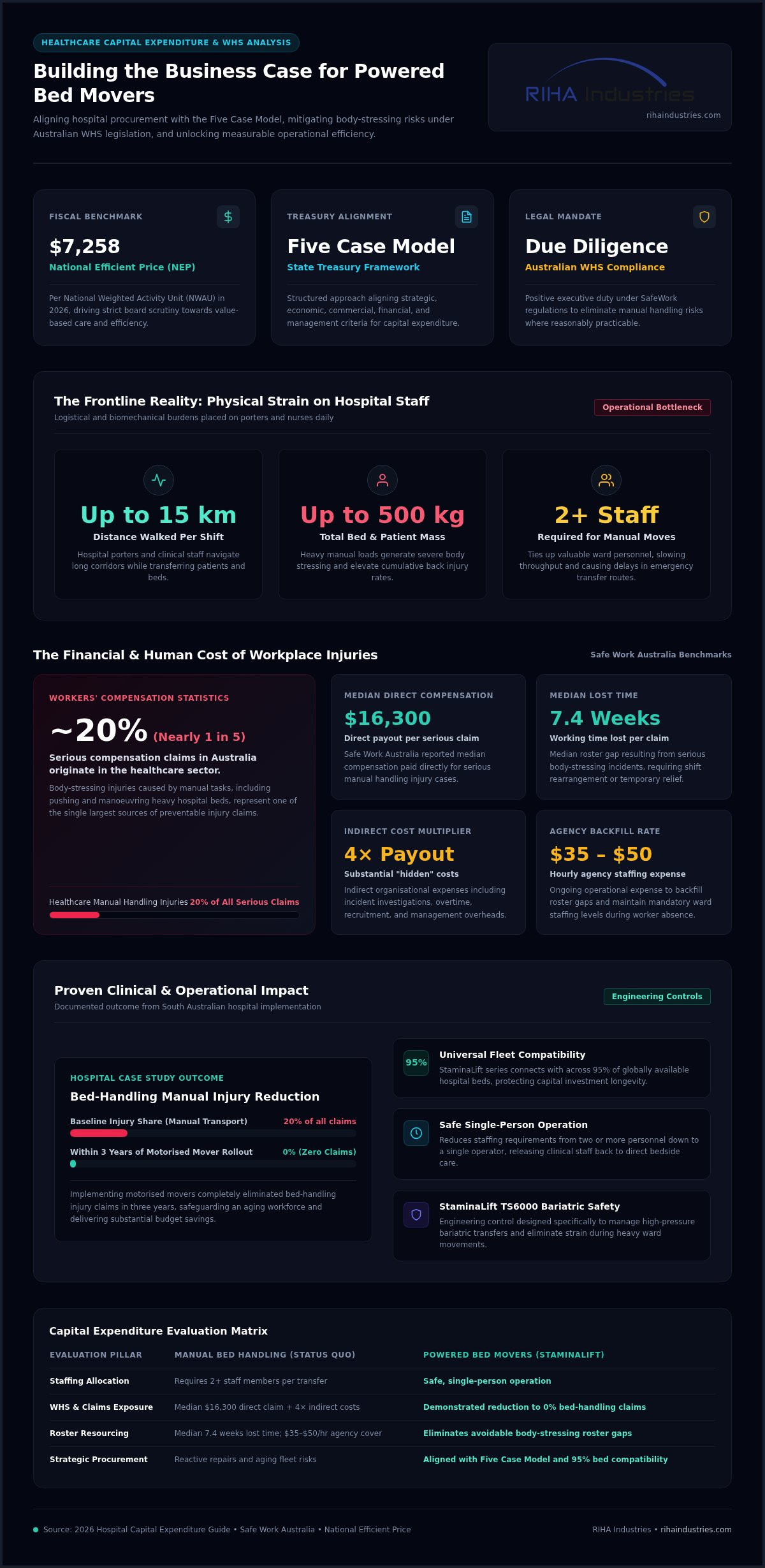
The 2026 fiscal environment for Australian healthcare is defined by a rigorous focus on efficiency. With the National Efficient Price (NEP) rising to $7,258 per National Weighted Activity Unit, hospital boards are scrutinising every dollar. This means that simply asking for new tools is no longer enough. Creating a business case for hospital capital expenditure requires a shift in perspective; you must move from discussing equipment costs to demonstrating long-term value. Boards now prioritise evidence-based procurement that supports value-based care. The goal is to improve patient outcomes while reducing the total cost of service delivery through smart technology integration.
The Strategic Importance of Modern Equipment
Aligning your equipment needs with the hospital’s five-year strategic plan is essential for approval. When facilities "make do" with aging fleets, they inadvertently increase operational risk. Manual patient transport is a prime example of this hidden burden. Hospital porters and nurses often walk up to 15km per shift, pushing beds that can weigh up to 500kg. Older, non-motorised beds often require two or more staff members to move, which slows down patient throughput and creates bottlenecks in the emergency department. Modernising with technology, such as the StaminaLift series, allows for safe, single-person operation. This efficiency directly supports clinical goals by freeing up staff for bedside care and ensuring patients move through the system without delay.
Regulatory Compliance as a Funding Catalyst
Work Health and Safety (WHS) legislation is perhaps the most powerful driver for capital expenditure in 2026. Under Australian law, executives have a positive due diligence duty to eliminate manual handling risks where reasonably practicable. SafeWork SA and other regional regulators are increasingly focused on preventable body-stressing injuries. These account for nearly 20% of all serious claims in Australia. The financial implications of an audit or a serious injury are immense. Beyond the median compensation claim of $16,300, the indirect costs of roster disruptions and recruitment can be four times higher. When creating a business case for hospital capital expenditure, referencing these regulatory obligations turns a "wish list" item into a mandatory safety requirement. Engineering controls like the StaminaLift TS6000 don't just move beds; they protect the hospital from expensive litigation and ensure compliance with national safety standards.
Identifying the Direct and Indirect Costs of Manual Patient Handling
Hospital porters and nurses often navigate a grueling physical environment, walking an average of 15km per shift while manoeuvring beds that frequently exceed 500kg. This constant strain is not just a logistical hurdle; it is a primary driver of burnout and physical injury. When you are creating a business case for hospital capital expenditure, it is vital to move beyond the sticker price of equipment and analyse the cumulative financial burden of manual handling. Every back injury represents a disruption to the care team and a significant, preventable cost to the facility.
The Financial Reality of Workplace Injuries
The direct costs of a serious injury claim are only the tip of the iceberg. Safe Work Australia reports that the median compensation paid for a serious claim is $16,300, with a median of 7.4 working weeks lost. However, the Safe Work Australia guidance on manual tasks highlights that the total impact on an organisation often includes indirect costs that are four times higher than the direct payout. These hidden expenses include the administrative burden of investigations and the high cost of hiring agency staff to fill roster gaps, which often costs between $35 and $50 per hour. One large South Australian hospital successfully reduced bed-handling injuries from 20% of all manual handling claims to zero within three years by implementing motorised movers. This shift not only saves money but also preserves the health of an aging workforce.
Operational Friction and Throughput Delays
Manual patient transport creates significant operational friction, which we define as the cumulative delay and inefficiency caused by the physical and logistical limitations of manual equipment during patient transport. When a transfer requires two porters or a nurse and an orderly, it effectively doubles the labour cost per move. If a second staff member isn't immediately available, the transfer is delayed, leading to emergency department ramping and ward bed-block. These delays cascade into surgical departments, where late theatre starts can cost thousands of dollars in lost surgical time. When creating a business case for hospital capital expenditure, highlighting these throughput bottlenecks proves that motorised assistance is an operational necessity rather than a luxury. By switching to a single-operator system with equipment like the StaminaLift TS5000, hospitals can reclaim these lost hours and improve patient flow. You can use a dedicated ROI calculator to see how these operational gains translate into annual savings for your specific facility.
Calculating the Return on Investment (ROI) for Powered Bed Movers
When creating a business case for hospital capital expenditure, the most persuasive evidence you can present is a clear, data-backed payback period. Hospital administrators often view new equipment as a depreciating expense; however, powered movers function as a strategic investment that generates immediate operational returns. By utilising a dedicated ROI calculator, facilities can model the transition from manual to motorised transport, accounting for the reduction in staff downtime and the acceleration of patient throughput. Comparing the cost of a single StaminaLift unit against the financial fallout of one serious back injury claim makes the choice for investment clear.
Labour Efficiency and Staff Utilisation
Motorised systems like the StaminaLift TS5000 redefine staff utilisation by turning a traditionally two-person manual task into a safe, single-person operation. This change effectively halves the labour cost per transfer, allowing orderlies and porters to increase their daily volume of transfers without the compounding physical fatigue that leads to errors or injuries. Modern upgrades, such as lithium battery technology, offer 20% better performance over standard lead-acid alternatives, ensuring the fleet remains operational across back-to-back shifts. These gains in efficiency are supported by OSHA safe patient handling resources, which confirm that engineering controls are the most effective method for mitigating the high-cost musculoskeletal disorders that plague the healthcare workforce.
Long-term Asset Management
Sustainability and longevity are essential pillars of a modern business case in the Australian healthcare sector. Choosing Australian-made equipment provides distinct advantages, including 24-hour parts shipping and local technical support that minimises fleet downtime. RIHA Industries utilises innovative 3D printing for spare parts, a process that extends the functional life of equipment and avoids the need for premature decommissioning. This circular approach to maintenance ensures that your capital works harder for longer. To protect the integrity of these assets, a structured hospital equipment preventative maintenance programme is vital. It ensures that your movers remain reliable, high-performing tools that continue to deliver labour savings long after the initial payback period has concluded. By focusing on smart repairs and preventative care, you demonstrate to the board that you are prioritising both financial prudence and environmental responsibility.
Structuring Your Proposal to Align with Executive Strategic Goals
A successful pitch speaks the language of the board. When you are creating a business case for hospital capital expenditure, your proposal must mirror the executive's top priorities: clinical safety, operational efficiency, and financial prudence. Start with a concise executive summary that frames the acquisition not as a purchase, but as a risk-mitigation strategy. Use local hospital data to build a compelling problem statement, highlighting how current manual handling practices are directly linked to staff injury rates and ward bottlenecks. This approach ensures the board views the equipment as a solution to a documented problem rather than a discretionary expense.
Addressing the "Why Now?" Question
The timing of your request is critical. Australian healthcare is currently facing a significant workforce crisis, and staff retention has never been more vital. Investing in advanced engineering controls demonstrates a commitment to the well-being of nurses and porters, who are often the most at risk of career-ending musculoskeletal injuries. To help decision-makers visualise the impact, use 3D and AR visualisations to show how compact units like the StaminaLift 2100 Bed Mover navigate through narrow corridors and tight elevators without compromising safety. Our patented "connect and lock" mechanisms allow for effortless attachment to beds, which significantly reduces the need for staff to bend or overreach during the hitching process. When presenting the proposed solution, focus on functional precision. Features like 360-degree manoeuvrability are not just technical specs; they are essential for navigating the complex geometry of modern hospital wards, allowing a single operator to pivot heavy loads within their own length.
Mitigating Risks for the Board
Boards are naturally risk-averse, so your proposal must address reliability and compliance. Emphasise that the equipment is FDA-registered and Australian-made, ensuring it meets the highest international and local standards for medical devices. Mention the availability of comprehensive training and certification programmes, which guarantee that staff are competent and confident in using the technology. For a detailed breakdown of what to look for, refer to our 2026 hospital bed mover procurement guide. This level of thoroughness proves that every aspect of the product lifecycle has been considered, from initial procurement to long-term operational support.
Presenting the financial case clearly is the final step. Highlight the projected ROI and payback period, showing that the initial capital expenditure is offset by the reduction in workers' compensation premiums and agency backfill costs. You can contact RIHA Industries today to receive a tailored proposal template that aligns with your hospital's specific strategic goals.
Positioning RIHA Industries’ StaminaLift as the Logical Conclusion
Once you have established the financial and safety frameworks for creating a business case for hospital capital expenditure, selecting a partner that aligns with these rigorous standards is the final step. RIHA Industries provides this alignment through the StaminaLift range, a suite of solutions engineered to resolve the specific friction points of modern healthcare logistics. The StaminaLift Transfer System 5000 offers unmatched fleet compatibility, integrating seamlessly with 95% of hospital beds available globally. This universal utility ensures that a single capital investment can support an entire facility, regardless of the variety in bed brands or models.
For high-acuity environments and bariatric care, the StaminaLift Transfer System 6000 represents the pinnacle of power and control. It is capable of moving nearly one tonne up a 7-degree incline, allowing a single operator to manage the most physically demanding transfers with total confidence. Beyond standard patient beds, we provide extensive customisation options, including tailored hitches and theatre table clamps. This ensures that even specialised equipment in the operating suite can be moved without the risk of staff strain or equipment damage.
Innovation Born in South Australia
The history of StaminaLift is rooted in a mission to protect the well-being of healthcare professionals. Manufactured in Edinburgh North, South Australia, our equipment is a product of local engineering excellence designed for a global market. Because we manage the manufacturing process locally, we engage directly with hospital service agents to ensure our designs reflect real-world clinical needs. This dedication to reliability is enhanced by modern digital tools, including Bluetooth diagnostics and battery monitoring apps. These features allow facility managers to track fleet health in real-time, ensuring that every unit is charged and ready for the next shift. Choosing an Australian-made solution also provides the reassurance of national service coverage and rapid parts availability, which are essential for maintaining the long-term ROI of your capital works.
Next Steps: Trials and Demonstrations
A successful business case often moves beyond the spreadsheet and into a practical environment. We encourage facilities to transition from the sales pitch to hands-on hospital trials, where staff can experience the 360-degree manoeuvrability and ease of use for themselves. These trials provide the qualitative data on staff morale and physical relief that often clinches board approval. To support your proposal, we can also provide a custom ROI calculation tailored to your facility's specific labour rates and injury history. Taking this data-driven approach ensures your request is grounded in reality and focused on long-term sustainability. Contact RIHA Industries for a tailored consultation to begin building a safer, more efficient future for your hospital today.
Securing a Safer, More Efficient Clinical Future
Securing necessary funding in 2026 requires a fundamental shift from viewing equipment as a simple purchase to seeing it as a strategic risk-mitigation tool. By creating a business case for hospital capital expenditure that prioritises data-driven ROI and frontline safety, you can align your department's operational needs with the board’s long-term strategic goals. We've seen how identifying hidden costs and using formal evaluation models transforms a standard request into a compelling argument for progress.
The evidence for motorised assistance is undeniable. Implementing equipment that is compatible with 95% of globally available beds and proven to reduce bed-handling injuries to zero provides a clear path to clinical excellence. As a proudly Australian-made and owned manufacturer, RIHA Industries is committed to providing reliable engineering that empowers your staff and protects your facility’s budget.
Ready to take the next step in your procurement journey? Download our Hospital CapEx ROI Framework and explore the StaminaLift range to start building your winning proposal. With the right evidence and a focus on well-being, you'll be well-positioned to secure the tools your team deserves.
Frequently Asked Questions
What are the main components of a hospital capital expenditure business case?
A successful business case should follow the Five Case Model, which includes the strategic, economic, commercial, financial, and management cases. The most effective way of creating a business case for hospital capital expenditure is to align each component with your facility's specific safety goals and operational targets. This structure ensures the board understands not just the equipment cost, but the long-term clinical value and risk mitigation provided by the investment.
How do I calculate the ROI for a motorised hospital bed mover?
To calculate your return on investment, you must aggregate the direct savings from avoided workers' compensation claims and the indirect savings from reduced staff backfill and overtime. Use a formula that multiplies the labour hours saved through single-person operation by the fully loaded hourly rate of your transport team. RIHA Industries provides a dedicated ROI calculator to help you model these multi-year savings with precision and accuracy.
Is there a difference between CapEx and OpEx in hospital budgeting?
CapEx refers to the initial investment in long-term assets like the StaminaLift TS5000, while OpEx covers day-to-day costs such as wages and maintenance. When creating a business case for hospital capital expenditure, you should demonstrate how a capital investment reduces your operational budget over time. By lowering injury claims and agency backfill costs, a one-off purchase effectively creates permanent savings within your annual operating expenditure.
How does staff safety impact the success of a capital expenditure request?
Staff safety is a primary funding driver because hospital executives have a legal due diligence duty under Australian WHS laws to eliminate manual handling hazards. Highlighting that motorised movers can reduce bed-handling injuries from 20% to zero provides a powerful ethical and financial justification for the board. This focus on well-being also improves staff retention, which is critical during the current healthcare workforce shortage.
What data should I include to justify a bariatric transfer system like the TS6000?
Justifying a bariatric system like the TS6000 requires data on the frequency of high-weight patient transfers and the specific injury risks associated with those moves. Emphasise that this unit can safely move nearly one tonne up a 7-degree incline, providing an engineering control that manual teams simply cannot match. This data proves the system is a necessary safety requirement for acute care and bariatric environments.
Can I include preventative maintenance costs in my CapEx proposal?
You should definitely include preventative maintenance in your proposal to demonstrate a thorough understanding of the total cost of ownership. Outlining a structured maintenance plan ensures the equipment remains reliable and high-performing throughout its entire clinical lifecycle. Mentioning RIHA Industries’ ability to 3D-print spare parts for older machinery also shows a commitment to sustainability and long-term asset protection that boards highly value.
Why is Australian-made equipment a better choice for local hospital business cases?
Australian-made equipment offers superior reliability for local facilities due to national service coverage and 24-hour shipping for critical replacement parts. This proximity eliminates the long lead times associated with international imports, ensuring your fleet remains operational when needed most. Furthermore, products manufactured in Edinburgh North are designed specifically for the unique demands and rigorous safety standards of the Australian healthcare system.
How do I address concerns about equipment compatibility with existing hospital beds?
Address compatibility concerns by highlighting that the StaminaLift range is designed to connect with 95% of globally available hospital beds and stretchers. Our patented, tool-free coupling systems and adjustable hitches ensure a secure fit for a wide variety of equipment brands and models. You can also utilise our online 3D viewer and AR tools to verify compatibility with your specific fleet before procurement.


