
Hidden Costs of Manual Patient Handling: What Healthcare Facilities Should Measure in 2026
What does a patient move really cost when the visible labour is only part of the picture? The hidden costs of manual patient handling can include staff injury and absence, disrupted workflows, administrative work and the physical demands placed on the workforce. These effects may not appear as a single expense, but they matter to staff and facility operations.
Labour hours are often easier to track than the flow-on effects of a handling task. A sound assessment starts with local evidence, not assumptions or broad savings claims.
This article outlines the workforce, operational and financial costs to consider, then explains how to build a facility-specific baseline using records such as injury reports, absence data, overtime and workflow interruptions. It also shows how to compare current controls with powered patient and bed-handling equipment as one possible risk-control option. Equipment does not replace safe handling practices. The aim is to help you identify where changes may support staff and operations, using evidence from your own facility.
Table of Contents
What are the hidden costs of manual patient handling in healthcare?
The hidden costs of manual patient handling are indirect or delayed impacts that sit beyond the immediate task, such as moving a bed or assisting with a transfer. They may show up later as staff absence, time diverted from other duties or interruptions to care. In practical terms, these are workforce, service and operational consequences that may not appear in the expenditure recorded for the task itself.
Direct expenditure is usually easier to identify: a claim, treatment expense or overtime payment has a record attached to it. Less visible impacts may not appear as a single line item. For example, a delayed transfer may affect the timing of other tasks. Whether that creates a meaningful cost depends on what work is affected and what local records show.
Which costs appear directly in facility records?
Start with records that can be linked to handling demands, and check how each item is categorised. Depending on local systems and documentation, useful sources may include:
Injury reports, claims, treatment and rehabilitation records, plus applicable workers’ compensation information.
Staff absence records and any overtime or temporary backfill associated with an absence.
Incident or workforce reports that may already include some of these costs.
Avoid counting the same expense twice just because it appears in more than one system. Note what each figure represents, where it came from and how it was calculated.
Which impacts are less visible at first?
Look for interrupted transfers, delayed tasks and time spent arranging assistance or adjusting other duties. You can record these through incident notes, workflow observations or staff feedback. However, don’t assign them a financial value without a defensible local method. Ask whether the disruption happens repeatedly, where it occurs and what work is affected.
Staff confidence, wellbeing and retention are also worth monitoring, but don’t assume a cause. Combine staff feedback with available workforce information, and distinguish a documented pattern from a possible connection that needs further investigation. Mechanical equipment can provide another approach to some handling tasks. This overview of powered alternatives describes patient lifts and their role in reducing the physical demands of lifting.
Costs will differ between facilities. Case mix, handling frequency, routes, staffing arrangements and the quality of local records all affect what can be measured. Separate confirmed expenditure from operational observations and untested assumptions. This gives decision-makers a clearer picture without implying that one cost estimate applies to every facility.
How do manual patient handling demands affect staff and hospital workflows?
Repeated movement can add physical demand across a shift, particularly when staff push or pull beds, stretchers and other patient-transfer equipment along corridors or between departments. Map common tasks and routes to see where that demand occurs: for example, ward to imaging, bed returns, transfers between units, and movement through lifts or tight spaces. For each task, note how often it happens, who is involved and whether staff regularly need assistance.
Measure the workload rather than inferring a health outcome from a route or task count. Useful indicators include the number of moves, distance travelled, staff involved, time taken, delays and reported exertion. RIHA has cited an average of 15 km walked daily by healthcare professionals, but the population and measurement method should be validated before a facility uses that figure as a benchmark. Local observations are more useful when the scope and method are recorded.
How can repeated movement affect workforce capacity?
Review incident reports alongside restricted duties, absence and overtime to build a fuller picture of workforce capacity. These records can reveal patterns worth investigating, but an association between handling activity and an injury does not prove that a particular task caused it. OSHA’s safe patient handling guidance discusses risks and consequences for healthcare workers, including the hidden costs of manual patient handling. For practical considerations when assessing equipment, see these patient handling equipment selection criteria.
Where can handling demands disrupt hospital workflows?
Measure bed movement separately. Record when a bed move is delayed while staff are located or made available, how long the delay lasts and whether another task is postponed. Keep these observations distinct from other manual handling activity, such as repositioning a patient, so you can identify which tasks and routes are contributing to the pressure.
Consult staff across shifts and departments. A route that is straightforward during a quieter period may become difficult when corridors are busy or several transfers overlap. Ask where moves tend to stall, what makes them more demanding and which work is interrupted. Compare feedback with time-stamped observations and staffing records rather than relying on individual recollections alone.
Movement counts, time, staffing, delays and workforce records together provide measurable indicators of demand. If local evidence points to recurring pressure from bed movement, facilities can explore whether powered bed movers and patient transfer systems are worth evaluating alongside existing controls. Suitability depends on the equipment, route and task, so assess each option in the facility’s own conditions.
Is manual patient handling really cheaper than powered alternatives?
Not necessarily. A manual method may have little or no immediate equipment expenditure, but that does not prove it has the lowest total cost. Staff time, the number of people needed, workflow interruptions and documented workforce impacts can all affect the comparison. The hidden costs of manual patient handling vary by facility, so don’t assume a powered option will save money without evidence from local tasks and records.
Compare the current method, existing handling controls and a powered bed mover using the same measures over the same period. For a recurring bed transfer, for example, record how often it occurs, the staff required, time taken, delays and relevant incident information. Becker’s Hospital Review discusses direct and indirect costs in safe patient handling and provides context for how a facility might calculate its manual handling costs. Use local data for facility decisions rather than assuming another organisation’s results will apply.
What should a fair comparison include?
Keep assumptions visible and separate. Record purchase and implementation costs, training requirements, expected maintenance and potential downtime as distinct items. Compare these with the staff time, assistance requirements, interruptions and documented incidents associated with the current method. Don’t count an unverified reduction in injuries or delays as a saving. For further evaluation prompts, see this 2026 hospital bed mover procurement guide.
When might a powered bed mover be worth assessing?
Frequent bed movements, heavy equipment or recurring staff effort may be reasons to investigate another control. They are not proof that a powered mover is the right choice. Check compatibility with the beds in use, manoeuvrability on actual routes, operator training and the effects on surrounding workflows. Include constraints such as tight turns, thresholds and lifts in the assessment.
RIHA’s StaminaLift bed movers may be among the options a facility evaluates, but suitability depends on the beds and operating conditions. For example, the StaminaLift Transfer System 5000 is compatible with 95% of hospital beds, while the Transfer System 6000 is designed for bariatric and acute care beds. Check the requirements and capacity of the specific model against the task. A practical assessment should document what works, what does not and any change in staffing or task time. Powered equipment can support safer handling practices for appropriate tasks, but it does not remove every handling risk or replace those practices.
Facilities considering a powered bed mover can review RIHA’s StaminaLift equipment as part of their evaluation. Compare any option against local evidence and include training, maintenance and service support in the decision, not just the initial purchase cost.
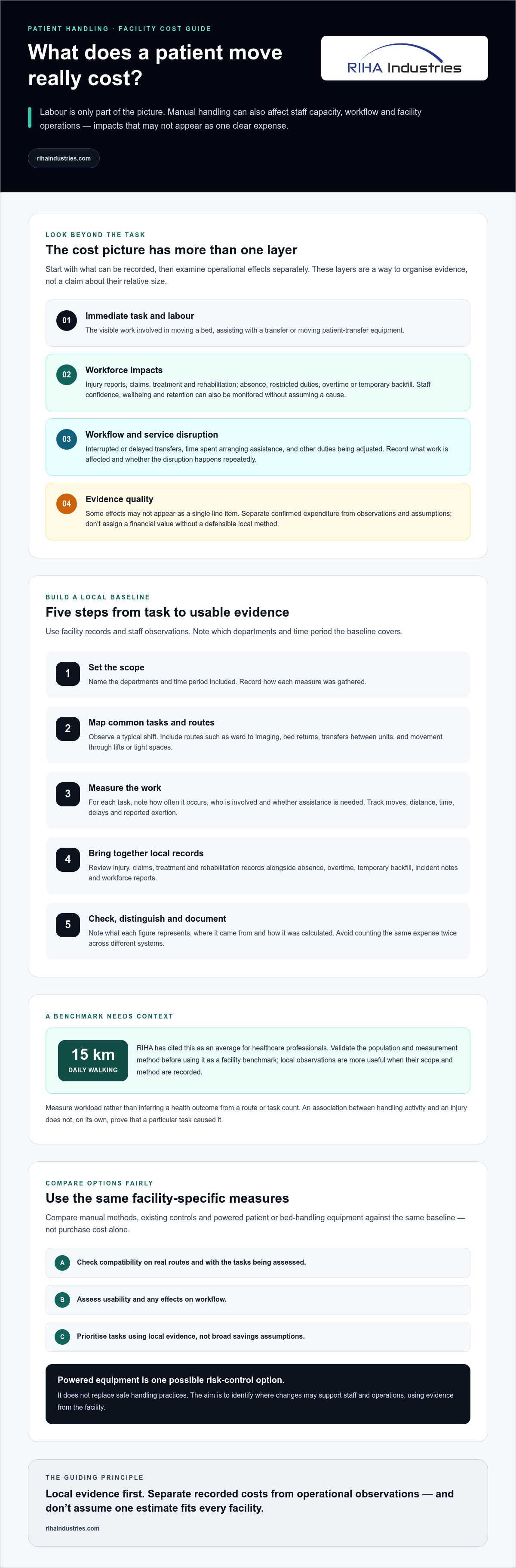
How can a healthcare facility calculate its manual handling costs?
A consistent baseline helps a facility identify where manual handling demands occur and compare possible controls using local evidence. Define the review period and departments first. Then focus on specific tasks, such as moving beds along a regular route, rather than combining every type of patient handling into one figure.
A credible comparison needs task frequency, staff involved, time per task, route conditions and relevant workforce records, all measured over a clearly stated period. Record how each measure is defined and where it came from. This makes the findings easier to check and repeat.
Which baseline measures should facilities collect?
Use a simple collection plan across representative shifts. Include observed activity and available records, and note where information is not routinely captured.
Handling activity: count relevant moves, staff involved and time per task. Note route conditions that may affect movement.
Workforce indicators: review absence, incidents, restricted duties, overtime and backfill using consistent definitions.
Staff observations: ask where tasks recur, what affects the work and whether the observed frequency reflects a typical shift.
Check observations against records and staff feedback rather than relying on a single shift or one person’s recollection. Keep documented events distinct from reported concerns, and avoid counting the same absence or cost in multiple categories.
How should facilities compare options and outcomes?
Compare current practice with a proposed control over an equivalent review period and, where possible, similar departments and tasks. Track the same activity, workforce and workflow measures before and after a change. If conditions differ, record them so that changes in results are not attributed to equipment without context.
Show assumptions separately. List equipment purchase, training, maintenance and potential downtime as distinct considerations. Avoid unsupported savings estimates and state what is included, what is excluded, and which figures are documented versus estimated. This keeps the assessment transparent for operational and financial review.
Lifecycle support also belongs in the evaluation. Consider how maintenance and repair arrangements could affect equipment availability, and consult this hospital bed mover repair and maintenance guide as one reference. A powered bed mover may warrant assessment where local evidence identifies recurring demand, but the facility’s baseline should guide the decision, not a general industry average.
Once the facility has identified relevant tasks and measures, explore RIHA’s powered bed movers and patient transfer systems as potential options to assess against its routes, equipment and handling processes.
How can facilities cut hidden patient handling costs?
Start with the tasks your records and staff identify as demanding or disruptive. Prioritise recurring bed movements, routes that regularly cause delays and tasks where staff report difficulty. Review them through your facility’s existing risk-control processes. This keeps the focus on practical opportunities to improve handling rather than assuming one solution will suit every department.
A structured trial can show whether a powered option fits the work. Before it starts, agree on what to assess and how to record the findings. Involve the staff who perform the task, and test representative beds and routes under realistic conditions. A demonstration on a clear, straight corridor alone may not show how equipment performs around tight turns or in busy spaces.
How can a facility trial safer handling controls?
Observe the whole task, including connecting the mover, starting and stopping, turning and positioning the bed. Check bed compatibility and manoeuvrability, and confirm that the proposed operation suits facility procedures. If one-person operation is relevant, assess it in practice and identify the training users need. Ask staff about ease of use and any workflow changes.
Set success measures before the trial. These might include task time, staff involved, route suitability, usability feedback and interruptions. Record the conditions and any limitations, then compare the findings with the baseline. A trial can inform a decision, but it cannot promise that injuries will be eliminated or every hidden cost avoided.
How can RIHA support a facility’s evaluation?
RIHA Industries is an Australian manufacturer of powered bed movers and patient transfer systems. Its StaminaLift equipment is designed to move compatible beds, with some systems intended to help one operator. Compatibility and suitability still need to be checked against the beds, routes and tasks at each facility. Australian manufacturing, national service coverage and preventative maintenance and repair services may also be relevant when planning implementation and ongoing use.
Plan for ownership after the trial: decide who will train staff, monitor use, arrange preventative maintenance and review whether the equipment continues to meet the facility’s needs. Clear responsibilities help integrate a control into daily work instead of leaving it unused or inconsistently applied.
Reducing the hidden costs of manual patient handling starts with evidence, staff input and careful evaluation. Contact RIHA Industries to discuss your facility’s handling assessment and whether its powered bed-moving options suit the tasks you have identified.
Turn local evidence into safer handling decisions
The hidden costs of manual patient handling extend beyond the immediate task. Staff workload, interruptions and workforce records can reveal impacts that are not obvious in a purchase or labour figure alone. A consistent facility baseline helps decision-makers understand where pressure occurs and compare existing controls with powered options using the same measures.
Any assessment should reflect real tasks, routes, bed compatibility and staff feedback. A structured trial can show whether an option is usable and fits the workflow, while training, maintenance and ongoing review support implementation. Treat reported outcomes from individual hospitals with care. Any facility-specific injury result should be verified before publication and should not be presented as a guaranteed or universal outcome.
RIHA Industries manufactures Australian-made StaminaLift equipment and provides national service coverage within Australia. If your facility is assessing bed movement and patient handling, discuss your facility’s patient-handling assessment with RIHA Industries. A measured, evidence-led evaluation is a practical step towards supporting staff wellbeing and more reliable workflows.
Frequently Asked Questions
What are the hidden costs of manual patient handling?
The hidden costs of manual patient handling can include injury-related expenditure, staff absence, overtime, temporary backfill and interruptions to routine work. Which categories apply depends on a facility’s records and processes. Review direct expenditure alongside workforce and workflow indicators, and define each measure clearly. Check whether the same impact appears in more than one report so it is not counted twice. Keep potential effects that have not been measured separate from documented costs.
Is manual patient handling cheaper than using powered equipment?
Not necessarily, but powered equipment is not automatically cheaper either. Compare current labour and incident data with the assumptions for equipment purchase, training, maintenance and downtime. Include workflow fit, such as whether a mover suits the beds and routes involved. Use equivalent review periods and local evidence rather than generic savings claims. A structured trial can help show whether the option benefits the specific tasks being assessed.
How can a hospital calculate the cost of manual handling?
Define the tasks, departments and review period first. Collect consistent data on handling frequency, staff time, incidents, absence, overtime and backfill. Add operational impacts, such as transfer delays, only where there is supporting evidence. Record assumptions separately and check for double-counting across reports. Then compare current practice with proposed controls over the same period. Facility-specific data provides a more useful basis for decisions than unsupported universal estimates.
Can manual patient handling lead to staff injuries?
Manual handling can expose staff to physical demands, but do not assume a task caused an injury. Assess the work, consult staff and review incident and injury records using consistent definitions. Look for patterns across relevant tasks and shifts, while recognising that an association does not prove causation. Apply the controls required in the relevant jurisdiction and seek competent safety advice where needed. Equipment can support risk controls, but it does not guarantee injury prevention.
What data should a facility collect before investing in a bed mover?
Record how often beds are moved, who performs each task, the time involved and the routes used. Note compatibility requirements and relevant incidents or work restrictions, then gather staff feedback. Before a demonstration, agree on measures such as usability, task time and workflow effects so options can be compared fairly. Check that any stated equipment capacity or compatibility applies to the specific model, beds and intended use being assessed.
How can powered bed movers reduce manual handling demands?
A powered bed mover assists with moving compatible beds and may reduce the physical effort required for some tasks. Its effect depends on bed compatibility, route conditions, operator training and how it is used. Assess the equipment in the facility’s actual environment, including turns and access points, and retain appropriate handling procedures. Measure task outcomes and staff feedback during evaluation. Do not assume a mover removes every manual-handling risk or suits every bed movement.


