
Hospital Bed Mover Finance Guide for Australian Hospitals
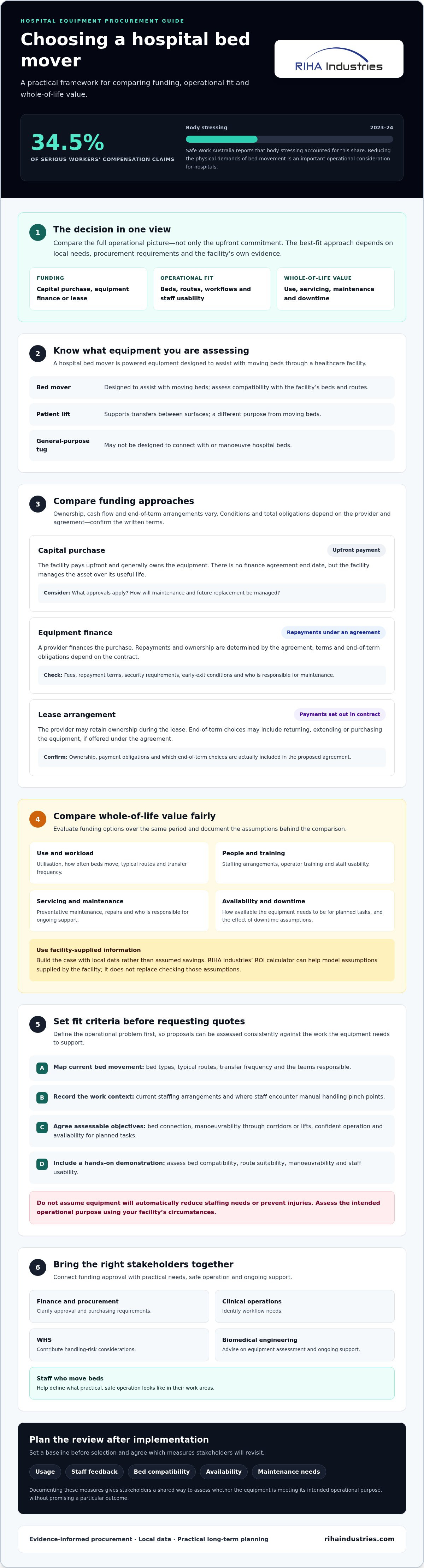
Safe Work Australia reports that body stressing accounted for 34.5% of serious workers’ compensation claims in 2023-24. For hospitals, reducing the physical demands of bed movement is an important operational consideration, but the right investment must also fit the facility’s budget and procurement process. This hospital bed mover purchasing guide reframes the decision: compare whole-of-life value, not just the upfront commitment.
It’s understandable to weigh a capital purchase against ongoing finance obligations while also building support from clinical, procurement, finance and WHS stakeholders. A clear business case can connect staff-safety priorities with practical operational needs, using local information rather than assumed savings.
This guide will help you shortlist funding approaches for further review, assess how utilisation, servicing and maintenance affect long-term value, and prepare a transparent case using your facility’s own data. It will also outline what to check when evaluating equipment fit and staff usability, and how RIHA Industries’ ROI calculator can help model facility-supplied assumptions. The aim is a confident, evidence-informed decision that supports your team and remains practical over time.
Table of Contents
Why include a hospital bed mover in your equipment funding plan?
Compare hospital equipment funding options before choosing a bed mover
Assess whole-of-life value, not just the hospital bed mover’s funding terms
Build a procurement process that connects funding approval to operational needs
Choose a bed mover partner for implementation and ongoing support
Why include a hospital bed mover in your equipment funding plan?
A hospital bed mover is powered equipment designed to assist with moving beds through a healthcare facility. It is different from a patient lift, which supports transfers between surfaces, and from a general-purpose tug, which may not be designed to connect with or manoeuvre hospital beds. Since hospital beds are specially designed for hospitalized patients, a mover should be assessed for compatibility with the beds and routes used at your site.
Build the equipment case around the work it needs to support. Consider how often beds move, who moves them, where they travel and how the equipment would fit into existing workflows. Keep that assessment separate from the funding choice: a lender may provide finance, but isn’t the equipment supplier. This hospital bed mover purchasing guide helps structure the decision, but it isn’t personal financial or tax advice. Seek guidance from qualified advisers on funding, tax treatment and procurement requirements.
What operational problem should the purchase solve?
Start with a practical picture of current bed movement. Identify the bed types involved, typical routes, transfer frequency and the teams responsible. Record current staffing arrangements and where staff encounter manual handling pinch points, without assuming that equipment will automatically reduce staffing needs or prevent injuries.
Then agree on objectives that can be assessed. These might include how easily the mover connects to the facility’s beds, how it manoeuvres through corridors or lifts, whether staff can operate it confidently, and how available it needs to be for planned tasks. A hands-on demonstration can help staff assess usability and route suitability before the facility compares proposals.
Who needs to support the business case?
Bring the people who will fund, select, use and maintain the equipment into the discussion early. Finance and procurement can clarify approval and purchasing requirements; clinical operations can identify workflow needs; WHS can contribute handling-risk considerations; and biomedical engineering can advise on equipment assessment and ongoing support. Staff who move beds should help define what practical, safe operation looks like in their work areas.
Agree on how the purchase will be reviewed after implementation. Set a baseline and decide which measures to revisit, such as usage, staff feedback, bed compatibility, availability and maintenance needs. Documenting these measures before selection gives stakeholders a shared way to assess whether the equipment is meeting its intended operational purpose, without promising a particular outcome.
Compare hospital equipment funding options before choosing a bed mover
Funding structure affects cash flow, ownership and what happens at the end of an agreement. Compare the options against your facility’s budget, procurement rules and intended period of use. The right choice depends on local circumstances, not on a funding model being universally better. Availability, conditions and total obligations vary by provider and agreement, so request written terms before comparing.
How do purchase, finance and lease arrangements differ?
Use this table as a starting point for discussions with finance and procurement teams. The details can differ between providers, so confirm every point in the proposed agreement.
Don’t compare payment amounts alone. Review the full obligations, including fees, maintenance responsibilities, insurance requirements if applicable, and the cost or process of ending an agreement early. Ask providers to clarify any assumptions in writing.
What should Australian facilities verify?
Ask your finance team to review accounting, tax and internal approval implications, and seek qualified tax and legal advice before committing. Public hospitals should also check how their funding arrangements and governance affect capital decisions. The National Health Funding Body explains Activity Based Funding (ABF); confirm with the relevant health authority how funding arrangements apply to your facility and proposed purchase.
Grants or other public funding may be worth investigating, but don’t treat them as assured sources. Confirm eligibility, application dates, permitted uses and reporting requirements directly with the responsible programme. Compare written proposals using the same assumptions and check that inclusions are equivalent. This hospital bed mover purchasing guide supports evaluation, but isn’t personal financial, tax or legal advice. For the equipment side of the decision, you can review RIHA’s bed mover range separately from any funding provider’s terms.
Assess whole-of-life value, not just the hospital bed mover’s funding terms
A funding option can look manageable on paper while the equipment proves difficult to use in daily operations. Assess the complete ownership or use period, including how often the mover is needed, whether it suits your facility and what support it requires. Compare alternatives over the same evaluation period, using consistent inputs so decision-makers can see what is known and what remains an estimate.
Which inputs belong in a bed mover business case?
Build the model from local operational information, not generic assumptions. Record beds moved per shift, the routes involved, the teams and operators, and the steps staff currently take. Then document the assumptions used for each option, including:
Expected usage and the staffing arrangements relevant to bed movement.
Operator training and the time required to prepare staff for use.
Scheduled maintenance, repairs and the impact of potential downtime.
Charging needs and how equipment availability will be managed during operations.
RIHA Industries’ ROI calculator can help model facility-supplied inputs. Clearly label each input as a measured figure, estimate or assumption, and confirm the calculator’s current scope and limitations before relying on its output. Treat projected savings or payback as modelled results, not guaranteed outcomes. This hospital bed mover purchasing guide is most useful when stakeholders can trace each figure back to its source and test how different assumptions affect the comparison.
How should compatibility and usability affect value?
Operational fit shapes whether a mover can be used where it’s needed. Check the facility’s bed and attachment inventory against the equipment’s confirmed compatibility information. Don’t rely on a general compatibility statement alone; confirm applicability to the specific beds in use.
Assess the actual environment, too. Routes that appear straightforward on a floor plan may involve tight turning spaces, narrow corridors, lifts, ramps or gradients. Include storage in the assessment, along with where charging can take place. A practical demonstration can reveal constraints that a specification sheet won’t.
Invite intended operators to assess the controls, connection steps, braking and visibility while moving through representative routes. Record their feedback against agreed criteria, such as ease of connection, manoeuvrability and confidence using the equipment. Compare each suitable option using the same evaluation period and documented assumptions, then keep the assessment alongside the business case. That gives finance, operational and procurement stakeholders a clearer basis for weighing funding terms against practical value over time.
Build a procurement process that connects funding approval to operational needs
A defined procurement process helps ensure funding approval supports equipment that works in the facility’s real operating conditions. Set the requirements and evaluation criteria before requesting quotes, then use the same information to assess each proposal. This hospital bed mover purchasing guide approach makes gaps, assumptions and trade-offs easier for stakeholders to identify.
Confirm the need. Document the bed types, movement tasks, routes, teams and operational requirements the equipment must address.
Agree on evaluation criteria. Set priorities for compatibility, manoeuvrability, operator usability, training, maintenance and availability before approaching suppliers.
Prepare a specification. Include bed types, wheel dimensions, load requirements and connection needs, along with site conditions such as corridors, lifts, gradients and storage locations.
Request comparable proposals. Give each supplier the same written requirements and ask them to identify inclusions, exclusions, assumptions and details requiring confirmation.
Demonstrate and evaluate. Test suitable equipment against representative workflows, and collect feedback from intended operators.
Submit and implement. Document the recommendation, evaluation results and approval responsibilities. Once approved, confirm implementation arrangements, training and ongoing support expectations.
What should a hospital bed mover specification include?
Make the specification practical enough to assess, not just a list of general preferences. Describe the beds and attachments in use, including relevant wheel dimensions and connection requirements. Note the load requirements that apply to the facility’s tasks, then map routes and site constraints, from tight turns and lift access to gradients and storage. Ask suppliers to state how compatibility has been assessed and what needs further verification.
Include expectations for staff training, scheduled maintenance, repairs and support response requirements. Specify what the facility needs, then ask suppliers to confirm in writing what they can provide. Avoid treating an unconfirmed service expectation as an included commitment.
How can stakeholders compare supplier proposals fairly?
Use a consistent comparison process. Check each proposal against the same criteria and separate confirmed specifications from assumptions, exclusions and unresolved questions. For example, a compatibility statement should be checked against the facility’s bed inventory rather than treated as confirmation that every bed is suitable. Record differences in training, servicing and support so the evaluation reflects the full proposal, not only its headline terms.
During a demonstration, have operators assess connection steps, controls and movement through representative areas. Capture their feedback alongside the technical review, and record who is responsible for the final recommendation and approval. This creates a clear decision trail from operational need to selection.
To assess equipment in practice, discuss a bed mover demonstration with RIHA.
Choose a bed mover partner for implementation and ongoing support
A funding provider and an equipment manufacturer may be separate organisations, so assess the agreement and the equipment support plan independently. A workable investment depends not only on funding terms, but also on whether the mover suits your beds and workflows, operators know how to use it, and maintenance and repairs can be planned. Include these considerations in your hospital bed mover purchasing guide before finalising a recommendation.
What support should a facility consider after purchase?
Clarify the support arrangements in writing before committing. Ask what service coverage applies to your location, what preventative maintenance options are available, how repairs are handled and whether relevant parts can be sourced. Confirm expected response processes with the provider rather than assuming a particular timeframe or level of availability.
Plan training for the teams who will operate the equipment, including how new staff and existing operators can access refresher guidance. Also ask how equipment issues are diagnosed, what servicing resources are available and how the facility can review performance and maintenance needs over time. These details help biomedical engineering, procurement and operational teams understand what support is included and what they may need to arrange separately.
How does RIHA fit into the evaluation?
RIHA Industries is an Australian manufacturer of specialist bed movers and patient transfer systems, including the Australian-made StaminaLift range. Its role is equipment supply and support, not finance. Facilities should first confirm that a model’s specifications and bed compatibility suit their own inventory and operating requirements. Then use a hands-on demonstration to assess connection, manoeuvrability and staff usability in relevant workflows.
RIHA offers staff training, preventative maintenance and repairs, with national service coverage in Australia. Ask how these offerings apply to the specific model and facility, and confirm the details that matter to your procurement plan. For model-specific considerations, consult the StaminaLift Transfer System 5000 buying guide. The bed mover procurement guide can also help teams structure their wider evaluation. These guide titles are provided here as reading references, not linked pages.
Bringing equipment fit and ongoing support into the same review helps your facility make a more complete decision. Arrange a practical bed mover discussion with RIHA to explore whether a demonstration can support your evaluation.
Make your next bed mover decision with confidence
A sound investment starts with the operational need, not the funding arrangement. Compare purchase, finance and lease options against your facility’s governance and budget, then assess whole-of-life value using consistent, clearly documented assumptions. Confirm equipment compatibility, workflow fit and ongoing support before seeking approval.
This hospital bed mover purchasing guide is designed to help your team build a practical business case and make a considered choice. A hands-on demonstration can help assess how equipment performs in your facility, while planning for operator training, preventative maintenance and repairs supports informed implementation.
RIHA Industries manufactures Australian-made StaminaLift equipment and provides national service coverage in Australia. To discuss your facility’s requirements, discuss your facility’s bed mover requirements with RIHA. With clear operational priorities and the right stakeholders involved, your team can take the next step towards an equipment decision that supports staff and day-to-day care with confidence.
Frequently Asked Questions
What financing options are available for hospital equipment in Australia?
Australian facilities can investigate a capital purchase, equipment finance or a lease, subject to their procurement rules and the provider’s terms. Grants or other public funding may also be relevant where a programme permits the proposed purchase. Compare ownership, payment structure, fees, obligations and end-of-term conditions, not just the initial outlay. Finance, tax and legal implications vary, so seek advice from qualified professionals and confirm programme details with the responsible organisation.
Can a hospital lease a bed mover instead of buying one?
A hospital may be able to lease a bed mover if a suitable provider and agreement are available and the arrangement meets the facility’s procurement requirements. Check who owns the equipment during the term, what happens at its end and whether purchase, extension or return options are specified. Review maintenance responsibilities, fees and early-exit conditions in writing. The manufacturer and lease provider may be separate organisations, so assess equipment suitability independently.
How should a hospital compare equipment finance and leasing?
Compare written agreements over the same evaluation period, including total payment obligations, fees, ownership, maintenance responsibilities and any end-of-term choices. Ask the finance provider to explain repayment terms, early-exit conditions and other contractual obligations; ask the lessor to clarify return conditions and any purchase or extension options. Don’t assume the arrangements include the same services. Have your finance team and qualified legal and tax advisers review the terms before approval.
What should a hospital include in a bed mover business case?
A bed mover business case should connect the operational need to measurable evaluation criteria and clearly labelled assumptions. Include the beds and routes involved, movement frequency, current handling steps, staffing assumptions, training, maintenance and possible downtime. Document how compatibility and usability will be assessed, including a practical demonstration where possible. Explain the funding approach and approval pathway, then define how the facility will review use, operator feedback and equipment availability after implementation.
Are grants available to fund hospital bed movers in Australia?
Grants may be available through particular programmes, but eligibility and permitted equipment purchases depend on each programme’s rules. Check directly with the responsible organisation for current application dates, eligible applicants, funding purposes, assessment criteria and reporting requirements. Don’t include a grant as confirmed funding until the facility has verified its eligibility and any award has been approved. Ask finance and procurement teams whether the application timing fits the equipment decision and approval process.
Does RIHA Industries offer finance or equipment leasing?
No. RIHA Industries manufactures and supplies specialist bed movers and patient transfer systems, and offers preventative maintenance and repairs; it doesn’t provide loans or equipment leasing. A facility considering finance or a lease would need to assess options with a separate provider. Evaluate the equipment and any funding agreement independently, and confirm that the selected mover suits the facility’s beds, workflows and support requirements before proceeding.
How can a facility estimate the return on a hospital bed mover?
Estimate potential return using facility-specific inputs, not assumed savings. Record bed movements, routes, staffing assumptions and expected equipment use, then include training, maintenance and downtime in the model. RIHA’s ROI calculator can help assess facility-supplied assumptions, but check its current scope and limitations. Label measured data, estimates and assumptions clearly, compare alternatives over the same period, and treat any projected savings or payback as estimates rather than guaranteed results.


