
Designing a Safe Patient Handling Programme: 2026 Guide
Hospitals invest millions in ceiling hoists and slide sheets, yet their nursing staff and orderlies continue to suffer career-ending back injuries. When clinical leaders focus exclusively on bedside transfers while ignoring corridor transport, the entire safety net collapses. When orderlies move occupied hospital beds weighing up to 500 kg across 15 km per shift, relying on good posture isn't enough. Successfully designing a safe patient handling program requires closing this critical operational gap by integrating engineered transport controls into the core workflow.
You already recognise the relentless toll of manual handling incidents on your team's wellbeing, retention, and your facility's operational budget under Australian WHS frameworks. Balancing strict compliance against equipment adoption often feels like an uphill battle. This comprehensive guide details how to design, implement, and sustain a zero-lift policy that protects staff, safeguards clinical dignity, and secures measurable financial returns. We explore the architectural principles, regulatory benchmarks, and vital transport equipment needed to build an injury-free healthcare environment.
Table of Contents
Building the Strategic Business Case for Safe Patient Handling in 2026
Securing executive support for clinical safety initiatives requires speaking the language of risk mitigation, workforce stability, and return on investment. Healthcare workers sustain disproportionate rates of debilitating musculoskeletal disorders from cumulative physical tasks. Direct financial losses mount rapidly through soaring workers' compensation premiums, agency backfill expenditure, and lost-time injuries. Yet the indirect costs cut even deeper. Physical exhaustion accelerates clinical burnout, degrades morale, and drives skilled clinicians into early retirement.
When designing a safe patient handling program, framing the initiative purely as an administrative safety policy fails to gain traction. Leaders must present a strategic business case demonstrating that proactive engineering controls protect both operating margins and clinical capacity.
Musculoskeletal Strain and Staff Retention in Modern Healthcare
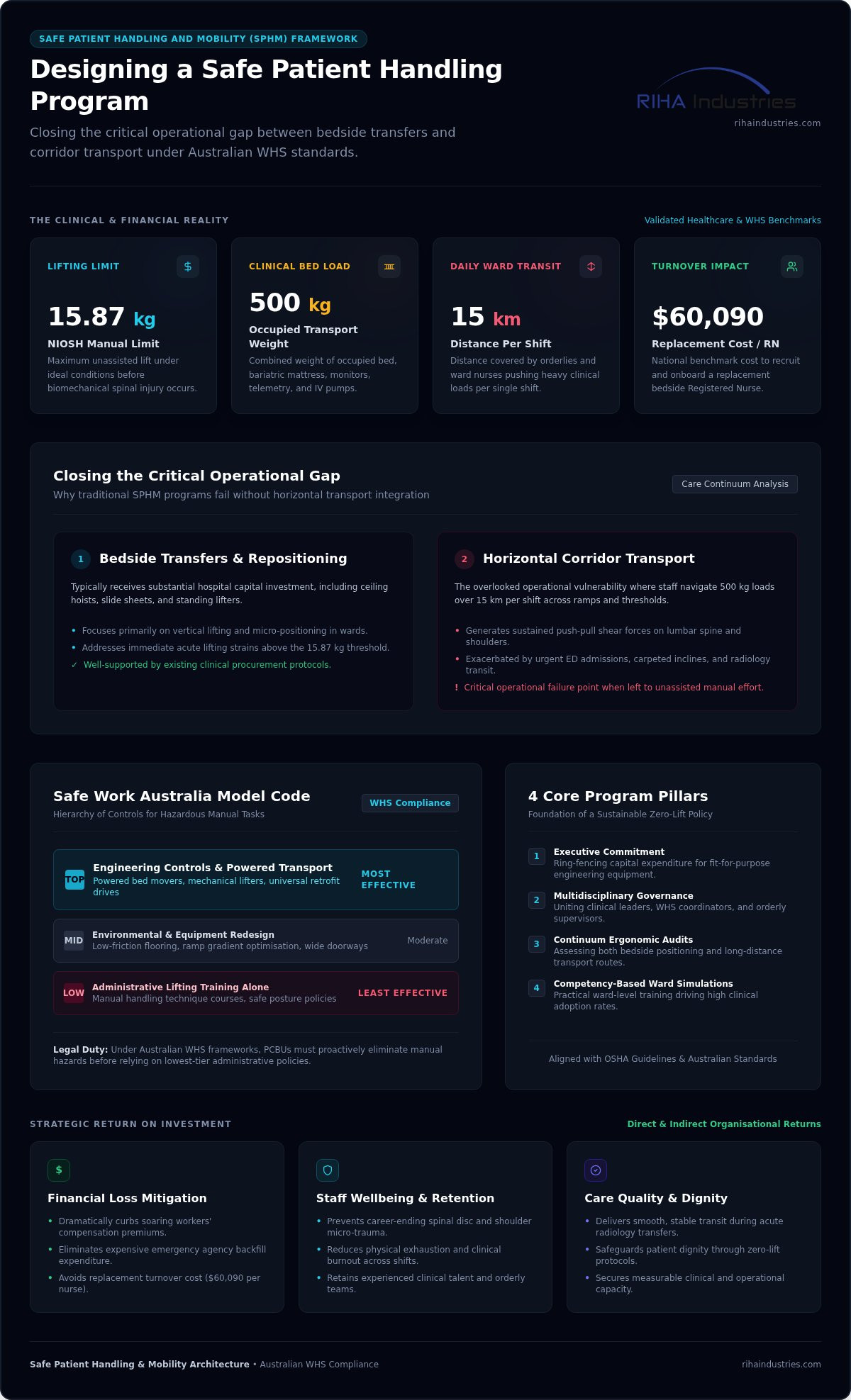
Repetitive micro-trauma from manual repositioning degrades spinal discs and shoulder soft tissue over time. Data from the Revised NIOSH Lifting Equation confirms that lifting loads exceeding 15.87 kg under ideal conditions presents hazardous biomechanical strain, making unassisted transfers clinical liabilities. Manual patient handling remains the leading driver of nurse physical disability in acute environments. With national benchmarks placing bedside RN turnover replacement costs at $60,090 per nurse, retaining experienced staff is critical. Adopting rigorous patient handling equipment selection criteria safeguards your frontline workforce while curbing avoidable recruitment churn.
The Hidden Cumulative Load of Ward Transit and Equipment Transport
While bedside transfers receive intense scrutiny, horizontal transit along expansive hospital corridors represents an overlooked physical burden. Orderlies and nurses walk up to 15 km daily, regularly pushing clinical loads across ward thresholds and carpeted ramps. Standard occupied beds frequently weigh up to 500 kg when factoring in bariatric mattresses, monitoring telemetry, and intravenous pumps. Initiating movement generates extreme push-pull shear forces on the lumbar spine. Acute wards face continuous exposure during urgent radiology transfers and emergency department admissions, where sustained muscular effort over hundreds of metres compounds fatigue far beyond brief bedside interventions.
Legislative Compliance Under Safe Work Australia and WHS Standards
Australian Work Health and Safety (WHS) legislation places positive duties on Persons Conducting a Business or Undertaking (PCBUs) to eliminate hazardous manual tasks so far as is reasonably practicable. Under the Safe Work Australia Model Code of Practice, relying solely on manual lifting technique courses sits at the lowest administrative tier of the Hierarchy of Controls. Regulatory audits and clinical accreditation standards demand demonstrable engineering interventions, ranging from mechanical patient lift systems to powered bed movers. Executive liability now hinges on systematically removing manual physical burdens before preventable injuries occur.
Core Pillars of an Effective Safe Patient Handling and Mobility (SPHM) Framework
A resilient Safe Patient Handling and Mobility (SPHM) program is not an isolated policy document stored on an intranet server. It is an active organisational system uniting engineering controls, clinical governance, and practical competency. When designing a safe patient handling program, executive teams often make the mistake of buying mechanical aids without updating operational systems. Aligning with recognized international benchmarks and OSHA safe patient handling guidelines requires building an ecosystem where clinical safety and patient dignity reinforce one another.
Sustainable success requires four interconnected pillars:
Executive commitment: Ring-fencing capital expenditure for fit-for-purpose engineering controls instead of relying on cheap administrative workarounds.
Multi-disciplinary governance: Uniting clinical managers, orderly supervisors, and occupational health teams to review real-time hazard data.
Definitive minimal-lift standards: Removing ambiguity around when mechanical equipment must be deployed.
Peer-led champion networks: Sustaining front-line competency across night shifts, weekends, and high-turnover rosters.
Establishing Leadership Commitment and Governance Committees
Program governance begins with a formal charter bringing together nursing directors, orderly supervisors, WHS managers, union delegates, and biomedical engineering. This steering group monitors quantifiable safety metrics, including Lost Time Injury Frequency Rates (LTIFR) and equipment utilisation figures. Leaders must establish non-punitive reporting workflows where staff can log near-misses and equipment faults immediately. When healthcare providers explore robust engineering controls from specialists like RIHA Industries, safety committees gain the necessary hardware backing to eliminate transport and transfer hazards permanently.
Developing an Ergonomics-Led Minimal-Lift Institutional Policy
Policies must be unambiguous. The institutional standard should dictate that any patient handling task exceeding baseline physical thresholds mandates mechanical intervention. Clinical protocols need clear criteria matching patient dependency levels directly to designated transfer devices. Exceptions must be strictly limited to time-critical resuscitations, with mandatory post-incident ergonomic debriefs. Standard operating procedures must formally ban manual dragging and bodily lifting, embedding mechanical workflows straight into ward handovers.
Empowering Ward-Level Ergonomic Champions and Super-Users
Policies succeed or fail at the bedside. Facilities must recruit and upskill respected bedside clinicians, orderlies, and physiotherapists across all shifts as departmental super-users. These individuals receive advanced training to conduct peer assessments, troubleshoot mechanical hitches, and correct unsafe practices on the spot. By integrating formal recognition pathways and continuous clinical coaching, super-user networks sustain daily clinical compliance and build authentic ward-level safety ownership.
Conducting Comprehensive Ergonomic Risk Assessments Across the Care Continuum
Traditional healthcare safety audits often focus narrowly on bedside repositioning while completely missing the physical hazards of moving patients between wards. An effective ergonomic risk assessment must map every physical touchpoint across the patient's entire journey. When designing a safe patient handling program, safety managers need to evaluate clinical mobility, architectural bottlenecks, and equipment push-pull forces as an integrated system. Aligning assessment protocols with evidence-based frameworks, such as NIOSH safe patient handling and mobility recommendations, ensures no blind spots compromise staff safety.
Comprehensive audits evaluate three primary operational layers:
Functional mobility tiers: Objective scoring of patient weight-bearing ability and cognitive status before every shift transfer.
Architectural transit routes: Identifying floor friction transitions, lift clearances, and ramp inclines that spike push-pull forces.
Dynamic movement biomechanics: Quantifying the mechanical forces required to steer heavy loads along high-traffic corridors.
Evaluating Patient Mobility and Dependency Classifications
Subjective estimations lead to inconsistent equipment usage. Clinical teams should adopt validated bedside algorithms, such as the Banner Mobility Assessment Tool (BMAT), to standardise mobility scoring across all shifts. Patients are categorised systematically from fully independent to completely dependent bariatric profiles. Bedside visual cues, such as colour-coded transfer cards outside patient rooms, instantly signal to rotating orderlies and nursing staff exactly which mechanical aids are legally and clinically mandated for every transfer.
Auditing Environmental Hazards: Ramps, Thresholds, and Corridors
Even the best transfer devices fail if the physical environment works against them. Safety audits must measure friction changes across vinyl-to-carpet junctions, expansion joint transitions, and standard 7-degree internal ramps leading to imaging suites. Restricted lift dimensions and cluttered corridors force staff into awkward postures when turning heavy trolleys. Reviewing guidelines on patient transport equipment aged care helps safety teams evaluate how tight room geometries and narrow doorways dictate equipment dimensions.
Analysing Push-Pull Biomechanics During Bed Movement
Clinical risk assessments must capture real-world transit dynamics using push-pull dynamometers. These tests document the extreme initial push forces required to overcome castor inertia on standard hospital beds. Navigating around tight corners generates intense asymmetric rotational torque on lumbar discs and shoulder joints. Measuring these real push-pull loads provides the empirical evidence necessary for designing a safe patient handling program that justifies mechanical transport solutions.
Procuring and Integrating Modern Engineering Controls
Engineering controls represent the highest tier of protection in healthcare risk management. Effective procurement begins with auditing existing capital assets against four distinct physical handling requirements: vertical repositioning, lateral transfers, seated mobility, and corridor transit. When designing a safe patient handling program, clinical procurement committees must avoid fragmented equipment purchases. Selecting multi-purpose engineering aids that integrate seamlessly with current hospital assets ensures immediate staff adoption, streamlined preventative maintenance, and lasting injury prevention.
A structured four-step procurement process keeps the program grounded in operational reality:
Asset and gap analysis: Map current lifters, slings, and transport aids against ward-specific clinical acuity.
Fleet compatibility check: Prioritise handling devices with universal connection mechanisms that match diverse bed and trolley models.
Clinical floor trials: Test manoeuvrability, acoustic output, and physical footprint during live ward operations.
Infrastructure standardisation: Align battery charging stations, intuitive joystick controls, and service protocols across the entire facility.
Selecting Bedside Hoists, Lateral Transfer Aids, and Slide Sheets
Bedside tasks demand purpose-built lifting gear. Ceiling-mounted track hoists provide rapid, single-carer operation while freeing up tight floor space in intensive care units. Mobile floor lifters offer versatile backup across general wards, provided room layouts accommodate their turning circle. For supine repositioning across imaging suites and operating theatres, air-assisted lateral transfer mats significantly reduce surface friction. Infection control teams must pair these tools with strict laundering workflows or tracked single-patient-use sling lifecycles to prevent cross-contamination.
Integrating Motorised Bed Movers for Ward and Facility Transit
Motorised bed movers eliminate the massive push-pull strains caused by manual corridor transport. Modern systems feature 360-degree turning capabilities, allowing a single operator to steer heavy beds through narrow doorways, crowded elevators, and across floor junctions effortlessly. Deploying the StaminaLift Transfer System 5000 provides universal hitching compatibility with 95% of hospital beds, securely connecting underneath the frame to preserve clear sightlines. For bariatric care, the heavy-duty StaminaLift Transfer System 6000 manages patient loads up to 900 kg on inclines up to 7 degrees with complete stability.
Upgrading Logistics and Support Services with Electric Tugs
Manual handling risks extend well beyond patient transfers. Heavy logistical movements in linen delivery, catering, and clinical waste handling present equal musculoskeletal hazards to support personnel. Introducing powered tow tugs, such as the Easi Rider and Easi Mover, enables single operators to move wheeled loads up to 1,500 kg safely. Reviewing specialised hospital porter equipment helps facilities streamline logistical transit while maintaining sound levels below 65 dB in acute recovery zones.
To eliminate transit injuries across your facility, explore engineered hospital transport systems with RIHA Industries to trial powered bed movers designed specifically for modern clinical environments.
Implementation, Competency-Based Training, and Program Sustainability
Procuring advanced equipment solves only half the challenge. The true measure of success lies in day-to-day clinical uptake and long-term mechanical reliability. When designing a safe patient handling program, health networks must bypass passive classroom modules in favour of active, ward-based simulation. Real-world competency verification, combined with strict preventative maintenance, ensures engineered aids remain frontline tools rather than forgotten fixtures in ward corridors.
Long-term program sustainability depends on three disciplined operational cycles:
Simulation-based competency: Moving beyond check-box theory to observed, scenario-based drills during shift handovers.
Fleet reliability management: Structured battery conditioning, smart charging habits, and scheduled mechanical servicing.
Longitudinal metric tracking: Proving financial and clinical value through transparent injury and operational reporting.
Conducting Ward-Based Simulation and Competency Verification
Passive online learning cannot prepare orderlies or nurses for dynamic clinical environments. Super-users must run five-minute peer-led simulations targeting difficult scenarios, such as moving non-cooperative patients or tight elevator entries. Assessors must directly verify technical competencies. Clinicians must demonstrate hitching mechanisms, speed modulation on variable floor grades, emergency stop braking, and manual jaw releases. Embedding these quick practical checks into normal team handovers maintains clinical fluency without compromising bedside care hours.
Establishing Rigorous Preventative Maintenance and Fleet Servicing
Flat batteries and faulty hitches will kill staff confidence in minutes. Healthcare facilities require structured Preventative Maintenance and Repairs programs to guarantee high fleet availability. Routine charging schedules prevent shift disruptions, while certified technicians inspect drive wheels, emergency releases, and electrical couplings on a set timetable. Integrating Bluetooth diagnostics and 3D digital viewer tools allows engineering teams to troubleshoot issues immediately, order genuine parts, and resolve mechanical faults before downtime disrupts patient movement.
Measuring Program ROI: Injury Reductions, Cost Savings, and Culture
Sustaining capital investment requires continuous proof of financial and operational returns. Facilities should track leading and lagging indicators monthly, focusing on Lost Time Injury Frequency Rates (LTIFR), compensation payout shifts, and employee retention numbers. Clinical evidence confirms the power of complete engineering controls. At a major South Australian hospital, introducing StaminaLift motorised movers reduced bed-moving injuries from 20% to zero within two years. Enabling single-person transit also saves thousands of clinical hours across acute wards, demonstrating why designing a safe patient handling program built on proven engineering controls delivers an undeniable operational return.
Building an Injury-Free Healthcare Workplace for the Future
Successfully designing a safe patient handling program means looking beyond the bedside to eliminate physical hazards across the entire hospital journey. When healthcare leaders replace outdated manual techniques with genuine engineering controls, comprehensive environmental audits, and practical ward-based competency drills, staff retention stabilises and patient dignity is preserved.
Zero-injury workplaces are entirely achievable with the right mechanical partners. Certified Australian-made engineering featuring 360-degree manoeuvrability and universal hitching has already demonstrated real-world impact, reducing bed-moving injuries from 20% to zero within two years in clinical trials. As the recognised Top Hospital Bed Movers and Accessories Manufacturer 2025 by Medical Tech Outlook, our mission is to ensure your clinical staff return home safe and uninjured after every shift. Discover how StaminaLift motorised bed movers eliminate transit strain in your facility and take the decisive step towards protecting your healthcare workforce today.
Frequently Asked Questions
What is the primary objective of a safe patient handling program?
The primary objective is eliminating musculoskeletal injuries among healthcare workers while maintaining patient safety, comfort, and clinical dignity. When designing a safe patient handling program, facilities replace hazardous manual lifting, transferring, and pushing with engineered mechanical aids. This systemic approach protects nurses and orderlies from career-ending spinal damage, curbs escalating workers' compensation costs, and fosters an institutional culture prioritising physical wellbeing across every ward.
Why is manual lifting technique training insufficient to prevent healthcare worker injuries?
Manual lifting classes fail because human joint biomechanics cannot safely withstand typical clinical loads. Standard transfers regularly exceed human lifting limits, especially when dealing with unpredictable patient shifts or awkward postures. Under Safe Work Australia guidelines, administrative training sits at the bottom of the Hierarchy of Controls. True risk mitigation requires higher-level engineering controls that absorb physical forces rather than relying on body mechanics alone.
How do motorised bed movers fit into an Australian safe patient handling program?
Motorised bed movers address the high-risk transit phase of patient handling, which traditional programs often overlook. Orderlies and ward nurses routinely transport occupied beds weighing up to 500 kg across long distances. Integrating equipment like the StaminaLift Transfer System 5000 or the StaminaLift 2100 Bed Mover enables single-person bed transit with 360-degree manoeuvrability, directly eliminating push-pull spinal strain in compliance with Australian WHS standards.
Can a safe patient handling program realistically reduce hospital worker injuries to zero?
Yes, zero-injury outcomes are demonstrable when engineering solutions completely replace manual effort. At a large South Australian hospital, introducing StaminaLift motorised movers reduced bed-moving injuries from 20% to zero within two years. When facilities pair ergonomic bed movers with ceiling hoists, lateral slide aids, and enforced minimal-lift policies, cumulative physical strain vanishes, allowing hospitals to achieve and sustain zero lost-time handling incidents.
What are the essential components of a patient mobility assessment protocol?
An effective assessment protocol features an objective, bedside scoring algorithm, clear functional mobility tiers, and visible visual communication cues. Tools like the Banner Mobility Assessment Tool evaluate trunk stability, weight-bearing capacity, and cognitive cooperation. The protocol must prescribe the mandatory mechanical aid for each tier, ensuring every nurse, orderly, and allied health professional uses the identical, validated transfer method across all shifts.
How can hospital administrators overcome staff resistance to using mechanical handling equipment?
Administrators overcome resistance by ensuring equipment is immediately accessible, universally compatible, and supported by respected peer champions. Resistance usually stems from bulky devices that are complicated to attach or slow down ward routines. Selecting intuitive movers with quick hands-free hitches, positioning charging stations strategically, and conducting hands-on simulations during shift handovers ensures clinicians view mechanical aids as valuable time-savers rather than operational hindrances.
How does bariatric patient handling alter facility risk management and equipment needs?
Bariatric care magnifies mechanical strain, demanding heavy-duty engineering controls rated well beyond standard operational thresholds. Manual repositioning or pushing becomes completely impossible without severe injury risk. Facilities require dedicated bariatric transit systems, such as the StaminaLift Transfer System 6000, which provides 450 kg lifting capacity and can push or pull up to 900 kg on inclines up to 7 degrees with complete clinical control.
What role does preventative maintenance play in sustaining safe patient handling initiatives?
Preventative maintenance guarantees daily equipment availability, preventing staff from reverting to manual techniques due to uncharged batteries or mechanical faults. Successful programs establish scheduled fleet servicing contracts, routine battery conditioning cycles, and smart diagnostic monitoring. Maintaining certified parts and prompt technician support preserves equipment uptime, reinforcing staff trust and ensuring your investment in designing a safe patient handling program delivers lasting safety dividends.


