
Hospital Staff Retention Strategies: Building a Stronger Healthcare Workforce
Recruitment can’t create a stable workforce if the conditions that drive people away remain unchanged. For hospital porter retention, that means looking beyond vacancies to the daily realities of demanding physical work, tight schedules and uneven support. Porters keep essential hospital tasks moving, but their contribution can be overlooked when leaders focus only on clinical roles.
Workload, safety, recognition, reliable scheduling and opportunities to develop all influence whether staff feel able to stay. No single change addresses every cause of turnover, and equipment alone isn’t a retention strategy. But practical improvements to physically demanding tasks can form part of a broader effort to make work safer and more sustainable.
This article explores the interconnected factors that shape hospital staff retention, with strategies for identifying preventable turnover, improving day-to-day working conditions and building a measurable plan. It also looks at how powered bed-moving equipment can help reduce physical effort for portering teams as one part of a wider approach.
Table of Contents
Why hospital staff retention strategies matter across every role
What shapes hospital staff retention: workload, support and work design
Which hospital staff retention strategies address causes rather than symptoms?
How to put hospital staff retention strategies into practice and measure progress
Support sustainable hospital work with practical tools and ongoing partnership
Why hospital staff retention strategies matter across every role
Recruitment fills vacancies; retention helps prevent them from repeatedly reopening. Staff retention is an organisation’s ability to keep people in their roles over time, rather than relying on constant replacement or short-term workforce coverage. As a foundation, Employee retention describes efforts to encourage employees to remain with an organisation.
Retention means creating conditions in which people can continue doing their work, contribute their knowledge and see a reason to stay. That takes more than keeping positions covered on a roster. A vacancy may be filled temporarily while the underlying workload, support or work-design issue remains. Recruitment brings people in; lasting retention asks what makes their day-to-day work sustainable.
Departing staff take practical knowledge of local processes, equipment and team communication with them. Remaining colleagues may need to absorb duties while recruitment and onboarding take place, adding pressure and making consistent handovers harder. These effects vary by team, so leaders need to understand the circumstances behind departures rather than treat each vacancy as an isolated staffing gap.
Retention also looks different across roles. Nurses balance clinical responsibilities and shift demands; porters move patients, beds and equipment across busy facilities; support workers and facilities staff have their own task loads, schedules and operational dependencies. A strategy that responds to one group’s pressures may miss another’s. Start by examining work as staff experience it, including the resources, communication and support available to each team.
How turnover affects hospital teams and daily operations
Each departure creates work beyond finding a replacement. Teams must manage recruitment and onboarding while continuing essential duties, and newer staff need time and support to learn local routines. Stable teams can draw on shared knowledge and established communication, helping daily tasks and handovers run smoothly. Consider these effects alongside vacancy figures when assessing workforce stability.
Why hospital porter retention deserves specific attention
Porters help keep hospital activity moving by transporting patients, beds and equipment between departments. Repeated pushing, pulling and manoeuvring can make the role physically demanding. Limited access to suitable equipment or timely operational support may add strain. These conditions matter to hospital porter retention because the work needs to remain manageable over time, not just get done during a busy shift. For practical context on safer, more efficient portering, see this hospital porter equipment guide.
What shapes hospital staff retention: workload, support and work design
People rarely decide to stay or leave for just one reason. Workload, roster predictability, relationships with managers, access to equipment and opportunities to build skills can combine to shape how sustainable a role feels. These factors also interact. Unclear communication can make a busy shift harder to manage, while reliable support and well-designed tasks can help staff feel equipped to do their work.
Retention improves when everyday working conditions support people together, rather than relying on one initiative to offset problems elsewhere. Look beyond individual attitudes to identify patterns in how work is organised. Some issues may affect a whole service; others may be specific to a department, shift or occupational group and need local investigation.
Workload, rosters and the realities of frontline roles
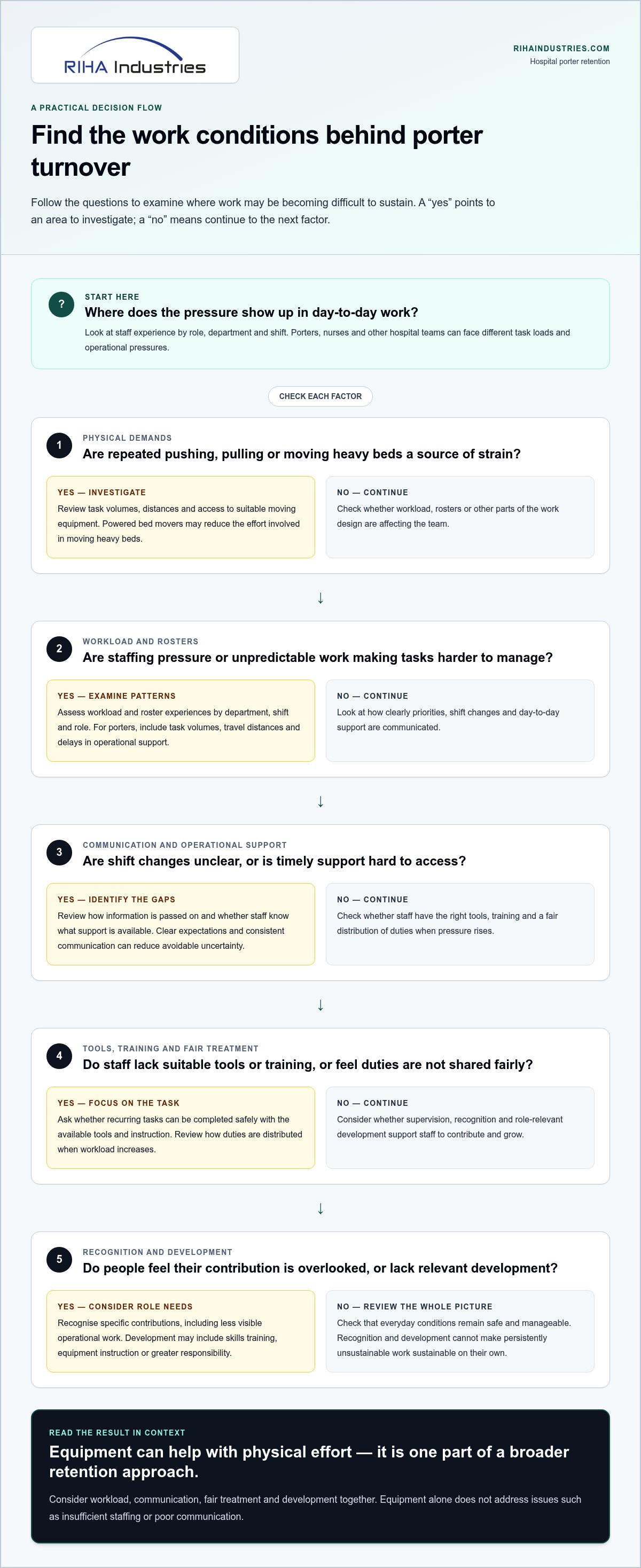
Staffing pressure and unpredictable work can make it difficult to plan, recover between demanding tasks or know what support is available. Examine workload and roster experiences by department, shift and role instead of assuming one solution suits everyone. For porters, investigate task volumes, distances, access to suitable moving equipment and delays in operational support. Assess nursing workloads on their own terms, as they involve different responsibilities.
Practical questions can reveal where work design needs attention: Are shift changes communicated clearly? Do staff have the tools and training to complete recurring tasks safely? Are duties distributed fairly when pressure rises? For porters, access to powered bed movers may reduce the effort involved in moving heavy beds. This can support more sustainable work, but it won’t resolve broader issues such as insufficient staffing or poor communication.
Management, recognition and opportunities to develop
Respectful supervision helps staff understand priorities, raise concerns and receive timely feedback. Clear expectations and consistent communication reduce avoidable uncertainty, while fair treatment builds trust. Recognition also matters when it reflects specific contributions, including the less visible work that keeps hospital operations moving.
Development should be relevant to each role. Clinical staff may value pathways to extend their practice; non-clinical staff may benefit from skills training, equipment instruction or opportunities to take on greater responsibility. Recognition and development can strengthen a supportive workplace, but they can’t compensate for unsafe or persistently unsustainable conditions. For hospital porter retention, ask porters directly about physical demands and the practical support available during their shifts.
Where moving heavy beds is a recurring source of physical effort, powered equipment can form one part of a wider improvement plan. RIHA’s powered bed movers are designed for this work and can be considered alongside workload reviews, staff input and consistent management support.
Which hospital staff retention strategies address causes rather than symptoms?
Recruitment incentives can help attract applicants or fill an urgent gap, but they don’t necessarily change the conditions that prompted staff to leave. Pay matters, yet higher pay alone can’t make an unmanageable workload, unclear supervision or poorly designed tasks sustainable. New equipment may reduce a particular physical burden without addressing rostering, communication or staffing pressures.
A retention programme is an ongoing way of improving work, not a one-off initiative with an assumed lasting effect. Choose actions in response to what staff describe and what local workforce information shows. Match each response to a specific issue, then assess whether working conditions have improved.
Match retention actions to the problem staff describe
Use staff conversations, exit feedback and operational observations to identify the problem before settling on a solution. The same concern may need different responses across roles or teams.
Why a single retention initiative rarely reaches every team
A change that helps one ward may not suit a porter team, facilities crew or another hospital site. Tasks, shift patterns, equipment access and sources of pressure can differ. For hospital porter retention, assess the physical demands of moving beds and equipment separately from clinical workload concerns, then select controls suited to those tasks.
Technology can reduce physical effort when it suits the work and is supported by training and maintenance. It should sit alongside decisions about staffing, supervision and work design, not stand in for them. For a practical framework on evaluating equipment for handling tasks, see these patient handling equipment selection criteria.
How to put hospital staff retention strategies into practice and measure progress
A practical retention plan makes clear what staff say needs attention, what the organisation will try and how it will review the effect. Use a repeatable cycle rather than treating a new initiative as a finished solution:
Listen: Invite nurses, porters, support workers and managers to describe barriers to staying and suggest workable changes.
Analyse: Combine staff conversations and exit feedback with workforce information. Look for patterns by role, department and shift.
Prioritise: Select a small number of issues to address first, with a named owner and realistic timeframe for each action.
Trial: Put the selected change into practice in a defined setting, and explain to affected staff what will happen.
Measure: Review relevant workforce indicators alongside feedback from the people experiencing the change.
Adapt: Keep, adjust or stop the action based on what the evidence and staff experience show.
Close the loop by telling staff what leaders heard, what will change and which concerns need further review. Clear communication helps people see how their input shaped the plan, even when not every request can be addressed straight away.
Build a practical retention plan with staff input
Focused conversations can uncover differences that broad workforce figures hide. Porters might identify recurring physical tasks or equipment access as priorities, while nurses may raise other workload or roster pressures. Ask what would make work more manageable, then check whether the proposed change fits the team’s shift patterns and responsibilities. For hospital porter retention, involve porters in decisions about bed-moving tasks and related equipment.
Measure outcomes without losing the human context
Track retention and turnover alongside vacancies, absence and staff feedback. Review these measures over an appropriate period and record relevant workforce changes, such as shifts in staffing or workload, so comparisons have context. Where numbers are small, reporting results for a role, department or shift could risk identifying individuals. Protect confidentiality and combine or qualify data where needed.
A before-and-after change in turnover doesn’t prove that a particular initiative caused the difference. Other workplace changes may have contributed, and a metric alone can’t explain staff experience. Ask teams what has improved, what remains difficult and whether the trial created unintended effects. Review findings regularly and adapt the plan rather than claiming success from a single measure.
If staff identify bed-moving effort as a priority, powered bed movers for healthcare settings may be one part of a wider, measurable improvement plan.
Support sustainable hospital work with practical tools and ongoing partnership
Safer, more sustainable portering work can support retention, but it is one part of a broader workforce approach. Staff also need workable workloads, clear communication, effective supervision and opportunities to raise concerns. For hospital porter retention, practical tools are most useful when they address a physical barrier staff have identified and fit the way work is organised across the facility.
Where powered moving equipment can support porter teams
Moving heavy beds repeatedly can place physical demands on porters. Powered bed movers are designed to reduce the effort involved and can support single-person operation for suitable tasks. This may help teams manage bed movements more sustainably, but it doesn’t replace staffing, safe work practices or effective coordination.
Before introducing equipment, involve porters in reviewing the tasks it will support. Consider the routes used, storage, bed compatibility and how equipment will fit into everyday workflows. Training helps staff use equipment appropriately, while risk assessment and clear work organisation remain essential. The aim is to make a demanding task more manageable, not to assume a tool will solve every workload or retention challenge.
RIHA Industries designs and manufactures Australian-made powered bed movers and tugs for healthcare settings. The StaminaLift range includes the TS5000, compatible with 95% of hospital beds, and the TS6000, designed for bariatric and acute care beds and capable of transporting nearly one tonne. These models offer different options for facilities assessing bed compatibility and load requirements. StaminaLift equipment is designed to reduce the physical burden of moving beds, with single-person operation in mind.
Connect retention priorities with practical next steps
Start with one recurring physical or workflow barrier identified by staff. Agree on what improvement would look like, introduce a suitable change and gather feedback from the people using it. Review whether the task feels more manageable and whether new difficulties have emerged. This keeps equipment decisions connected to real working conditions rather than treating purchase as the end of the process.
Ongoing support matters, too. RIHA provides staff training, preventative maintenance and repairs to support equipment use over time. These services complement local management responsibilities, including listening to staff, reviewing workloads and maintaining safe work processes.
Building a stronger workforce takes sustained attention to both people and the conditions in which they work. If your team is reviewing bed-moving tasks or other mobility needs, RIHA’s healthcare mobility solutions can form one practical part of a wider retention plan.
Build a more sustainable healthcare workforce
Stronger retention starts with understanding the conditions that shape people’s experience at work. Listen to staff, identify pressures by role and team, then trial practical changes and measure their effect on workforce trends and day-to-day work. For hospital porter retention, that includes taking physical demands seriously while recognising that equipment is only one part of a broader strategy.
Safer, more manageable work is built through consistent support, thoughtful work design and useful tools. RIHA Industries designs and manufactures Australian-made powered bed movers and tugs for healthcare settings, alongside staff training, preventative maintenance and repairs. These can support facilities working to make bed-moving tasks more sustainable while leaders continue to address workload, communication and supervision.
Every improvement can begin with a conversation about one recurring barrier and a clear plan to review what changes. Explore RIHA’s healthcare mobility solutions to see how practical equipment and ongoing support may fit your team’s needs. With staff involved and progress reviewed over time, hospitals can take meaningful steps towards a safer, more supported workforce.
Frequently Asked Questions
What are the most effective hospital staff retention strategies?
Effective hospital staff retention strategies address the reasons people consider leaving, rather than relying on a single incentive. Listen to staff, review workload and rosters, strengthen supervision and communication, and make development pathways clearer. Choose actions that suit each role and team. Track workforce trends and staff feedback over time to see what’s helping and adjust measures that aren’t improving everyday work.
How can hospitals improve staff retention without relying only on pay increases?
Hospitals can improve retention by making work more manageable, predictable and supportive. Review how tasks are allocated, communicate roster changes clearly and give staff respectful supervision, useful feedback and access to relevant learning. Ask teams what barriers they face and act on the findings. These changes don’t make fair pay unimportant, but they recognise that salary alone may not address problems with workload, work design or access to practical support.
Why is hospital staff retention important?
Hospital staff retention supports continuity in teams and helps preserve practical knowledge of local processes, equipment and communication routines. Repeated departures can add recruitment and onboarding work while remaining staff cover essential duties. Keeping experienced people in roles can help teams maintain established ways of working, although the effect varies across settings. Monitoring retention alongside staff feedback helps leaders understand where continuity is under pressure and what workplace changes may be needed.
How can hospitals improve hospital porter retention?
To improve hospital porter retention, identify the demands porters experience during their shifts. Ask about workload, scheduling, task allocation, equipment access and the physical effort involved in moving beds and other heavy loads. Consider suitable powered bed movers, staff training and clear work processes as part of a broader plan. Involve porters in decisions about their work and review changes with their feedback.
Can workplace equipment improve staff retention?
Workplace equipment can support retention when it addresses a real source of strain or difficulty, but it can’t guarantee that staff will stay. For example, powered bed movers are designed to reduce the physical effort involved in moving heavy beds. Their value depends on appropriate selection, training and integration into daily work. Hospitals still need to address staffing, communication, supervision and other conditions that shape the staff experience.
How do you measure staff retention in a hospital?
Measure retention and turnover over a consistent period, then review the results alongside vacancies, absence and staff feedback. Look for differences by role, department and shift where reporting can protect confidentiality. Record relevant workforce changes so results are interpreted in context. A simple before-and-after comparison can show that a measure changed, but it doesn’t prove why. Conversations with staff can help explain the figures and guide next steps.
What causes hospital staff to leave their jobs?
Staff may leave because of demanding workloads, unpredictable schedules, stress, limited support or unclear opportunities to develop. The mix of pressures can differ between clinical, portering, support and facilities roles, and between teams or shifts. Avoid assuming one factor explains every departure. Use exit feedback, staff conversations and local workforce information to identify recurring issues, then investigate what’s happening in affected roles before choosing a response.
How can hospitals support staff wellbeing and retention at the same time?
Hospitals can support wellbeing and retention together by improving everyday work conditions and involving staff in decisions. Review workload and work design, promote clear communication, provide respectful supervision and address physical demands with suitable equipment and training. Make development opportunities accessible across clinical and non-clinical roles. Check whether changes are helping by combining workforce measures with regular staff feedback, then adapt the approach if teams report new or unresolved pressures.


