
How to Measure the Success of a Safe Patient Handling Program
What if injury rates improve, but teams still rely on inconsistent handling practices? Fewer reported injuries are encouraging, yet they don’t show the whole picture. Knowing how to measure success of safe patient handling program means checking whether safer practices are becoming part of daily work, staff feel supported and equipment is ready when needed.
Comparisons are difficult when departments record incidents, training and equipment use differently. A balanced measurement framework makes results more useful without claiming more than the data can show. Start by choosing meaningful indicators, setting a consistent baseline and comparing follow-up results carefully.
Bring together staff injury and lost-time data with measures such as training completion, staff confidence, equipment use and maintenance records. Then use the findings to identify gaps, improve the programme and explain its value to stakeholders. Powered equipment can support safer handling, but assess its contribution alongside training, implementation and sustained use.
Table of Contents
What does success look like in a safe patient handling programme?
A low injury count is encouraging, but it can’t prove that handling has become safer or that teams follow consistent practices. Injuries may be under-reported, and a small number of events can obscure the risks staff face during routine transfers. A useful evaluation looks beyond one result to assess safety, staff experience, adoption of agreed practices and day-to-day reliability.
Safe patient handling is a coordinated approach, not a single device, training session or injury statistic. Appropriate powered equipment can support safer transfers, while training helps staff use it correctly. Clear procedures, accessible equipment and regular maintenance also affect whether safer practices can be sustained. To measure success, assess how these elements work together rather than treating any one measure as proof.
Outcome measures show what changed, such as worker injuries, patient incidents or transfer delays.
Implementation measures show whether the programme is being put into practice, such as training completion, equipment use, staff confidence and equipment availability.
What outcomes should a facility expect to evaluate?
Evaluate outcomes for both workers and patients, then consider how transfers affect the flow of care. These measures reveal different parts of the picture:
Worker safety: Record handling-related injuries, including sprains and strains, alongside lost workdays and incident reports. Interpret changes in light of reporting practices and staff exposure.
Patient safety and experience: Review relevant incidents, such as falls during transfers, and gather feedback about comfort, dignity and confidence during movement.
Transfer processes: Assess whether transfers follow facility procedures and whether staff report difficulty or avoidable manual effort.
Operational reliability: Monitor transfer delays, equipment availability and workflow disruption. Maintenance records and reports of unavailable equipment can help explain why intended practices aren’t always possible.
These measures show trends and help identify where a programme may be contributing to change. They don’t automatically prove that the programme caused it. For example, fewer reported injuries alongside consistent equipment use and positive staff feedback gives a fuller account than injury figures alone, while still requiring careful interpretation.
Why do Australian healthcare settings need a broader view?
Handling exposure isn’t uniform across a facility. A ward with frequent bed movements may face different demands from a unit where transfers are less frequent. Tasks, staffing, patient needs and access to equipment can also vary between teams and shifts. Comparing results without this context may hide practical barriers or make one area appear safer simply because it handles fewer transfers.
Set the evaluation within the facility’s work health and safety (WHS) framework, and account for requirements that apply in its state or territory. Safe Work Australia guidance can inform a consistent approach, but it doesn’t replace relevant local regulator requirements. This context helps leaders interpret results fairly and decide where procedures, training, equipment access or maintenance need attention.
Which measures show whether a safe patient handling programme is working?
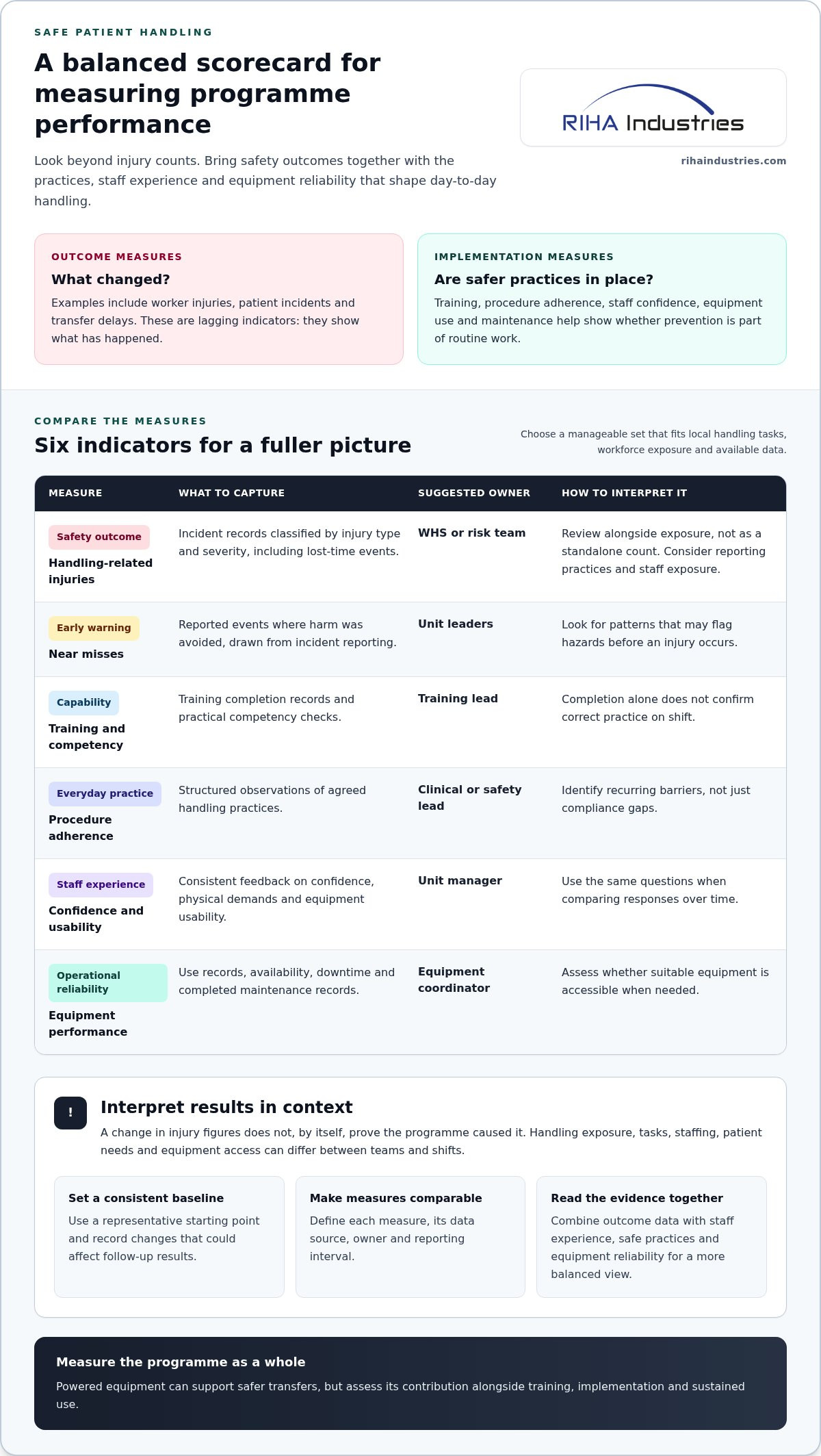
A balanced scorecard connects results with the practices that may influence them. Don’t try to track every available figure. Choose a manageable set that reflects local handling tasks, workforce exposure and data capacity. Before collecting data, define each measure’s source, owner and review interval.
Lagging indicators show what has happened, such as injuries or lost-time events. Leading indicators show whether safer practices are being used in routine work. Staff experience and operational measures add context by showing whether procedures feel workable and suitable equipment is available. This approach aligns with the CDC Guidelines on Safe Patient Handling and Mobility, which discuss prevention and programme practices.
Which safety and workforce indicators belong on the scorecard?
Track injury type and severity as well as lost-time events, so a change in minor reports doesn’t obscure more serious harm. Include near misses to identify hazards even when no one is injured. Where reliable data is available, relate events to hours worked or handling activity. A raw count can rise because exposure increased, so record the denominator and use the same calculation method for each reporting period.
Use a consistent staff survey or feedback process to ask about confidence, perceived physical demands and usability. Keep the questions and collection method stable. Review results by team or work area where privacy and the number of responses allow.
How can facilities measure adoption and operational performance?
Record who completes training and competency checks, then use planned observations to see whether agreed procedures are followed. Adoption measures show whether safer practices are being used in routine work. Pair them with equipment utilisation, availability, downtime and maintenance completion. Low use may point to access, suitability or confidence barriers, while unavailable equipment can interrupt the intended process.
Assign each indicator to a role that can act on it, and set a reporting rhythm that supports timely review without overloading staff. RIHA Industries provides equipment training and maintenance support to contribute to staff readiness and equipment reliability as part of a broader programme.
How do you collect reliable baseline and follow-up data?
Good comparisons start before a programme change. If wards use different injury definitions, training records or equipment logs, apparent improvements may reflect inconsistent counting rather than changed practice. A repeatable collection method is as important as the measures themselves.
Use this workflow to record what was happening before changes began and what happens afterwards:
Set the scope. Identify the wards, worker groups, handling tasks and reporting period you’ll include. Keep the scope practical, but record any teams or activities excluded so future readers understand what the results cover.
Define each measure. Write down what counts as an injury, near miss, completed competency check, equipment-use event or period of downtime. Specify the data source, calculation method, owner and review interval for each indicator.
Establish the baseline. Select a period that reflects ordinary operations, rather than an unusual surge, closure or staffing disruption. Check historical records for missing entries, changed definitions and shifts in handling activity or workforce levels.
Collect follow-up data consistently. Use the same definitions, sources and collection method after implementation. Record changes that may affect comparability, such as altered staffing, workloads, procedures or equipment access.
Review and document. Check data for gaps and unusual changes before interpreting results. Record the review date, limitations, decisions made and actions assigned, so the next review has a reliable point of reference.
How should a facility establish its baseline?
Make the baseline specific enough to reproduce: name the included wards and worker groups, describe the handling tasks, set the reporting period and list the records used. Compare historical incident entries with relevant staffing or activity information where available. Note whether reporting practices, injury definitions or record systems changed during that period, as these can affect comparisons.
Document the starting position for procedures, training and equipment, including what is available and how it is maintained. This context helps distinguish a programme change from a pre-existing condition. A representative baseline should capture routine variation across shifts and workloads, not just a convenient snapshot.
How can teams make ongoing data collection practical?
Give each indicator a named owner and provide a shared template with plain-language definitions and fields for the date, unit, source and relevant context. Bring together incident records, training logs, equipment-use and maintenance records, and staff feedback where appropriate. Limit access to people who need the information for their role, protect staff privacy and follow the facility’s data-governance processes.
Schedule reviews at a manageable interval and use the same approach after programme changes. Consistent definitions, recording methods, exposure denominators, reporting periods and data sources make trend comparisons more dependable. If a measure changes, document when and why rather than silently blending old and new calculations.
How should you interpret results without overstating success?
Read the scorecard as a whole, not as a verdict based on one number. Compare the same wards, worker groups, tasks and reporting periods, and use consistent exposure measures where available. A fall in injury reports may be encouraging, but its meaning changes if staffing, handling frequency or reporting practices have also changed.
Pair lagging outcomes, such as injuries and lost-time events, with leading indicators, including training completion, observed procedure use, staff feedback and equipment availability. If injuries are unchanged while adoption improves, safer practices may be taking hold before outcome trends shift. If injuries fall but reported equipment use or procedure adherence does not, investigate whether other factors could explain the change.
Changes observed after implementation don’t, by themselves, establish that an intervention caused them. Treat results as evidence of trends and possible contribution, note limitations, and avoid claiming a direct causal effect unless the evaluation supports it.
What can make injury figures difficult to compare?
Incident data may be affected by under-reporting, small event counts, changes in staff numbers or revised injury definitions. A different patient mix, higher transfer frequency, altered ward activity or other safety controls can also influence results. Check these factors before comparing periods, and be cautious about drawing strong conclusions from a short timeframe or an isolated change in the figures.
Where possible, compare rates using a consistent denominator, such as hours worked or handling activity, rather than relying only on raw counts. If the denominator or method changes, state that clearly and avoid presenting the figures as directly equivalent.
How should mixed or unexpected results shape decisions?
Use mixed results to guide investigation, not to dismiss the programme or declare success prematurely. Discuss findings with staff and relevant WHS, clinical and operational stakeholders. Ask whether training needs, access to suitable equipment, maintenance interruptions or workflow pressures are affecting routine adoption. Record any explanation as a hypothesis to test, not a proven cause.
If feedback points to equipment suitability, use the facility’s transfer tasks and workflow to guide the review of patient handling equipment selection criteria. RIHA’s training and maintenance support can help with staff training and equipment upkeep.
How can you turn programme results into sustained improvement?
Measurement creates value when it leads to practical changes staff can see and evaluate. After each review, select a specific issue, agree on an action, name the person responsible, set a due date and choose a follow-up measure. For example, if staff report that a powered bed mover is difficult to access, review where it is stored, then check equipment availability and staff feedback at the next review.
This action cycle makes findings useful without treating them as a final verdict. It also gives leaders a way to assess progress over time: track outcomes, respond to barriers and check whether changes improve routine practice.
How can review meetings keep improvement accountable?
Bring a concise dashboard to review meetings, with indicator definitions, trends, limitations and open actions in one place. Invite frontline staff alongside relevant WHS, clinical and operational stakeholders, so results can be interpreted in the context of actual work. At the next measurement cycle, revisit each action, record what changed and note whether the follow-up measure moved as expected.
How can equipment use and support contribute to sustained results?
Evaluate equipment fit and utilisation alongside user training, availability and maintenance. A device may suit a task but be underused if staff need further instruction or it isn’t accessible during routine work. Regular use alone doesn’t demonstrate that the wider handling programme is working. Review equipment measures alongside procedure adherence, staff feedback and safety outcomes.
Powered bed movers can support safer bed movement as one component of a broader programme, alongside appropriate procedures and trained staff. RIHA’s StaminaLift bed movers and patient transfer systems can form part of that equipment strategy. Assess their contribution through task suitability, use, availability and maintenance records rather than assuming it from purchase alone. If a review identifies questions about fit or utilisation, the StaminaLift 5000 buying guide can inform the equipment discussion.
Training and equipment upkeep can help address barriers revealed by the data. Where staff confidence or competency needs attention, safe equipment-use training can be a useful programme component. If downtime or incomplete servicing is affecting access, include maintenance follow-up in the action plan and track equipment availability at the next review. The hospital bed mover maintenance guide can support planning when equipment reliability is a priority.
Action: State the change required and the barrier it addresses.
Owner and due date: Assign responsibility and a timeframe for completion.
Follow-up measure: Specify what will show whether the action was completed and made a difference.
Keep the cycle active: review the evidence, make a proportionate adjustment, then check the result. Explore RIHA’s patient handling equipment and support as you consider the equipment and training components of your programme.
Make your next review a practical starting point
Strong measurement should lead to a clear next step, not just another report. Choose one finding your team can act on, then decide how you’ll check whether the change helps staff and supports safer handling. Measuring success becomes an ongoing improvement process, grounded in local evidence rather than assumptions.
Equipment can be one part of that work. RIHA’s Australian-made StaminaLift patient transfer systems and bed movers are supported by staff training and certification, with national service coverage across Australia. Consider how these products and services fit your programme’s handling tasks, workforce needs and measures of equipment use and reliability.
Discuss how RIHA equipment and support can contribute to your safe patient handling programme, and take the next step towards safer, more reliable daily practice.
Frequently Asked Questions
How do you measure the success of a safe patient handling programme?
Measure success by checking whether safer handling is becoming more reliable in everyday work, not just whether reported injuries change. Use evidence from different parts of the facility. For example, compare transfer-related incidents with observed practice and staff feedback by ward, then note whether improvements are consistent across teams or limited to one area.
What is the most important safe patient handling programme metric?
There isn’t one metric that captures success in every facility. Injury trends matter, but they can be hard to interpret without context. To prioritise, identify the main local handling risk, then choose an outcome measure and a behaviour measure that relate to it. For frequent bed movements, for instance, pair relevant injury records with observations of the agreed bed-moving procedure.
How often should a safe patient handling programme be evaluated?
Choose a review rhythm that fits the facility’s reporting systems and governance processes, then keep it consistent enough to compare periods. Review often enough to flag emerging barriers, such as repeated equipment downtime, but not so often that normal variation is mistaken for a trend. Set an additional review after a substantial change to procedures, equipment or training, and record what changed.
How do you calculate a patient handling injury rate?
Divide the number of defined, relevant injuries by a stated exposure measure, such as hours worked, then apply a consistent multiplier if your facility uses one. For example, a rate based on hours worked should use the same hours-worked definition and multiplier in every comparison period. State which injuries and workers are included, identify the records used, and have the facility’s safety team validate the calculation and its limitations.
Can a safe patient handling programme be successful if injury numbers do not fall?
Yes, unchanged injury numbers don’t automatically mean a programme has failed. Check whether exposure rose, reporting became more complete or event severity changed. Also look for practical signs of progress, such as staff using agreed procedures more consistently. If those signs improve while injury figures remain flat, investigate barriers and continue monitoring before making a firm judgement about the programme’s effect.
How can a hospital show that equipment contributed to safer patient handling?
Keep records that connect equipment to specific handling tasks, such as where it was used, whether trained staff operated it and whether it was available when required. Compare those records with observed practice and relevant outcomes over consistent periods. This can show how equipment supported implementation. It can’t, on its own, prove that a particular device caused an injury change, since other workplace factors may also have influenced the result.
What should be included in a safe patient handling programme dashboard?
Include a focused set of indicators, each with its definition, reporting period and data source. A ward-level dashboard might show injury trends alongside training status, staff feedback and equipment downtime, with a note explaining any unusual change in workload. Add the person responsible for each follow-up action and its status. This gives frontline teams and managers a shared view of what needs attention without obscuring results in excessive detail.


