
How to Improve Hospital Operational Efficiency Through Better Patient Transport
Improving patient transport efficiency depends less on moving faster and more on making every handover, dispatch decision and journey work together. When transfers run late, appointments can be disrupted, procedures delayed and beds kept occupied for longer. Transport teams also face pressure to respond to changing demand while coordinating equipment and physically demanding work.
These challenges are familiar to hospital leaders, but they don’t have to be treated as unavoidable. A clearer view of how transport requests are made, prioritised and completed can reveal where delays begin and which practical changes can help without interrupting essential care.
This article explains how to use operational evidence to identify bottlenecks, coordinate staff and equipment, and support safer movement. It also covers how powered bed movers, staff training and reliable equipment maintenance can contribute to a more consistent transport workflow.
Table of Contents
How patient transport efficiency shapes hospital operations
Hospital operational efficiency means delivering reliable care while making effective use of staff time, equipment and available spaces. Patient transport is part of this system, not a separate task at the edges of care. A transfer that starts late can affect a diagnostic appointment, delay a patient’s return to the ward or leave a bed unavailable for the next person who needs it.
Efficient patient transport is the coordinated movement of people between care areas, with clear responsibility, suitable resources and safety guiding each transfer. Speed alone isn’t a reliable measure of success. A rushed journey that compromises safe handling or leaves a patient uncertain isn’t efficient. Improving patient transport efficiency means making movement more predictable while supporting patient wellbeing and staff capability.
Where patient transport fits in the hospital workflow
A patient may move from a ward to imaging, then return to the ward or continue to another care area. Another pathway might take a patient from a ward to an operating theatre and later to recovery. Someone preparing for discharge may also need to travel from their room to a designated discharge area. These are examples, not a standard sequence for every hospital.
Each journey depends on connected tasks: a request is made, transport is assigned, the patient is prepared and the receiving team is ready to take over. Waiting can build when it’s unclear who owns the next step, when a handover misses key details or when the receiving area isn’t ready. Clear task ownership helps teams know when to request movement, who is coordinating it and when the transfer is complete.
Why transport delays have wider operational effects
A late transfer can put pressure on schedules beyond the journey itself. If a patient reaches imaging later than planned, staff may need to adjust the sequence of work. If a transfer back to a ward is delayed, a bed may remain occupied and affect planning for incoming patients. The scale of these effects varies by hospital, so local workflow evidence is more useful than assuming a universal delay rate.
Flow also depends on suitable equipment and staff being available when demand changes. A team may be ready to move a patient but waiting for equipment, or equipment may be available while staff are committed elsewhere. Reviewing these factors together helps managers distinguish travel time from dispatch, preparation and handover waits. That gives teams a clearer starting point for improving coordination without treating faster movement as the only goal.
How to find the bottlenecks slowing hospital operations
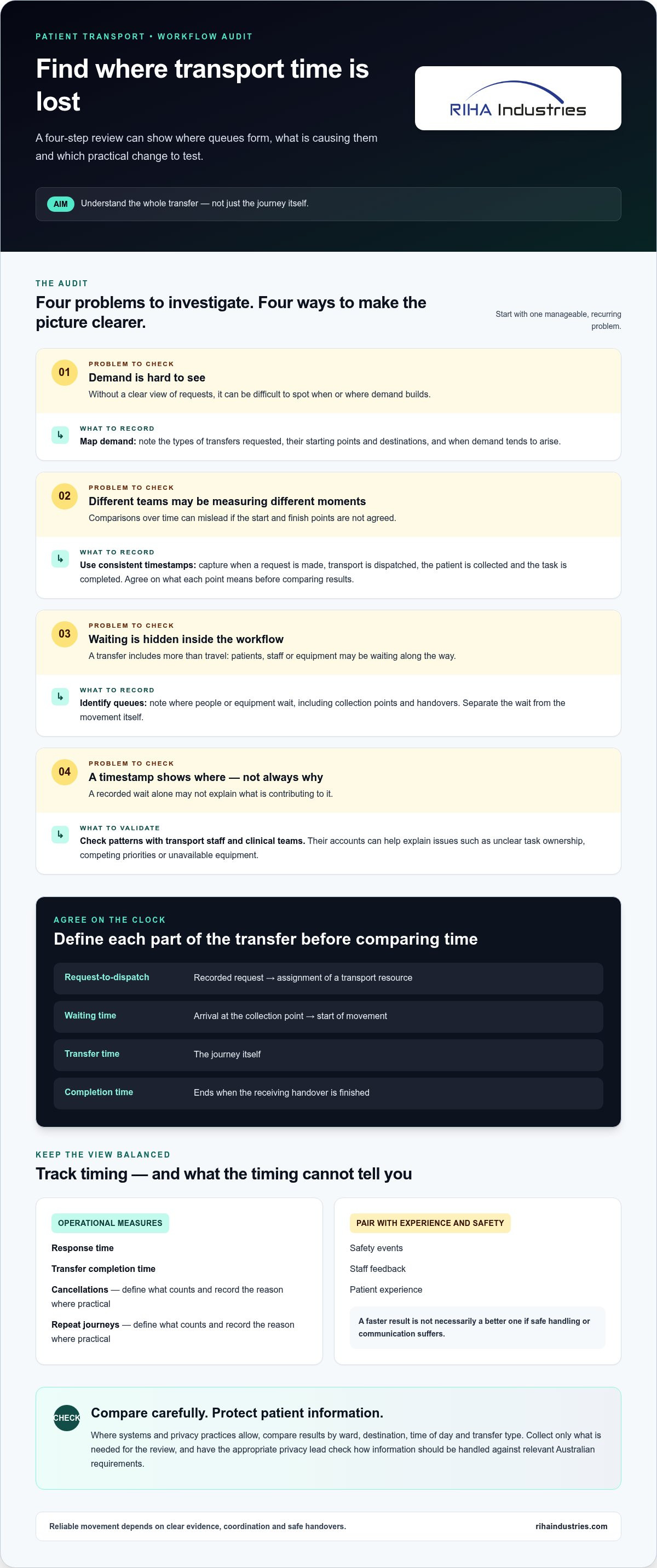
Before changing a transport process, establish where time is being lost and what contributes to the delay. A short, structured audit can help distinguish a dispatch issue from a handover wait, equipment constraint or peak in demand. This evidence gives managers a practical basis for improving patient transport efficiency without redesigning every workflow at once.
Use four steps to build a clear picture:
Map demand: Record the types of transfers requested, their starting points and destinations, and when demand tends to arise.
Record timestamps: Capture when a request is made, transport is dispatched, the patient is collected and the task is completed.
Identify queues: Note where patients, staff or equipment wait, including at collection points and handovers.
Validate causes: Discuss patterns with transport staff and clinical teams before deciding what needs to change.
Use consistent definitions. For example, request-to-dispatch time can run from the recorded request to assignment of a transport resource. Waiting time can cover the period between arrival at the collection point and the start of movement. Transfer time measures the journey itself, while completion time ends when the receiving handover is finished. Agree on these start and end points first, or comparisons over time may be misleading.
Which transport measures are useful to track?
Monitor response time, transfer completion time, cancellations and repeat journeys. Define what counts as a cancellation or repeat, and record the reason where practical. Pair timing measures with safety events, staff feedback and patient experience. That way, a faster result isn’t mistaken for a better one if safe handling or communication suffers. The Healthcare Operational Efficiency discussion from Relias also emphasises reviewing processes as part of wider operational improvement.
Where systems and privacy practices allow, compare results by ward, destination, time of day and transfer type. This may reveal, for example, that waits cluster around a particular handover or a predictable period of demand. Protect patient information, collect only what’s needed for the review, and have the appropriate privacy lead check how data should be handled against relevant Australian requirements before collection or use.
How to identify recurring workflow delays
Look for repeated queues, congested routes and demand peaks, then compare operational records with staff accounts. A timestamp may show where a wait occurs, but staff can help explain whether the cause is unclear task ownership, competing priorities or unavailable equipment. Start with one manageable, recurring problem and use the evidence to guide a targeted response. If bed movement or equipment allocation emerges as a factor, explore RIHA’s bed movers and tugs as part of a broader workflow review.
Which patient transport improvements make the biggest practical difference?
The most useful change depends on what local evidence shows. A hospital with uneven demand may benefit from more deliberate scheduling, while repeated waits at handover points may call for clearer task ownership. Centralised dispatch, local coordination, suitable equipment and better scheduling can each help, but none is a universal fix. Improving patient transport efficiency means matching the response to the bottleneck while maintaining safe movement and a positive patient experience.
Centralised dispatch or local team coordination?
A central point can make competing requests and resource availability more visible, helping coordinators allocate tasks across the hospital. But centralisation isn’t automatically best. Ward teams may have valuable knowledge of patient readiness, local routes and immediate clinical priorities. The right model may combine central oversight with local input. Choose based on demand, geography and who already holds responsibility, then review whether coordination improves without adding handover steps.
How equipment and movement methods affect throughput
Moving beds manually can place considerable physical demands on staff. Powered bed movers can assist with movement and help teams manage transfers more consistently. Their usefulness depends on how well they manoeuvre through corridors, lifts and clinical spaces, and whether they’re compatible with the beds in use. Equipment supports a workflow rather than replacing it: staff training, maintenance and safe procedures remain important for reliable operation.
How to implement hospital efficiency improvements without compromising safety
A measured trial lets a hospital improve a transport workflow while keeping patient care and safe movement in focus. Start with one bottleneck identified in the operational review, then test a targeted change against an agreed baseline. Avoid changing several parts of the process at once, or it may be difficult to tell which adjustment made a difference.
A practical improvement cycle is to:
Select one problem: Choose a recurring delay, route or department with a clear operational impact.
Agree on a baseline: Record relevant measures, such as waiting time, completion time, cancellations and staff feedback, using consistent definitions.
Trial a change: Explain the revised workflow to affected teams and set boundaries for safe operation and patient care.
Review the results: Set a review date in advance, compare results with the baseline and decide whether to adapt, stop or extend the trial.
Involve transport staff, clinicians, facilities teams and relevant safety leads from the outset. Each group sees a different part of the journey: transport staff understand practical movement constraints, clinicians know patient-care priorities, and facilities teams can identify environmental factors such as access or route restrictions. Their input can expose unintended effects before a trial expands. Improving patient transport efficiency should never mean rewarding speed at the expense of safe handling, patient comfort or clear communication.
How to run a focused transport workflow pilot
Choose a defined scope, such as one route, department or recurring handover delay. Share what will change, who is responsible at each step and how staff can raise concerns. During the trial, track the agreed measures and collect feedback from the people using the workflow. At the review date, compare like with like and adjust the process before considering a broader rollout.
How to support staff adoption and safe practice
Give staff role-specific instruction when responsibilities, procedures or powered equipment change. Build routine equipment checks and maintenance into operational planning so teams can identify issues and support reliable use. Make it straightforward to report handling concerns, near misses and practical barriers, and include these alongside timing results in the review. Staff feedback can show whether a change works in real clinical spaces, not just on paper.
When a trial involves powered bed movement, pair workflow changes with suitable equipment, staff training and ongoing maintenance. RIHA provides powered bed movers and staff support as part of a wider approach to safer, more consistent transfers.
How equipment, maintenance and staff support sustain better hospital efficiency
Reliable movement depends on more than the dispatch process. Equipment needs to suit the task and clinical environment, operate consistently and be used by staff who understand its role. A bed mover that’s difficult to manoeuvre in a ward corridor, for example, may not support a smooth workflow even if it reduces the effort required to move a bed. Training and planned maintenance help make equipment a dependable part of day-to-day operations.
RIHA reports that healthcare professionals move beds an average of 15 km per day, reaching up to 75 km per week. Local workloads and movement patterns vary, but these figures illustrate the repeated physical demands of bed movement. RIHA also reports that injuries from moving hospital beds at a large South Australian hospital fell from 20% to zero within two years of implementing StaminaLift.
Choosing mobility support for beds and heavy equipment
Match equipment to what staff need to move. RIHA’s StaminaLift bed movers include the Transfer System 5000, the Transfer System 6000 and the StaminaLift 2100 Bed Mover. The TS5000 is compatible with 95% of hospital beds. The TS6000 is designed for bariatric and acute care beds and can transport nearly one ton of weight. The StaminaLift 2100 is suited to Australian-manufactured beds found in Australia and Hong Kong.
For heavy equipment, RIHA’s Easi Rider and Easi Mover tugs can move loads of up to 1500 kg, including linen, meal and medical-equipment trolleys. Consider the load, intended use, equipment compatibility and the layout of routes, lifts and clinical spaces when selecting a solution. Improving patient transport efficiency means choosing equipment that fits the movement task, not assuming one solution suits every transfer.
Maintaining reliable equipment and measuring lasting results
Preventative maintenance and timely repairs support operational readiness by helping teams keep equipment in working order and address faults that could interrupt planned movement. Include equipment availability in reviews alongside transfer times, safety feedback and staff experience. If completion times improve but equipment is frequently unavailable or staff report difficulty using it, the workflow may not be delivering a reliable, repeatable result.
RIHA provides preventative maintenance and repair services for its specialised transfer systems. For practical guidance on equipment care, read RIHA’s hospital bed mover repair service guide. RIHA’s healthcare mobility solutions and support can help teams consider how powered movement equipment, training and maintenance fit into a wider efficiency plan.
Build a more reliable transport workflow, one improvement at a time
Improving patient transport efficiency starts with understanding where delays occur, then testing changes against a clear baseline. Consistent measures and feedback from transport staff, clinicians and other affected teams can help identify what works without losing sight of safe movement and patient care.
Better coordination is only part of the picture. Suitable equipment, staff training and planned maintenance can support repeatable transfers and help reduce the physical demands of moving beds and heavy equipment.
RIHA Industries designs and manufactures Australian-made healthcare mobility equipment, including StaminaLift bed movers and Easi tugs, and provides national service coverage in Australia. The company also ships parts worldwide within 24 hours. These products and support services can contribute to operational continuity as part of a broader efficiency plan.
Explore RIHA Industries’ patient transport and mobility solutions to see how powered movement equipment and ongoing support can fit your hospital’s needs. Start with the workflow evidence, involve staff and keep safety central as your team works towards more reliable patient movement.
Frequently Asked Questions
How can hospitals improve patient transport efficiency?
Hospitals can improve patient transport efficiency by identifying where requests wait, clarifying who coordinates each transfer and matching staff and equipment to demand. Start by recording consistent timestamps from request through completion, then discuss recurring delays with the teams involved. Test one practical change, such as a clearer handover or revised allocation process, and review its effects on transfer times, staff experience and safe patient movement before expanding it.
What causes delays in hospital patient transport?
Delays can arise at several connected points: a request may not be assigned promptly, a patient or receiving area may not be ready, or staff and suitable equipment may be committed elsewhere. Unclear task ownership can also create waiting between steps. Causes differ across hospitals and departments, so compare operational records with staff observations to find where a local queue forms before choosing a response.
Can centralised patient transport improve hospital operations?
Centralised coordination can give a team a broader view of incoming requests and available transport resources, which may support more consistent task allocation. It isn’t automatically the best model, though. Ward staff may hold important knowledge about patient readiness and local priorities. Consider hospital layout, demand patterns and existing responsibilities, and assess whether central oversight with local input would improve coordination without creating extra handovers.
How should a hospital measure patient transport performance?
Track request-to-dispatch time, waiting time, transfer duration and completion time, with clear definitions for each measure. Cancellations and repeat journeys can help reveal where workflows break down. Compare results by relevant areas, such as ward, destination or transfer type, where systems and privacy practices allow. Pair timing data with safety feedback, staff experience and patient feedback so faster movement isn’t mistaken for better performance on its own.
Can powered bed movers improve hospital transport efficiency?
Powered bed movers can assist staff with bed movement and reduce the physical effort involved in pushing or pulling beds. This may support more consistent transfers, particularly where beds move frequently or routes involve tight clinical spaces. Suitability depends on bed compatibility, layout and intended use. Equipment works best as part of a wider approach that includes staff instruction, safe procedures and maintenance, rather than as a standalone efficiency fix.
How can hospitals improve efficiency without compromising patient safety?
Choose one clearly defined bottleneck and trial a change against an agreed baseline. Involve transport staff, clinicians, facilities teams and relevant safety leads in planning and review. Set clear boundaries for safe handling, patient readiness and communication, and don’t reward speed at the expense of care. Collect staff feedback and record safety concerns during the trial. Review the results before adapting the process or extending it elsewhere.
What is the first step in improving hospital operational efficiency?
Start by mapping how transport requests move through the hospital and identifying where delays or queues occur. Record consistent timestamps from request to completion, then check the patterns with staff who carry out or receive transfers. This creates a practical baseline and helps separate symptoms from causes. Once a recurring issue is clear, prioritise one manageable change and measure its effect before considering wider workflow adjustments.


