
Patient Comfort During Hospital Transport: A Practical Guide
What if a more reassuring hospital transfer began before the patient was moved? A change of surroundings, unfamiliar staff, noise and unexpected movement can make a transfer unsettling. Patient comfort during hospital transport depends on more than the journey itself. It starts with how well the whole transfer is prepared and explained.
Care teams know clear communication matters, but busy ward routines can make it difficult to give every move the attention it deserves. A calm explanation, a check of the patient’s needs and attentive handling can help reduce avoidable discomfort and support dignity at every stage.
This practical guide covers steps teams can build into their workflow, from preparing the patient and describing what will happen to choosing suitable equipment and coordinating movement. It also looks at how equipment fit, controlled movement and manoeuvrability can support the process without replacing careful planning or staff communication. The aim is a repeatable approach that helps patients feel informed, secure and respected as they move through hospital.
Table of Contents
Why patient comfort during hospital transport deserves deliberate attention
A transfer between hospital departments may be familiar to staff, but it can feel significant to the person being moved. A patient may be leaving a ward for imaging, treatment or another area without knowing exactly what to expect. Patient comfort during hospital transport means attending to physical ease, emotional reassurance and dignity throughout the movement, not simply getting from one place to another.
This section focuses on routine movement within a hospital. It doesn’t cover emergency response or transport between facilities, where different clinical and operational considerations apply. For a broader introduction to the different contexts and arrangements involved, see this Patient transport overview.
Uncertainty can shape the experience. A patient might not know the destination, why they’re going there or how long the transfer will take. An unfamiliar route, busy corridors, noise, stops and abrupt changes in movement can add to unease or physical discomfort. These details affect people differently. A patient who has made the journey before may feel at ease, while another may be worried, in pain or disoriented.
Comfort measures sit alongside, not in place of, clinical assessment, monitoring and local procedures. Staff should follow the care plan and relevant clinical direction while noticing how the patient is responding. A transfer can be well organised and still feel unsettling if the person being moved is left uninformed or unheard.
What patients may experience during a hospital transfer
Patients may be concerned about pain, feeling exposed, losing their bearings or not knowing where they’re going. Staff can explain the destination and what will happen next, while maintaining privacy during preparation and movement. Needs may relate to mobility, communication, sensory preferences or the patient’s current condition, so avoid assuming one approach suits everyone.
Pay attention to both words and behaviour. A patient might describe discomfort or ask to pause; another may become quiet, tense, restless or visibly distressed. These signs don’t establish a cause on their own, but they are useful prompts to check in, listen and respond according to the patient’s needs and local procedures.
Comfort is more than a suitable bed or trolley
A suitable transport surface matters, but it’s only one part of the experience. Preparation gives staff a chance to address practical needs; clear explanations help the patient understand what is happening; privacy protects dignity; and controlled movement can make the journey feel less abrupt. These elements work together, with staff adapting their approach as the transfer unfolds.
Equipment supports the process, but it can’t guarantee how a patient will feel. Fit, route conditions and the way movement is managed all matter alongside communication and attentive handling. Patient-centred transport is a planned, respectful transfer that considers the person’s comfort, understanding and dignity at each stage.
How preparation and communication support a more reassuring transfer
A clear, repeatable sequence helps staff prepare without turning every transfer into a rigid checklist. Explain the journey, check the patient’s needs, prepare the person and surroundings, move in line with local clinical direction, then confirm arrival and comfort. Adapt each step to the patient’s condition, communication preferences and the purpose of the transfer.
Explaining the next step gives patients a clearer picture of what to expect and can reduce avoidable uncertainty. It doesn’t mean promising the journey will be comfortable or free of delays. Share what’s known, be honest about what may change, and give the patient a chance to ask questions.
Explain the journey before movement begins
Use plain language to say where the patient is going, why they’re being moved and what is likely to happen next. For example, explain that the transfer is to another department and who will be accompanying them, where appropriate. Pause for questions rather than delivering information while already setting off. If an answer isn’t known, say so and explain what you can.
Communication should match the person, not just the task. Speak directly to the patient, allow time for a response and use an interpreter or communication aid where appropriate to their needs. A familiar method, such as a written prompt or gesture, may help someone who has difficulty hearing or expressing themselves. Check understanding respectfully; don’t assume silence means the explanation was clear.
Prepare the patient and immediate surroundings
Before movement, check what’s relevant for this patient and transfer under local procedures. Consider whether their position is comfortable, clothing and coverings preserve privacy, and essential belongings are accounted for. Explain what you’re doing as you prepare. These small steps can help the person feel included rather than moved without warning.
Preparation also includes the space and the team. Clear the intended route of avoidable obstacles and interruptions, and agree who is guiding, communicating with the patient and managing the equipment. Share necessary handover information with the receiving team through appropriate channels, while keeping private details out of unnecessary conversation in public areas.
Explain: the destination, purpose and next step in accessible language.
Check: individual comfort, communication needs and relevant clinical direction.
Prepare: the patient, belongings, route and team roles.
Move: communicate as you go and respond to the patient’s feedback.
Confirm: arrival, immediate comfort and any handover needs.
This sequence is a prompt for thoughtful practice, not a substitute for clinical assessment, monitoring or local procedures. The CDC’s guidance on safe patient handling and mobility provides further context on handling and mobility considerations. Attentive preparation and clear communication are central to patient comfort during hospital transport, while the appropriate actions depend on the person and situation.
Equipment is one element of preparation. Teams considering how bed and trolley movers fit into their transfer process can explore RIHA’s bed and trolley movers alongside their communication and workflow needs.
Which transport details can make movement feel more comfortable?
Small details can shape how a transfer feels, but there’s no single setup that suits every patient or route. The patient’s condition, the purpose of the transfer and the hospital environment all inform what staff need to consider. Use the table below as a prompt for reviewing the journey, not as a ranking of equipment or a substitute for clinical judgement.
Compare bed, stretcher and trolley transfer needs
The transfer surface and destination influence how staff prepare and position the patient. A bed may need to move through a narrow corridor, while a trolley may be used for a different transfer purpose. Consider how the mover connects with the bed or trolley in use, and whether the combined equipment can be manoeuvred along the intended route. The StaminaLift TS5000 buying guide provides equipment-selection detail.
Compatibility is a practical starting point, not a promise of a particular patient experience. RIHA’s StaminaLift TS5000 is compatible with 95% of hospital beds. Teams should still consider their own bed fleet, route and transfer requirements. StaminaLift systems are designed for 360-degree manoeuvrability in confined spaces, though the layout and staff handling remain important parts of the process.
Consider noise, turning space and route flow
A busy corridor, tight corner or threshold can influence the pace and flow of a transfer. Staff can plan how to approach turns, keep the route clear and avoid unnecessary stops where practical. Facility layout is distinct from equipment capability: a manoeuvrable mover may assist in confined spaces, but it doesn’t remove obstacles or replace careful coordination.
Noise may also be relevant in a care environment. The StaminaLift TS5000 operates at 65 dB. This specification doesn’t establish how an individual patient will respond. Staff can explain equipment sounds as needed and check how the person is feeling, rather than assuming quieter operation will make every transfer more comfortable.
Suitable equipment selection can support a more controlled transfer when it fits the bed or trolley, the route and the team’s planned handling. These considerations can inform patient comfort during hospital transport, while the right approach remains specific to each patient and setting.
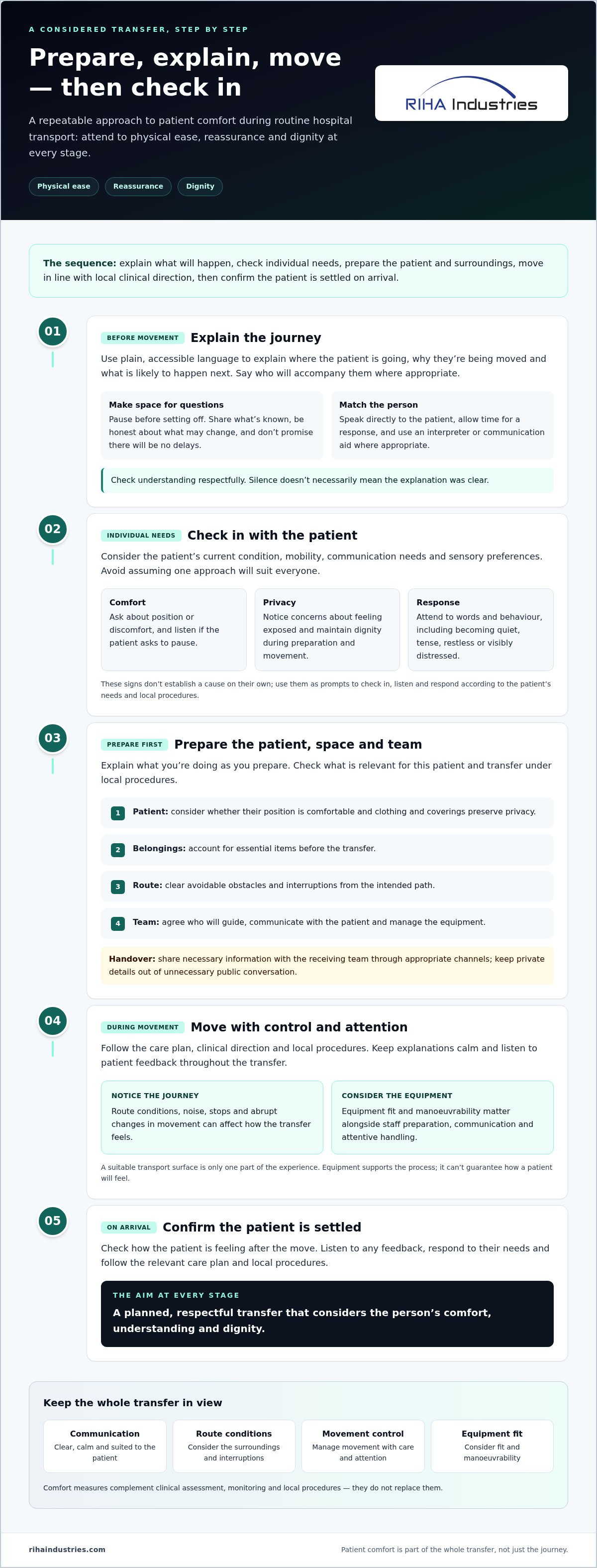
How hospital teams can make patient transport more comfortable
A simple before, during and after framework gives teams a consistent way to consider the patient’s experience while following local procedures and clinical direction. Clear roles help prevent confusion, and a calm explanation keeps the patient involved as the transfer progresses. Adapt the approach to the person, destination and circumstances rather than applying it as a rigid checklist.
Before: Confirm the destination and relevant transfer instructions, agree on team roles, and tell the patient what will happen next.
During: Coordinate movement at a pace suited to the patient and clinical direction. Invite feedback and respond to concerns as they arise.
After: Confirm arrival, check that the patient is settled appropriately and complete the handover through local processes.
Before and during movement: keep the patient informed
Before starting, introduce the people involved and explain the immediate steps in plain language. Let the patient know who will be guiding the transfer and what they can expect on the way. Keep explanations brief enough to follow, but allow time for questions. If the patient communicates discomfort, uncertainty or a need for something to change, acknowledge it and act in line with their needs and clinical direction.
During movement, maintain a controlled pace appropriate to the situation. One team member can take responsibility for communicating with the patient while others manage their agreed roles. This helps avoid competing instructions and gives the patient a clear person to address. Where the patient can provide feedback, check in at suitable points, such as after a change in direction or on arrival. Respond according to local procedures; don’t assume that quietness means everything is comfortable.
After arrival: complete the experience, not just the journey
Reaching the destination is not the final step. Confirm that the patient is in the intended place and settled in a position appropriate to their needs and care plan. Explain what happens next, and make space for the patient to raise a concern about the transfer. A short check-in can help identify an issue that might otherwise be missed during a busy handover.
Share relevant information with the receiving team using local handover processes, keeping private details appropriately protected. If a similar concern recurs, record or raise it through the hospital’s established review channels. Teams can then look collaboratively at possible contributing factors, such as route flow, preparation, role clarity or equipment use, and consider whether a workflow adjustment is appropriate.
Equipment decisions form one part of that review. The patient handling equipment selection criteria can help frame related considerations alongside the transfer process. Consistent attention to preparation, feedback and follow-through supports a more thoughtful approach to patient comfort during hospital transport.
For hospital teams reviewing their bed-moving equipment as part of this process, explore RIHA’s powered bed movers.
How RIHA Industries supports considered patient transport
Powered bed movers can form one part of a considered transfer process, alongside staff preparation, communication and attentive handling. RIHA Industries designs and manufactures Australian-made bed and trolley movers, including StaminaLift systems. This equipment supports movement in hospital environments, but it doesn’t guarantee patient comfort or replace clinical judgement. Patient comfort during hospital transport still depends on how the team plans and manages each individual transfer.
Equipment suitability is shaped by more than the mover alone. Bed design, route layout, turning space and the way a facility organises transfers all inform what may work in practice. Considering these factors together helps teams assess how equipment fits their setting and workflows.
Match mobility equipment to the hospital environment
Hospitals use different beds and trolleys, and corridors, doorways and transfer routines vary between facilities. Compatibility therefore matters: staff need to consider the specific bed or trolley, how the mover interfaces with it, and the route the combined equipment must travel. RIHA’s StaminaLift TS5000 is compatible with 95% of hospital beds. This figure applies to that model and is a compatibility specification, not a measure of patient experience.
StaminaLift systems are designed for 360-degree manoeuvrability in confined spaces. This may be relevant where a transfer involves tight turns or limited room to position equipment. Actual movement also depends on the facility layout and staff practice. For broader planning considerations, RIHA’s hospital bed mover procurement guide provides a useful reference for assessing equipment in context.
It’s important not to assume every model shares identical features. A considered assessment starts with the needs of the environment and transfer process, then relates them to the specifications of the equipment being considered. That keeps selection grounded in practical requirements rather than broad claims.
Support reliable use beyond the initial transfer
Equipment planning continues after selection. Preventative maintenance and repair support can form part of lifecycle planning, helping facilities account for equipment upkeep as well as its role in day-to-day operations. Staff should use equipment in line with applicable instructions and local procedures, with responsibilities for its use clearly understood within the team.
Consistent use also relies on staff understanding the equipment and coordinating movement with the patient in mind. RIHA provides staff training and certification to support safe and effective use of its products. Equipment knowledge should sit alongside clear communication, attention to patient feedback and the clinical direction for the transfer.
RIHA’s hospital mobility solutions are one operational consideration within a wider patient-centred process. Explore the bed and trolley movers and support options as part of planning for your facility, while keeping each patient’s needs and the transfer environment at the centre of the decision.
Make your next transfer plan more patient-centred
Use your next workflow review to identify one practical opportunity: clearer role allocation, a better-planned route or equipment that fits the beds and spaces your team uses. Small, consistent changes can help staff keep the patient’s needs in view while working within local procedures. A thoughtful approach to patient comfort during hospital transport is built into everyday practice, not left to chance.
Equipment planning can support that work. RIHA Industries designs Australian-made StaminaLift mobility equipment and provides national service coverage across Australia, alongside preventative maintenance and repair support. These operational considerations can inform a longer-term plan for hospital mobility, while attentive communication and handling remain central to each transfer.
Explore the options that may suit your facility’s approach to bed and trolley movement. Explore RIHA Industries' patient transport solutions and take a considered next step towards transfer practices that support both staff workflows and patient dignity.
Frequently Asked Questions
How can hospitals make patient transport less stressful?
Hospitals can make transfers less stressful by reducing avoidable uncertainty and tailoring the experience to the individual. For example, a patient who is sensitive to noise may benefit from a brief explanation before equipment is activated, while someone who becomes disoriented may appreciate a familiar staff member’s presence where practical. Notice what helps that person feel settled, and share useful preferences with the team involved in their care.
What should staff tell a patient before moving them?
Tell the patient the immediate purpose and destination, who will be accompanying them, and what they can expect during the move. Mention relevant practical details, such as whether there may be a wait or a change of department, if known. Use language the person understands, then pause for questions. Avoid guessing about timing or outcomes; being clear about what is known helps the patient make sense of the next step.
Can hospital equipment improve patient comfort during transport?
Equipment can support a more controlled transfer when it suits the bed or trolley and is used appropriately, but it can’t guarantee how a patient will feel. A mismatch, unfamiliar sound or poorly coordinated movement may affect the experience. Teams should consider equipment fit alongside the person’s positioning, communication needs and clinical direction. Powered movers are one operational tool, not a replacement for attentive staff or individual care.
How can staff protect patient dignity during a hospital transfer?
Protect dignity by speaking to the patient rather than discussing them as if they aren’t present, and explain before adjusting clothing, coverings or position. Keep the person appropriately covered and limit conversations about private information to those who need it for care. Where practical, avoid drawing unnecessary attention to the transfer in shared spaces. Ask about preferences respectfully, and take them into account within the patient’s care needs.
What can make a hospital transfer uncomfortable for a patient?
Discomfort may come from pain, an awkward position, exposure, sudden movement, noise or not understanding what is happening. The same corridor or equipment sound can affect people differently, depending on their condition, sensory needs and previous experiences. A patient may also find a transfer difficult if they’re tired or worried about the destination. Checking for individual concerns can help staff recognise what needs attention rather than making assumptions.
How should hospital staff respond if a patient feels uncomfortable during transport?
Acknowledge the concern, communicate it to the team and respond in line with the patient’s condition, clinical direction and local procedures. If movement can be safely paused, staff can check what the patient is experiencing and what adjustment may help. Don’t dismiss a verbal concern or rely only on visible signs. Follow relevant escalation processes if the discomfort suggests a clinical issue, then communicate any necessary information at handover.


