
Reducing Nurse Back Injuries: 2026 Manual Handling Guide
- Aug 8
- 11 min read
Did you know that Australian nurses face a risk of serious musculoskeletal injury that is 2.3 times the national average? This sobering statistic highlights a systemic failure in how we manage the physical demands of patient care. It's a reality that makes it incredibly difficult to reduce nurse back injuries when traditional manual handling techniques simply aren't enough to protect your team from the weight of modern bariatric beds and complex ward transfers.
You probably recognise the ripple effect of these injuries: the high cost of workers' compensation claims, the frustration of staff turnover, and the inefficiency of requiring multiple people for a job that should only take one. We believe that physical strain shouldn't be an inevitable part of the nursing profession. This 2026 guide introduces evidence-based strategies and motorised solutions designed to eliminate musculoskeletal risks and restore operational efficiency. We will explore how integrating advanced engineering, such as the StaminaLift TS5000, can help you achieve a zero-harm workplace while ensuring full compliance with the WHS Regulation 2025. By shifting from manual effort to intelligent automation, you can finally protect your staff from the physical toll of the job and focus on delivering world-class care.
Table of Contents
The Growing Crisis of Musculoskeletal Injuries in Australian Nursing
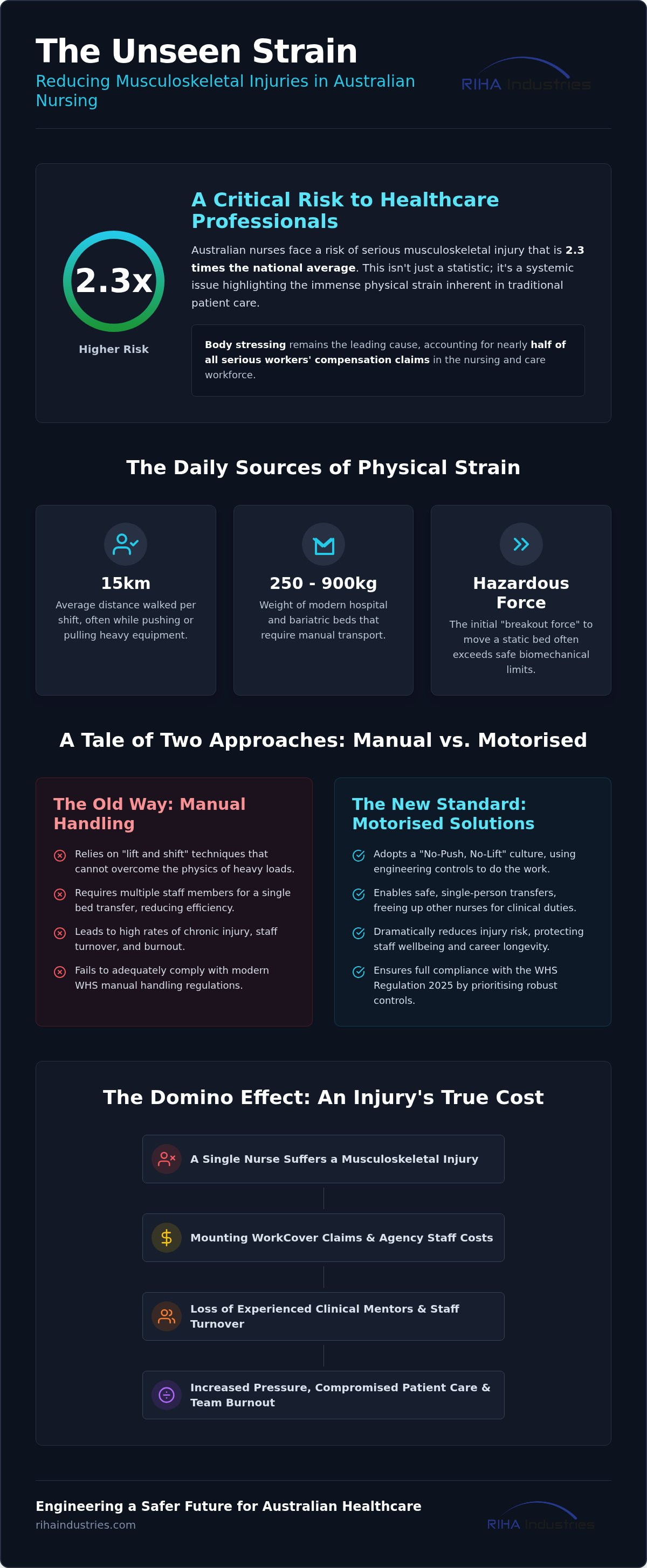
In the Australian healthcare sector, Musculoskeletal Injuries (MSIs) encompass a wide range of conditions affecting the muscles, nerves, tendons, and joints. These aren't just minor aches; they are debilitating injuries often caused by the hazardous manual handling of loads. For a nurse in 2026, the physical reality is staggering. A typical shift involves walking up to 15km while simultaneously pushing beds, trolleys, and heavy medical equipment. This constant physical exertion is a primary driver behind the urgent push to reduce nurse back injuries across the country.
Current data from Safe Work Australia reveals that the nursing and care workforce experiences serious musculoskeletal claims at a rate 2.3 times the national average. Body stressing remains the leading cause, accounting for nearly half of all serious claims. Under the Model WHS Act and the WHS Regulation 2025, healthcare providers have a strict legal duty to manage these risks. It's no longer enough to view injuries as an occupational hazard. They're a preventable outcome that requires robust engineering controls to ensure a safe work environment for every healthcare professional.
The Hidden Costs of Nursing Injuries
When a nurse is sidelined by a back injury, the financial impact extends far beyond the initial WorkCover claim. Hospitals face mounting medical expenses and the high cost of hiring agency staff to fill gaps. Perhaps the most significant loss is the departure of experienced clinical mentors who can no longer meet the physical demands of the ward. This turnover leaves teams understaffed, which directly compromises the quality of patient care and increases the pressure on remaining staff. A single injury can trigger a cycle of burnout that affects the entire organisation's operational efficiency.
Why "Lift and Shift" Training Is No Longer Enough
For decades, hospitals relied on manual handling training to mitigate risk. However, traditional "lift and shift" techniques fail because they don't account for biomechanical limits. The human spine simply isn't designed to safely push 500kg beds, especially during the initial "breakout" force required to start movement. Modern facilities are now moving toward a "No-Push" and "No-Lift" culture. This shift prioritises mechanical assistance over manual effort, acknowledging that training cannot overcome the physical laws of force and friction. To effectively reduce nurse back injuries, we must replace manual techniques with intelligent, motorised systems that do the heavy lifting for us.
Identifying High-Risk Zones: Why Manual Bed Handling is the Culprit
While bedside lifting gets much of the attention, the horizontal transport of patients is often the silent catalyst for career-ending injuries. To reduce nurse back injuries, we must look at the sheer physics of the equipment involved. Modern hospital beds are sophisticated engineering marvels, but they are also exceptionally heavy. A standard unit often weighs 250kg, while specialised bariatric beds can reach a staggering 900kg. Moving these loads manually requires a level of physical exertion that the human body isn't designed to sustain.
The most dangerous moment occurs during the "breakout force" phase, which is the initial effort required to overcome friction and get a stationary bed moving. This sudden burst of exertion often exceeds the safe limits of the human body. Citing the NIOSH safe patient handling guidelines, it's clear that manual force requirements in these scenarios far exceed recommended safety thresholds. Over a 20-year career, these repetitive micro-strains accumulate, leading to chronic disc degeneration and permanent loss of mobility.
Ramps and subtle inclines represent acute danger zones in many Australian facilities. When a nurse attempts to control a 500kg load on a slope, the demand on the lumbar spine increases exponentially. Gravity turns a standard transfer into a high-stakes balancing act. Without mechanical assistance, the risk of a sudden, debilitating muscle tear or spinal injury is exceptionally high. Understanding these high-risk zones is the first step toward building a safer environment. You can explore how our range of Australian-engineered movers addresses these specific challenges at rihaindustries.com.
The Bariatric Challenge
As patient weights increase across Australia, the demand for specialised bariatric care has surged. Handling a 900kg push-force requirement manually is physically impossible for a single staff member, and even a team of four is at significant risk. Moving loads of this magnitude, such as those typically managed by the StaminaLift Transfer System 6000, requires specialised motorised support to prevent catastrophic injury. This technology ensures that even the heaviest loads are handled with precision and safety.
Corridors, Lifts, and Tight Corners
Ward layouts in older hospitals are rarely designed for the massive beds used today. Steering heavy equipment through narrow corridors and around tight corners forces nurses into awkward, asymmetrical postures. This lateral spinal strain is a primary cause of soft-tissue damage. These confined spaces also present the risk of "pinned" injuries in elevators or small ward bays. For those managing facility-wide logistics, our hospital porter equipment guide provides deeper insights into navigating these high-traffic transport zones safely.
Manual vs. Motorised: The Evidence-Based Case for Powered Bed Movers
The transition from manual exertion to motorised assistance represents the most significant leap forward in workplace safety for modern clinical environments. When we compare the physical toll of pushing a 500kg bed to the effortless precision of a joystick-controlled mover, the evidence is undeniable. To effectively reduce nurse back injuries, facilities must move beyond reliance on human strength and adopt engineering controls that neutralise the weight of the load. While traditional transport requires at least two staff members to manage momentum and steering, motorised systems enable a single operator to move heavy equipment with total control. This shift doesn't just protect the individual; it restores clinical capacity by allowing a second nurse to remain on the ward for patient care.
Modern motorised solutions provide universal compatibility, allowing a single device to connect seamlessly with beds, stretchers, and trolleys across an entire facility. This versatility is bolstered by advanced safety features, such as automatic braking and emergency stop mechanisms, which provide immediate reassurance when navigating busy corridors. Research into ergonomic facility design to reduce injuries suggests that integrating these tools into the daily workflow can significantly lower the incidence of soft-tissue damage. By removing the need for physical pushing and pulling, hospitals can finally align their operational practices with the highest safety standards.
The StaminaLift Advantage
Our StaminaLift systems are engineered to address the specific architectural challenges of Australian hospitals. Featuring a patented jaw system, these movers connect to equipment without requiring the operator to bend, reach, or use complex strapping. This design eliminates the awkward postures that often trigger acute spinal injuries. With a 360-degree turning circle, the equipment offers unmatched manoeuvrability in tight ward layouts and small elevators. As the only FDA-registered bed mover, it represents a global benchmark for reliability and technical excellence, ensuring that your staff are protected by world-class technology.
Real-World Results: Zero Injury Targets
The impact of this technology is best demonstrated through proven outcomes in the field. In a landmark case study at a large South Australian hospital, the implementation of our motorised systems saw bed-moving injuries drop from a 20% incidence rate to zero within just two years. Beyond the financial savings on WorkCover claims, the psychological benefit to the workforce was profound. For an ageing nursing population, the "fear of injury" is a primary driver of burnout. Providing tools like the StaminaLift Transfer System 5000 empowers staff to perform their duties with confidence, knowing their physical well-being is a priority. This empowerment is essential for long-term staff retention and a healthy, sustainable workplace culture.
A Strategic Framework for Reducing Manual Handling Risks
Implementing a zero-harm policy requires more than just purchasing equipment; it demands a structured approach to risk management. A facility-wide manual handling audit is the essential first step to reduce nurse back injuries. By mapping the movement of patients and equipment, administrators can pinpoint "hot spots" where strains occur most frequently. These are often found in areas with subtle floor gradients or where high-traffic transfers between theatres and wards create a bottleneck. Identifying these zones allows for targeted intervention rather than a scattered, less effective response.
Once the risks are mapped, the focus shifts to procurement. Selecting technology that integrates with your existing bed fleet is vital for a smooth transition. New equipment shouldn't require a complete overhaul of your current assets. Instead, look for universal compatibility that allows one mover to manage various bed models across different departments. Finally, a robust staff training and certification programme ensures that every team member is confident and competent in using new motorised solutions. This cultural shift from manual effort to engineering reliance is what sustains long-term safety. To start building your facility’s safety framework, explore our full range of solutions at rihaindustries.com.
Selection Criteria for Bed Movers
When evaluating potential solutions, consider the specific needs of different clinical areas. Standard wards might only require a 600kg capacity, while bariatric units demand specialised movers capable of handling 900kg push-force loads. Battery life is another critical factor; your fleet must be ready for 24/7 operation with minimal downtime for charging. For a detailed breakdown of what to look for, consult our patient handling equipment selection criteria. Choosing the right tool for the specific ward environment ensures that the physical burden is truly eliminated, not just shifted.
Maintenance and Longevity
Reliability is the cornerstone of safety compliance. Implementing a strict preventative maintenance schedule ensures that your equipment remains a protective ally rather than a source of frustration. In rural Australian facilities where external servicing may be delayed, we provide innovative 3D-viewer tools to assist in-house technicians with basic repairs and inspections. This ensures your safety tools stay in the hands of your staff where they are needed most. You can learn more about sustaining your equipment in our hospital bed mover repair service guide. Consistent upkeep doesn't just extend the life of the machine; it protects the long-term health of your nursing workforce.
Transforming Healthcare Safety with StaminaLift and Easi Solutions
Achieving a zero-harm environment requires a commitment to integrating the right technology into every facet of hospital logistics. Our flagship solution, the StaminaLift Transfer System 5000, is engineered to be the workhorse of modern facilities, offering universal compatibility with 95% of global hospital beds. By providing a standardised tool that handles diverse fleets, we empower staff to reduce nurse back injuries across every ward, from emergency departments to intensive care. This universal approach ensures that no matter the equipment, the physical burden of transport is completely removed from the clinical team.
Safety shouldn't be limited to the bedside; it must extend to the porters and linen staff who manage the facility's heavy infrastructure. Our Easi series, including the Easi Mover and Easi Rider, provides specialised support for moving heavy trolleys and supply carts through narrow corridors. For facilities with unique fleet requirements, we develop custom hitches and attachments to solve the problem of non-standard equipment. This bespoke engineering ensures that every manual handling risk is addressed. To see these solutions in action, we invite you to book a hands-on demonstration within your facility to experience the immediate relief they provide to your team.
Australian-Made Reliability
Choosing Australian-made equipment provides distinct advantages in reliability and long-term support. Because we manufacture locally in South Australia, we offer rapid access to parts and 24-hour technical assistance, ensuring your safety tools are never out of commission for long. Our engineering philosophy focuses on sustainability, creating durable movers that extend the life of your existing bed fleet rather than requiring expensive replacements. The 35% projected growth in our export market serves as a clear indicator of the global trust placed in our Australian-engineered safety solutions. This international recognition reflects our commitment to world-class quality and technical excellence.
Calculating Your ROI
Justifying the procurement of motorised equipment to hospital boards requires a clear focus on the financial benefits of prevention. We provide a specialised ROI calculator to help administrators quantify the savings achieved through reduced absenteeism and lower insurance premiums. Balancing the initial equipment investment against the potential $100k+ cost of a single major back injury makes the financial decision straightforward. When you factor in improved operational efficiency and the ability for one person to perform transfers, the technology pays for itself through reclaimed clinical hours. We invite you to contact RIHA Industries to protect your staff today and begin your journey toward a safer, more efficient workplace.
Leading the Way to a Zero-Harm Healthcare Environment
The transition toward motorised transport is no longer a luxury; it's a fundamental requirement for modern Australian healthcare providers. By identifying high-risk zones and replacing manual effort with intelligent engineering, facilities can finally reduce nurse back injuries and protect their most valuable clinical assets. We've seen that transitioning to motorised movers creates a sustainable workplace where zero injuries isn't just a goal, but a proven reality for major hospitals. Our FDA-registered, Australian-made systems offer universal compatibility with 95% of hospital beds, ensuring that your team is supported by world-class technology every day.
It's time to empower your workforce with the tools they deserve. You can protect your nursing staff and reduce injuries with StaminaLift solutions, ensuring a safer future for your entire organisation. Together, we can eliminate the physical toll of manual handling and focus on what matters most: exceptional patient care.
Frequently Asked Questions
What are the most common causes of back injuries in nurses?
Manual patient handling and bed transport are the primary culprits for clinical staff. Specifically, the "breakout force" required to move a stationary bed and steering heavy loads through tight corridors cause acute and cumulative spinal strain. These activities often exceed safe biomechanical limits for the human body, leading to chronic disc issues and soft-tissue damage that can shorten a nursing career.
How can hospital management reduce manual handling risks?
Management can reduce manual handling risks by implementing engineering controls like motorised bed movers. Shifting from a "training-only" approach to a "no-push" policy ensures that staff don't have to rely on physical strength. This strategy aligns with WHS Regulation 2025 and helps to significantly reduce nurse back injuries by removing the physical burden from every transfer task.
Are motorised bed movers compatible with all hospital bed brands?
Yes, models like the StaminaLift Transfer System 5000 are designed for universal compatibility across diverse facilities. They feature a patented jaw system that connects to 95% of global hospital bed brands without requiring special hitches or manual lifting. This allows a single device to manage an entire fleet effectively, ensuring that every bed in your hospital can be moved safely.
Can one person safely move a bariatric patient with a bed mover?
Absolutely, motorised movers are designed specifically for single-person operation even with heavy bariatric loads. A specialised mover like the StaminaLift Transfer System 6000 can handle push-force requirements for patients up to 600kg or 900kg depending on the model. This eliminates the need for multiple staff members to assist in a single transfer, allowing your team to work more efficiently.
What is the return on investment for powered patient transfer equipment?
The ROI is realised through a dramatic decrease in workers' compensation claims and staff absenteeism. When you consider that a single major back injury can cost an Australian facility over $100,000, the procurement of preventative equipment becomes a clear financial advantage. It also improves ward efficiency by freeing up staff for clinical duties, which reduces the need for expensive agency cover.
Do motorised bed movers require special licensing for nursing staff?
No formal government license is required, but facility-specific certification is essential for safe operation. We provide comprehensive training programmes that ensure staff are competent in operating the joystick controls and safety features. This hands-on training builds confidence and ensures the equipment is used correctly to reduce nurse back injuries across the team, while also meeting your facility's WHS requirements.
How do bed movers handle ramps and uneven hospital floors?
Our equipment is engineered with advanced braking systems and high-torque motors to manage inclines and uneven surfaces safely. The motorised drive takes the full weight of the load, preventing the bed from "running away" on a ramp. This provides the operator with total control and prevents the acute strains associated with manual slope handling, even in older facilities with challenging layouts.
What maintenance is required for StaminaLift equipment to remain WHS compliant?
Compliance requires regular preventative maintenance and annual safety inspections to ensure the machine remains a protective ally. This includes checking battery health, motor function, and the integrity of the jaw attachment system. We offer dedicated maintenance and repair services to ensure your fleet remains in peak condition and meets all Australian safety standards, protecting both your investment and your workforce.


