
StaminaLift Transfer System 5000: The Definitive Buying Guide for Australian Hospitals
Updated: Jul 9
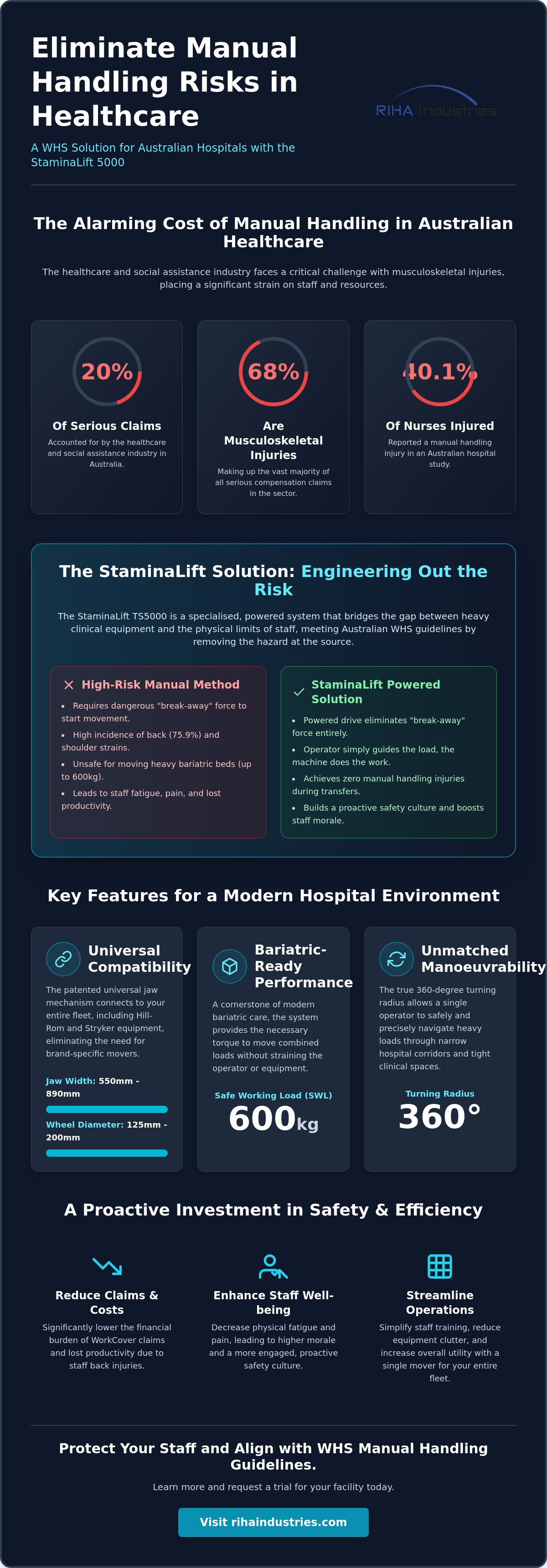
Did you know that the healthcare and social assistance industry accounts for 20% of all serious workers' compensation claims in Australia? With musculoskeletal injuries making up approximately 68% of these claims, the physical toll on hospital porters and nursing staff is reaching a critical point. Integrating the StaminaLift Transfer System 5000 into your facility isn't just about upgrading your ward equipment; it’s a vital step towards meeting WHS regulations and protecting your most valuable asset: your people.
You’re likely all too familiar with the frustration of a bed mover that won't connect to half your fleet or the struggle of navigating heavy loads through narrow clinical corridors. We understand that a "no-lift" policy only works if the technology is reliable, intuitive, and genuinely universal. In this guide, you’ll discover how the StaminaLift 5000 eliminates manual handling risks and transforms hospital portering efficiency with its unique compatibility across all ward equipment. We’ll walk through the technical specifications, the long-term benefits of Australian-made durability, and how this system ensures your facility achieves zero manual handling injuries during patient transfers.
Table of Contents
Why the StaminaLift Transfer System 5000 is Essential for Modern WHS
The StaminaLift Transfer System 5000 is a specialised, powered solution designed to bridge the gap between heavy clinical equipment and the physical limits of the human body. In an environment where hospital beds, stretchers, and patients can easily exceed a combined weight of 600kg, relying on muscle power alone is no longer a viable or legal strategy. Australian WHS guidelines require organisations to manage the risks of hazardous manual tasks by implementing engineering controls. By adopting this system, hospitals move beyond mere "lifting techniques" to a framework where the machine absorbs the physical burden.
One of the most dangerous moments in patient transport is the initial "break-away" force. This is the sudden surge of energy needed to overcome inertia and get a stationary bed moving. It's during this split second that most back and shoulder strains occur. The StaminaLift Transfer System 5000 uses a powered drive to eliminate this risk entirely. It ensures the operator never has to lean into a heavy load to start the journey. The machine does the hard work. The staff member simply guides it.
The Crisis of Manual Bed Handling in Healthcare
The healthcare sector remains one of the most hazardous industries for workers in Australia. While musculoskeletal injuries dominate compensation claims, a study of nurses in an Australian hospital found that 40.1% reported a manual handling injury. Back injuries accounted for 75.9% of those reports. Specifically, moving patients was associated with approximately one-third of all manual handling injuries in that study. Manoeuvring a 600kg load through a busy hospital centre isn't just difficult; it's a high-stakes physical challenge. Traditional "tug" systems often fail in tight clinical environments because they lack the precision to handle modern, heavy bariatric beds safely.
The StaminaLift Solution: Engineering Out the Risk
True safety comes from removing the hazard at the source. Acting as a sophisticated assistive device for patient transfers, the TS5000 provides a "hands-free" connection. It secures the bed to the mover without manual lifting or awkward bending. This engineering shift does more than prevent physical injury. It transforms staff morale. When porters don't finish their shift in pain, fatigue levels drop and workplace engagement rises. It marks a transition from a reactive culture, where injuries are seen as "part of the job," to a proactive safety culture. Staff well-being becomes a priority through intelligent design.
Technical Superiority: Universal Compatibility and Performance
Hospital fleets are rarely uniform. Facilities often manage a patchwork of equipment from various manufacturers, acquired over decades of ward upgrades. This fleet fragmentation creates a significant operational hurdle: most powered movers are brand-specific. The StaminaLift Transfer System 5000 solves this by moving away from proprietary connections in favour of a patented universal jaw mechanism. This engineering choice ensures that a single investment can service your entire facility, regardless of whether you're moving a Hill-Rom acute care bed or a Stryker stretcher.
Performance isn't just about connection; it's about capacity. With a Safe Working Load (SWL) of 600kg, this system is a cornerstone of modern bariatric care. It provides the necessary torque to transport high-dependency patients safely without straining the operator or the equipment. When hospital executives look at Justifying the Investment in Safe Patient Handling, they often find that the ability to move diverse loads, including linen carts and heavy trolleys, significantly boosts the machine's utility and long-term value.
The Universal Jaw: One Mover for Your Entire Fleet
The brilliance of the TS5000 lies in its adjustable wheel width capture. The jaw mechanism can expand or contract to accommodate widths from 550 mm to 890 mm. This range covers nearly every standard and specialised bed found in Australian hospitals. It also handles varying wheel diameters from 125 mm to 200 mm, which is critical for navigating the different castor sizes used on modern stretchers and procedural trolleys. By eliminating the need for multiple, brand-specific movers, you reduce storage clutter and simplify staff training. If you want to see how this fits your specific equipment, you can view the full compatibility specifications here.
Power and Endurance for the Australian Hospital Shift
A powered mover is only effective if it's ready to work when the staff are. The battery technology in the StaminaLift Transfer System 5000 is engineered to last through a full standard shift, providing reliable assistance during peak admission and discharge periods. Safety is integrated into the control system through keyless operation and a security lockout feature. This prevents unauthorised use while ensuring that trained porters can initiate a transfer quickly. Its compact footprint is also a major advantage. It's designed to fit into standard hospital lifts and elevators without requiring the bed to be detached, ensuring a seamless journey from the ward to the theatre or radiology centre.
Manoeuvrability and Precision in Challenging Environments
Navigating a busy Australian hospital often feels like a complex logistical puzzle. Older wings, particularly those in historic metropolitan centres, weren't designed for the footprint of modern bariatric beds. The StaminaLift Transfer System 5000 addresses this spatial conflict through a true 360-degree turning radius. This allows the operator to pivot the unit and the bed on its own axis. It turns a stressful two-person "dog-leg" manoeuvre into a controlled, one-person task. By providing this level of mechanical precision, the system ensures that equipment moves with the operator rather than against them.
Traditionally, moving heavy equipment required "spotters" to watch corners and help push. By centralising control and providing powered assistance, the TS5000 reduces this requirement. It empowers a single staff member to manage transfers that previously tied up multiple colleagues. This doesn't just improve efficiency; it ensures that clinical staff remain on the ward where they're needed most. Safety remains paramount during every journey. The system includes an emergency stop and automatic braking features that engage immediately if control is released. These safeguards provide peace of mind in high-traffic corridors where sudden obstacles are common.
Navigating Tight Corridors and Crowded Wards
Precision is vital when passing through narrow doorways or navigating crowded patient bays. The StaminaLift Transfer System 5000 features clear jaw activation indicators. These visual cues confirm a secure, hands-free connection before the journey begins. For larger hospital campuses where transfers involve long distances, the "ride-on" platform option is a significant advantage. It allows porters to travel quickly and comfortably, reducing physical exhaustion across an eight-hour shift. Intuitive controls ensure that even new staff members can become proficient with minimal training, further reducing the administrative burden on ward managers.
Versatility Beyond the Bed
While bed transport is the primary focus, the system's utility extends across the entire facility. In high-pressure Emergency Departments, it's used to move patient stretchers with the same level of precision. It's equally effective for transporting heavy linen trolleys and equipment carts that would otherwise pose a manual handling risk. This versatility makes it a multi-purpose asset for any hospital logistics team. For facilities managing exceptionally heavy loads or specialised bariatric equipment, the StaminaLift 6000 offers even higher capacity while maintaining the same intuitive handling characteristics and safety standards.
Justifying the Investment: ROI and Long-Term Value
Investing in high-end medical equipment requires a clear business case that extends beyond clinical benefits. For Australian hospital administrators, the financial justification for the StaminaLift Transfer System 5000 is found in the significant reduction of avoidable costs. When you consider that the healthcare industry accounts for 20% of all serious workers' compensation claims in Australia, the price of inaction is high. A single musculoskeletal injury, which represents 68% of these claims, can result in massive WorkCover premiums and long-term staff turnover. By eliminating the manual handling risks that lead to these injuries, the system often pays for itself within a remarkably short operational window.
Reducing the Total Cost of Ownership
The total cost of ownership involves more than just the initial purchase. Because the system features an intuitive design, the training burden for new porters and nursing staff is significantly reduced. Operational efficiency is further maintained through a structured approach to equipment health. Regular servicing ensures that small issues don't escalate into costly repairs or unexpected downtime. To keep your fleet in peak condition, you can learn about RIHA Industries’ Preventative Maintenance and Repairs.
Australian Made: Reliable Support and Parts
Choosing a system manufactured in South Australia provides a level of security that global vendors often can't match. Local production means that critical spare parts are always available, avoiding the weeks of downtime associated with international shipping. This local presence also ensures that all equipment remains in full compliance with Australian Standards and state-specific healthcare regulations. When you partner with a local manufacturer, you gain responsive service contracts and technical support that understands the unique pressures of the Australian clinical environment. If you are ready to enhance your facility's safety standards, contact RIHA Industries to discuss your fleet requirements.
Implementing the StaminaLift 5000 in Your Facility
Successful integration of the StaminaLift Transfer System 5000 involves more than a simple equipment delivery. It requires a thoughtful approach to change management that respects the daily workflows of your portering and nursing teams. By focusing on a structured rollout, facilities can ensure that the technology is embraced rather than sidelined. This process begins with identifying the specific operational bottlenecks where manual handling risks are highest, such as long-distance transfers between the emergency department and radiology. When staff see the immediate physical relief provided by the machine, the transition from manual to powered movement becomes a shared goal.
Staff training is the cornerstone of this implementation. Because the controls are designed to be intuitive, the learning curve is shallow, but hands-on sessions are vital for building confidence. We recommend appointing "super-users" within each department who can provide peer-to-peer support during the initial go-live phase. This approach ensures that technical questions are answered quickly and that best practices for hitching and manoeuvring are consistently followed. It's about creating a culture where using a powered mover is the standard expectation, not the exception.
From Trial to Full Integration
To ensure a successful adoption, we recommend conducting a focused ward trial. This allows your team to test the StaminaLift Transfer System 5000 in real-world conditions, providing valuable feedback on its manoeuvrability in your specific clinical corridors. Start by deploying the unit on "high-risk" routes where inclines or heavy bariatric loads are frequent. Once the benefits of reduced physical strain become evident to the staff, scaling to a facility-wide fleet becomes a natural progression. During this phase, choosing the right configuration is essential. Facilities with expansive campuses often opt for ride-on platforms to speed up transit times, while those with high-frequency transfers may prioritise specific battery configurations to ensure maximum uptime across triple shifts.
The RIHA Industries Advantage
RIHA Industries has spent over a decade refining the StaminaLift series, working closely with Australian healthcare providers to solve complex logistical challenges. This long-term commitment has resulted in a system that's both technically superior and deeply grounded in the practical needs of the ward. Major hospital networks across the country have successfully integrated these units, reporting a measurable decrease in lost-time injuries and a significant improvement in staff morale. When you choose this system, you aren't just buying a machine; you're partnering with a global leader dedicated to safe patient handling. It's time to move toward a future where workplace injuries are a thing of the past. Contact RIHA Industries today for a quote or demonstration to see how we can support your facility's safety goals.
Future-Proofing Your Facility’s Patient Transfer Standards
Elevating the safety standards of your hospital requires technology that integrates seamlessly with your existing workflows. We've seen how universal compatibility across all major bed brands simplifies fleet management, while the 600kg safe working load ensures that bariatric care is never a source of staff injury. By choosing a solution that offers a true 360-degree turning radius, you're giving your team the precision they need to navigate even the most challenging clinical environments with confidence.
Request a Quote for the StaminaLift Transfer System 5000 to see how we can help you create a safer, more efficient workplace for everyone.
Frequently Asked Questions
Is the StaminaLift 5000 compatible with Stryker and Hill-Rom beds?
Yes, the StaminaLift Transfer System 5000 is fully compatible with Stryker, Hill-Rom, and most other major bed brands found in Australian hospitals. Its patented jaw mechanism is designed to be truly universal, which means you don't need different movers for different equipment brands. This eliminates the frustration of fleet fragmentation and ensures your porters can move any bed in the facility with a single unit.
How much weight can the StaminaLift 5000 safely move?
The system has a Safe Working Load (SWL) of 600kg. This high capacity makes it an essential tool for bariatric patient transfers and moving heavy acute care equipment. By handling such significant loads, it ensures that your staff aren't exposed to the dangerous physical forces required to move heavy patients manually. It provides the necessary torque to manage these weights without straining the operator.
Do I need a special licence to operate a powered bed mover in Australia?
No special driver's licence is required to operate the unit in an Australian hospital. However, under national WHS regulations, employers must ensure that all staff are adequately trained in the safe use of the equipment. We provide comprehensive training and support to ensure your team is confident and competent in managing patient transfers safely within your specific clinical environment.
How long does the battery last on a single charge?
The battery is engineered to last for a full standard hospital shift under normal operating conditions. It provides reliable power for consistent use throughout the day, ensuring the unit is ready during peak admission and discharge periods. We recommend plugging the unit into a standard power outlet between shifts or at the end of the day to maintain peak performance and battery longevity.
Can the StaminaLift 5000 fit into standard hospital elevators?
Yes, the compact design ensures it fits into most standard hospital lifts and elevators without needing to detach the bed. This allows for a continuous, uninterrupted journey from the ward to procedural areas like radiology or theatre. Its tight turning radius also helps when manoeuvring in and out of lift lobbies where space is often limited and traffic is high.
What is the difference between the StaminaLift 5000 and the 2100 model?
The primary difference lies in the connection mechanism and the intended fleet variety. The StaminaLift Transfer System 5000 features the universal jaw for a wide variety of equipment brands, while the StaminaLift 2100 Bed Mover is a more compact unit often used for specific bed types. Choosing the 5000 model is typically the best option for facilities with a diverse fleet of beds and stretchers.
How does the universal jaw mechanism work without manual attachment?
The jaw uses a powered clamping system to secure the bed's castor wheels rather than relying on manual hitches, pins, or brackets. It adjusts its width and grip automatically to match the specific equipment you're moving. This hands-free approach removes the need for staff to bend down or perform awkward manual connections, which is a major factor in reducing workplace musculoskeletal injuries.
What kind of maintenance does the StaminaLift 5000 require?
Regular preventative maintenance is essential to ensure long-term reliability and safety for your staff and patients. This includes routine checks of the battery health, the universal jaw mechanism, and the automatic braking systems to prevent unexpected downtime. We offer structured Preventative Maintenance and Repairs to keep your fleet in peak condition and ensure compliance with Australian healthcare equipment standards and safety regulations.


