
WHS Manual Handling in Healthcare: 2026 Guide to Risk Mitigation
- Aug 9
- 12 min read
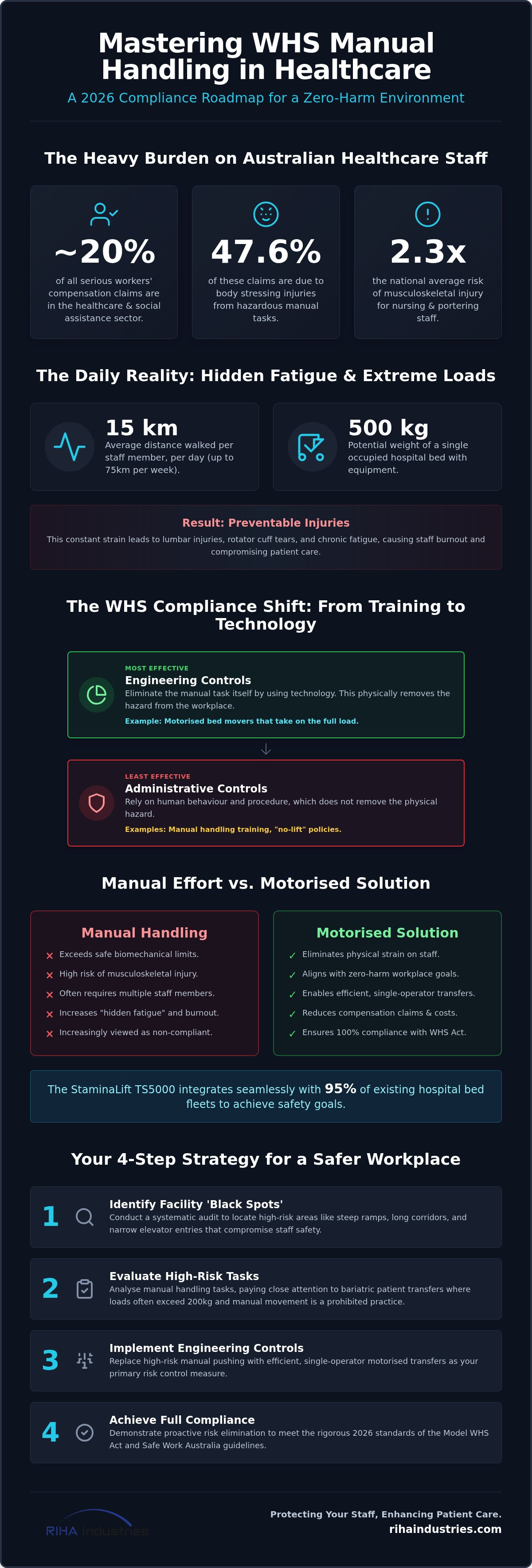
The healthcare and social assistance sector currently accounts for nearly 20% of all serious workers' compensation claims in Australia, with body stressing injuries responsible for 47.6% of those incidents. For the nursing and portering staff who walk up to 15 kilometres a day, the risk of a debilitating musculoskeletal injury is 2.3 times the national average. Managing WHS manual handling healthcare protocols in 2026 requires more than just updated training; it demands a fundamental shift in how we approach the physical movement of patients and equipment. We recognise the immense pressure this places on your team and the subsequent impact on staff retention and operational costs.
You're likely striving for a zero-harm environment while facing the complexities of rising premiums and rigorous WHS audits. This guide provides a roadmap to help you master compliance by transitioning from manual effort to evidence-based motorised solutions. We'll examine how engineering out the risk with technology like the StaminaLift series can protect your staff from physical strain and burnout. By the end of this article, you'll have a clear strategy to ensure 100% compliance with the Model WHS Act while significantly improving workplace safety and efficiency.
Table of Contents
Understanding WHS Manual Handling Regulations in Australian Healthcare
The WHS Act 2011 remains the cornerstone of workplace safety in Australia, but by 2026, the standards for compliance have become significantly more rigorous. Under this legislation, the manual handling of loads encompasses any task requiring a person to lift, push, pull, or carry an object or person. Within the clinical environment, WHS manual handling healthcare protocols now focus heavily on the physiological impact of repetitive tasks. Hospital administrators and facility managers carry a non-delegable duty of care to provide a workplace that is free from foreseeable risk. This duty is no longer satisfied by simply providing training; it requires a proactive approach to identifying hazardous manual tasks that are likely to cause musculoskeletal disorders.
A critical challenge involves the movement of standard hospital beds. When fully occupied, these units can reach weights of 500kg. Attempting to initiate or maintain the movement of such a load manually often exceeds safe biomechanical limits, leading to the high injury rates seen among nursing and portering staff. Modern safety audits reflect a decisive shift away from "safe lifting" education toward a model of total risk elimination. This evolution acknowledges that human bodies aren't designed to withstand the forces required to move heavy clinical equipment across long facility corridors.
The Hierarchy of Controls in a Clinical Setting
To achieve 100% compliance, facilities must apply the hierarchy of controls systematically. While patient transport itself cannot be eliminated, the manual effort behind it certainly can. Engineering controls represent the most effective way to protect staff after elimination. Motorised bed movers, such as the StaminaLift TS5000, serve as a primary engineering control by taking on the physical load. Administrative controls, like manual handling training or "no-lift" policies, are considered the least effective measures because they rely entirely on human behaviour and don't remove the physical hazard itself.
Safe Work Australia Guidelines for 2026
Recent updates to the Safe Work Australia Model Code of Practice for hazardous manual tasks have introduced stricter reporting requirements for musculoskeletal disorders. There is a heightened focus on bariatric patient handling, where loads frequently exceed 200kg. In these scenarios, manual movement is increasingly viewed as a prohibited practice under WHS manual handling healthcare standards. Facilities are now expected to demonstrate that they have integrated motorised assistance to manage these increased load weights, ensuring that staff safety isn't compromised by the physical demands of modern patient care.
The Physical Burden: Why Manual Bed and Trolley Handling is a High-Risk Activity
While much focus in WHS manual handling healthcare discussions is placed on lifting patients, the risk associated with pushing and pulling heavy equipment is often underestimated. A standard clinical bed, when loaded with a patient and life-support technology, can weigh up to 500kg. The physical exertion required to overcome static friction and initiate movement puts immense stress on the musculoskeletal system. This isn't a one-off event; it's a task performed dozens of times per shift, forcing the body to manage high-impact forces that lead to significant wear and tear.
Staff in large facilities often walk up to 15 kilometres a day, totalling 75 kilometres per week. This "hidden fatigue" significantly increases the likelihood of injury as the day progresses. Common outcomes include lumbar strain, rotator cuff tears, and chronic musculoskeletal fatigue, which don't just affect the individual. These injuries devastate hospital rosters and clinical care quality. When experienced staff are sidelined by preventable strains, the remaining team faces increased pressure, creating a cycle of burnout that compromises patient outcomes.
The Cumulative Effect of Pushing and Pulling
Injuries rarely happen in a single moment. Instead, they're often the result of repetitive micro-strains that gradually weaken the body's structural integrity. Emergency manoeuvres in tight corridors or elevators force staff into awkward postures where their mechanical advantage is at its lowest. Manual tasks in healthcare research indicates that these high-force events are primary contributors to long-term career-ending conditions. In Australian healthcare settings, the safe limit for manual transport is increasingly defined as any load not exceeding 200kg, a threshold frequently surpassed by modern clinical equipment.
Bariatric Challenges and Acute Care Loads
The rising weight of modern beds, often equipped with integrated monitoring technology, has made manual transport increasingly untenable. This is particularly evident with bariatric patients, where the combined mass of the patient and the specialised bed can exceed safe human limits. Relying on two-person manual moves often fails to mitigate the risk, as the physical space around the bed rarely allows both staff members to maintain ergonomic positions. Facilities looking to improve these outcomes should consider specialised patient transport equipment for aged care and acute settings. Implementing a motorised solution like the StaminaLift Transfer System 5000 ensures that the machine, not the person, bears the brunt of the weight, allowing for safe, single-person operation.
Evaluating Risk Control Measures: Manual vs. Motorised Handling
Selecting the right control measure is the difference between a compliant facility and one vulnerable to litigation. When we compare manual bed pushing against motorised assistance, the disparity in safety and efficiency becomes clear. Manual handling requires staff to exert significant physical force to overcome the inertia of heavy clinical equipment. In contrast, a motorised bed mover transfers the entire physical load to the machine. This shift allows a single staff member to perform a transfer that previously required two people, effectively doubling your available labour force during peak periods. By freeing up nursing staff from portering duties, you directly improve clinical care availability across the ward.
Precision in confined spaces is another critical factor. Navigating a 500kg bed through busy corridors or into narrow elevators manually often leads to "shunting" manoeuvres that strain the back and shoulders. Motorised solutions provide 360-degree manoeuvrability, allowing operators to guide heavy loads with fingertip control. This level of mechanical advantage ensures that equipment moves smoothly through the facility without the jerky, high-force corrections that characterise manual transport. From a financial perspective, the investment in motorised equipment is often less than the cost of a single major WHS manual handling healthcare claim, considering that musculoskeletal injuries in this sector frequently involve prolonged recovery times and higher median compensation payouts.
Engineering Out the Injury Risk
The StaminaLift TS5000 is designed to eliminate the most dangerous aspects of equipment transport. It features a universal jaw system that connects to beds without requiring the operator to bend, reach, or manually strap the load. This design choice removes the primary triggers for lumbar injury. Safety is further enhanced by automatic braking systems that engage on ramps and inclines, preventing runaway loads that staff would otherwise have to restrain manually. By dampening the physical start-stop forces, the technology protects the operator's joints from the repetitive jarring that leads to chronic musculoskeletal fatigue.
The ROI of Safety for Australian Hospitals
Reducing the frequency of serious workers' compensation claims is the most direct way to lower WorkCover premiums. In the nursing and care workforce, musculoskeletal claims are not only more common but also more expensive than the national average. Preventing just one career-ending injury can save a facility tens of thousands of dollars in direct and indirect costs. Beyond the balance sheet, providing a safer environment significantly improves staff retention. Keeping experienced nurses in the workforce longer preserves institutional knowledge and reduces the high costs associated with recruiting and training new personnel. For a detailed look at selecting the right technology for your facility, consult our 2026 hospital bed mover procurement guide to ensure your investment meets all WHS manual handling healthcare requirements.
Implementing a Compliant Manual Handling Strategy in Your Facility
A compliant strategy for WHS manual handling healthcare requires a methodical approach that moves beyond theory into practical facility management. It begins with a comprehensive audit of all wards and transport routes to understand the specific physical demands placed on your team. This process involves identifying 'black spots' where manual handling risks are amplified, such as steep ramps, high-traffic elevator entries, or narrow doorways in older wings of the hospital. By mapping these high-risk zones, you can prioritise equipment allocation where it is needed most.
Once these risks are mapped, trialling motorised solutions becomes essential. Testing the StaminaLift series within specific ward environments allows staff to experience the reduction in physical burden firsthand. This stage ensures that the equipment is compatible with your unique fleet, whether you are moving standard beds or specialised theatre tables. Integrating preventative maintenance from the outset then ensures equipment reliability and long-term WHS compliance, preventing a return to manual methods due to equipment downtime.
Staff Training and Cultural Buy-In
Transitioning from a 'hero culture', where staff pride themselves on manual lifting, to a safety-first motorised approach is a significant cultural shift. Success depends on moving away from classroom-based theory toward hands-on competency training. Providing certification for motorised tugs and bed movers ensures that every operator is confident in using the technology to its full potential. These practical demonstrations reinforce a culture where safety is never sacrificed for speed, making motorised assistance the natural first choice for every patient transfer.
Maintenance as a WHS Requirement
Maintenance is a fundamental WHS requirement rather than a mere operational task. A broken bed mover isn't just an inconvenience; it's a significant safety risk that forces staff back into high-risk manual handling. Integrating a robust hospital bed mover repair service ensures 100% equipment availability across all shifts. Modern systems now utilise Bluetooth diagnostics to monitor battery health and usage patterns, allowing for proactive servicing before a failure occurs. To ensure your facility remains safe and operational, consider our preventative maintenance and repairs program to keep your fleet in peak condition.
RIHA Industries: Leading the Way in Motorised WHS Solutions
RIHA Industries stands as a global leader in motorised equipment, specifically engineered to meet the rigours of the Australian clinical environment. While many facilities struggle with imported equipment and long lead times for components, our South Australian manufacturing base ensures that WHS manual handling healthcare solutions are always available and supported. The StaminaLift advantage lies in its thoughtful engineering, which prioritises both the safety of the operator and the comfort of the patient. By focusing on the machine's ability to absorb physical force, we empower healthcare professionals to focus on care rather than the mechanics of transport.
Our flagship StaminaLift Transfer System 5000 offers unmatched compatibility, integrating seamlessly with 95% of the global hospital bed fleet. This universal utility allows facilities to standardise their transport protocols across different departments without needing multiple attachment types. For the increasing bariatric patient surge, the StaminaLift Transfer System 6000 provides a robust one-tonne capacity, ensuring that even the most demanding acute care loads are managed without human strain. Beyond bed transport, the Easi Rider and Easi Mover transform facility logistics by providing porters with the tools to move heavy trolleys and meal systems with precision and ease.
Australian-Made Reliability
Choosing a local manufacturer provides a level of security that international vendors cannot match. We maintain a 24-hour parts shipping standard from our South Australian facility, ensuring that your safety equipment stays in service. Our engineering team also provides custom modifications, tailoring hitches for theatre tables and specialised trolleys that don't fit standard configurations. To support long-term sustainability and the longevity of your investment, we utilise 3D printing technology to produce components for older equipment fleets, preventing the premature obsolescence of reliable machinery.
Take Action: Protect Your Staff Today
The most effective way to understand the impact of motorised technology is through a hands-on demonstration. We invite you to request a trial in your facility, allowing your frontline staff to experience the immediate relief from physical burden. You can also utilise our ROI calculator to develop a data-driven business case for your WHS equipment budget, demonstrating the clear financial benefits of injury prevention. For a comprehensive look at implementation, read our StaminaLift Transfer System 5000: The definitive buying guide to start your journey towards a zero-harm workplace.
Securing the Future of Your Healthcare Workforce
Mastering WHS manual handling healthcare standards in 2026 requires a decisive move from reliance on staff technique to the implementation of reliable engineering controls. By addressing the physical burden of bed transport through motorised integration, you protect your team from the cumulative fatigue that leads to chronic injury. A South Australian hospital case study has already demonstrated the power of this approach, where bed-moving injuries were reduced from 20% to zero within just two years. This shift doesn't just ensure compliance; it fosters a culture of safety that keeps your most experienced nurses and porters in the field.
RIHA Industries provides the stable, long-term partnership needed to achieve these zero-harm goals. Our Australian-made and FDA-registered equipment is backed by national service coverage and 24-hour parts shipping to ensure your facility remains operational. It's time to empower your staff with the tools they deserve to perform their roles without physical strain. To see the tangible impact on your ward's safety and efficiency, book a hands-on safety demonstration for your facility today. We look forward to helping you build a safer, more resilient workplace.
Frequently Asked Questions
What are the primary WHS requirements for manual handling in hospitals?
Under the WHS Act 2011, healthcare facilities must eliminate or minimise risks as far as is reasonably practicable. This involves a systematic process of identifying hazardous tasks, such as pushing heavy beds, and applying the hierarchy of controls. By 2026, compliance audits place a heavy emphasis on engineering controls over administrative measures like training, ensuring that the physical environment is safe for all staff members during every shift.
How do motorised bed movers assist in WHS compliance?
Motorised bed movers act as a critical Level 2 Engineering Control within the hierarchy of controls. They eliminate the high-force physical exertion required to initiate and maintain the movement of heavy clinical loads. By removing the primary cause of musculoskeletal strain, these devices help facilities meet their legal duty of care and align with Safe Work Australia's updated guidelines for WHS manual handling healthcare protocols across the country.
Can one person safely move a bariatric bed under WHS guidelines?
Yes, one person can safely move a bariatric bed when using specialised equipment like the StaminaLift Transfer System 6000. This machine is engineered to handle loads up to one tonne, allowing a single operator to maintain full control without physical overexertion. Without such motorised assistance, manual bariatric transfers often require multiple staff members and still carry a high risk of injury due to the extreme forces involved.
What is the most common manual handling injury in the nursing profession?
Musculoskeletal disorders, specifically lower back strains and shoulder injuries, are the most prevalent issues. These often result from the repetitive pushing and pulling of heavy beds and trolleys rather than a single lifting event. Body stressing accounts for nearly 48% of serious workers' compensation claims in the sector, highlighting the urgent need for mechanical solutions that reduce the physical burden and long-term strain on frontline staff.
Are motorised tugs like the Easi Rider suitable for use on hospital ramps?
The Easi Rider is specifically designed to navigate hospital ramps and inclines safely. It features advanced braking systems and high-torque motors that prevent runaway loads, providing a level of security that manual handling cannot match. This capability ensures that facility logistics, such as moving meal trolleys or linen carts across different floor levels, remain efficient and compliant with all safety standards without risking staff injury.
How does the StaminaLift TS5000 connect to different types of hospital beds?
The StaminaLift TS5000 utilises a patented universal jaw system that connects to the castor wheels or frames of approximately 95% of global hospital beds. This connection is achieved at the press of a button, removing the need for staff to bend down or manually secure straps. This universal compatibility ensures that your entire fleet can be managed with a single, reliable motorised solution that adapts to your existing equipment.
What training is required for staff to operate motorised handling equipment?
Staff should undergo a competency-based training program that includes a hands-on demonstration and practical assessment. While there isn't a single national expiry for WHS manual handling healthcare training, industry standards suggest an annual refresher. This ensures that every operator understands the safety features, such as emergency stops and speed controls, and can operate the equipment confidently in busy clinical environments while protecting their own wellbeing.
How can we reduce workers' compensation claims related to manual handling?
Reducing claims requires a transition from manual effort to engineering controls that remove the physical hazard entirely. Implementing motorised bed movers has been proven to lower injury rates significantly, as seen in South Australian case studies where injuries dropped to zero. By decreasing the frequency of body-stressing incidents, facilities can lower their WorkCover premiums, improve staff retention, and ensure a more stable roster by keeping their workforce healthy.


